



It is not only the Iranian fleet that has come under fire in recent weeks. The Russia–Ukraine war continues at sea as well, and the one paying the price is Moscow’s emerging - and strategic - Arctic naval force.
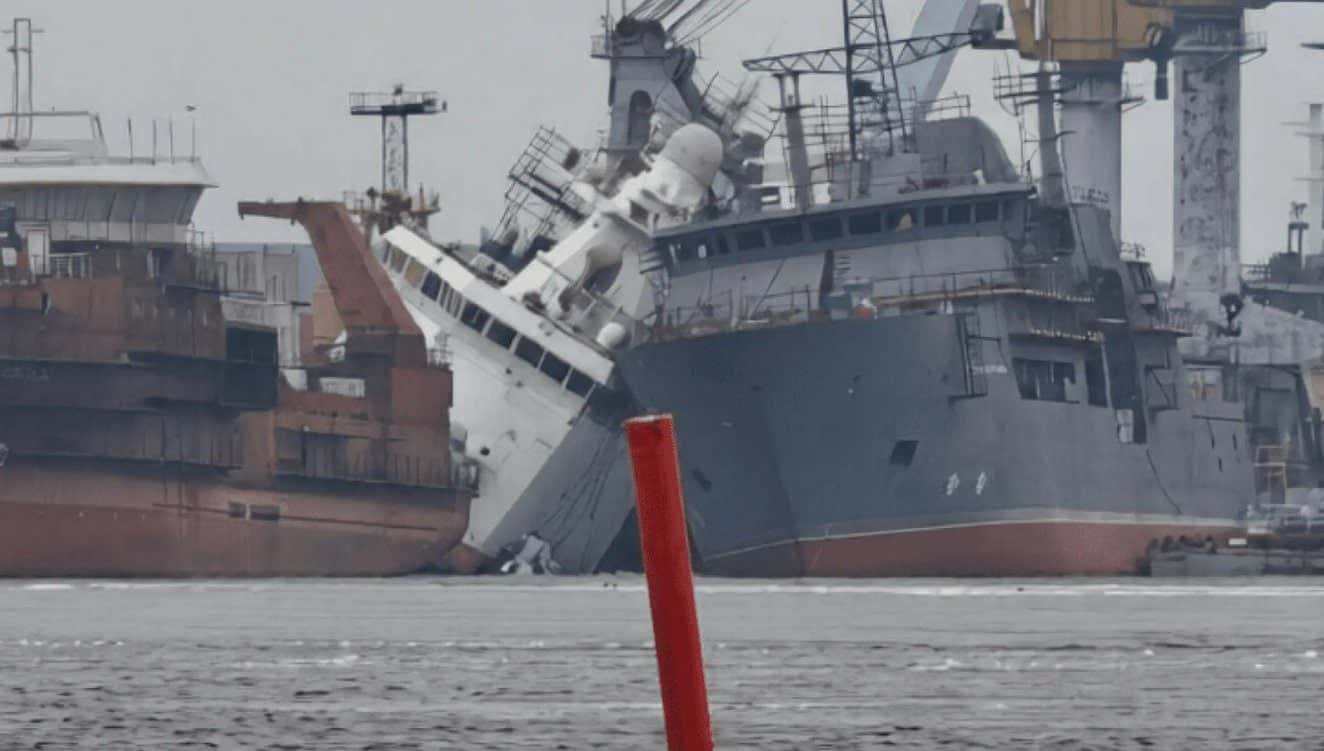
In recent days, images have been released showing the PURGA, a powerful offshore patrol icebreaker, launched in 2022 and still fitting out at the Vyborg shipyard in St. Petersburg.
The vessel appears listing and partially submerged, likely struck by a drone as part of a coordinated Ukrainian attack. During the night of March 24–25, the strike reportedly also targeted a nearby oil terminal and a group of BASTION-M systems, destroying one launcher. Minor damage may also have been sustained by the oceanographic vessel ADMIRAL BURILYCHEV (Project 22011), under construction alongside the PURGA, which appears slightly heeled - possibly after being impacted by the patrol ship’s tilting hull.
The PURGA is a large vessel, 114 meters long and 18 meters wide, with a displacement of 6,800 tons, belonging to the IVAN PAPANIN-class (Project 23550), currently planned in four units. Two - including the lead ship, delivered in 2025 - are intended for the Russian Navy, while the other two are for the naval service of the FSB (Federal Security Service). The PURGA belongs to this latter batch. Construction began in 2020 but has been delayed by the war and the resulting technical and logistical challenges facing the Russian shipbuilding industry. Although launched on October 7, 2022, the vessel was expected to be delivered by 2026.
The strike goes beyond the damage inflicted on a single ship, which is considered a valuable asset in Russia’s plans to strengthen its Arctic presence. These large patrol icebreakers are multi-role vessels, armed with a 76 mm AK-176MA gun, two AK-630M CIWS, heavy machine gun positions, and MANPADS for air defense and counter-drone roles. They are also designed to accommodate VLS for KALIBR-NK cruise missiles.
Their spacious design allows for an additional 50 personnel beyond the core crew, as well as two RAPTOR assault boats and a Project 23321 LCAC hovercraft, housed in side bays. A large flight deck with hangar enables operations with at least one helicopter, as well as drones.
Assessing the actual extent of the damage is not straightforward, as icebreakers feature reinforced steel hulls designed for extreme conditions. However, the incident highlights the ongoing difficulties faced by the Russian naval industry in wartime—and above all, the growing need to ensure round-the-clock protection even for sites far removed from the main theater of operations, now increasingly within reach of Ukraine’s so-called “drone admirals.”
Follow us on Telegram, Facebook and X.




Privacy Policy

Powered by © Mobilbyte s.a.s. Information Technology