



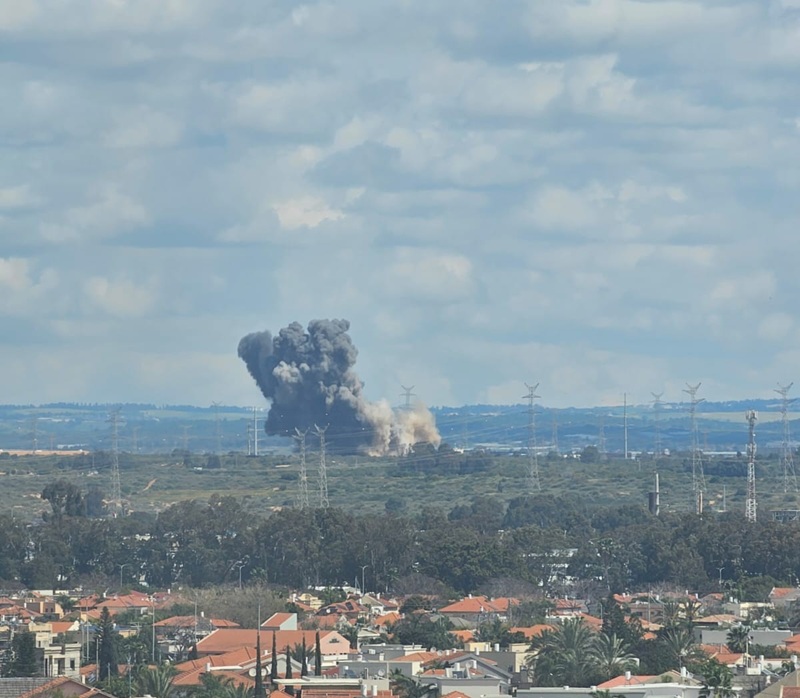
In recent days, Iranian missiles have been breaching Israel's defensive shield with increasing frequency.
This is the result of several converging factors. The first is the combination of simultaneous attacks launched from both Iran and Lebanon — a pattern that, in some instances, testifies to the fact that despite the punishment absorbed by both sides in this and previous conflicts, a certain degree of coordination and communication between Tehran and Hezbollah remains intact. Above all, Hezbollah is demonstrating a near-surprising capacity for resilience and adaptation, reflecting both its deep roots in Lebanese society and a widely redundant organizational infrastructure.
The second factor concerns the increasingly frequent use of missiles fitted with cluster warheads, which have caused considerable damage over the past week. In these cases, if the missile is not intercepted outside the atmosphere, it "opens up" releasing its submunitions (30-80) across an area with a radius of up to roughly 10 kilometers.
This issue feeds directly into the third factor: the defensive blanket is beginning to shrink dangerously. According to a study published in recent days by the consistently excellent London-based think tank RUSI, Israel has expended 81% of its ARROW-2/ARROW-3 interceptors and 54% of the STUNNER interceptors of the DAVID'S SLING system. To this must be added the 46% consumption of THAAD TALON interceptors from the battery deployed in the country.
In short, interceptor stocks across the medium-to-long range missile defense layer — covering both endo- and exo-atmospheric high-altitude engagements — are being drawn down significantly, with the ARROW-2/ARROW-3 situation now genuinely critical. Replenishment takes time — producing a single ARROW interceptor requires several months — at a production rate that cannot keep pace with consumption, and at a unit cost that is higher than in peacetime: wartime ramp-up is simply more expensive. There is therefore a very real risk that if Iranian attrition continues over the coming weeks, the associated costs could escalate — and not in a linear fashion.
Missile defense is enormously expensive, particularly at its higher-end tiers, and poses a serious long-term sustainability problem — one in which the advantage conferred by technological superiority erodes inexorably over time. The question at this point, then, is: how long can the Iranians keep this up?
Iran's missile stockpiles have probably been somewhat underestimated. It cannot be ruled out that, deep within its territory — above or below ground — the regime has maintained some residual production capability, exploiting its ties and influence with neighboring countries (Iraq, Turkmenistan, and Afghanistan) as well as Russia to smuggle in as much as possible. This would allow Tehran to sustain a certain level of attrition that could shift from merely irritating to genuinely unsustainable.
Moreover, what applies to Israel applies equally to the neighboring Arab states, which are also expending large quantities of interceptors against Iranian missiles and drones. According to the same RUSI study, these countries have consumed as much as 60% of their THAAD TALON interceptors and a significant 33% of PATRIOT PAC-3 stocks.




Privacy Policy

Powered by © Mobilbyte s.a.s. Information Technology