



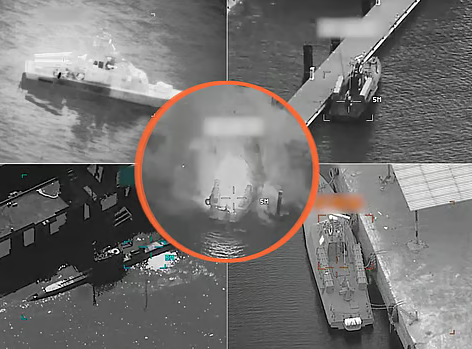
Three weeks into the war launched by Israel and the United States against Iran, the tally of naval losses inflicted on the regime has risen sharply.
The latest Pentagon report puts the figures at a minimum of 130 Iranian surface vessels hit - destroyed, sunk, or severely damaged - including 40 minelayers, and 11 submarines.
Further compounding an already devastating loss count, on 19 March strikes began targeting the so-called Northern Fleet, operating in the enclosed waters of the Caspian Sea.
It should be noted, however, that Iran's two naval forces — the regular Islamic Republic of Iran Navy (IRIN, or NEDAJA) and the Islamic Revolutionary Guard Corps Navy (IRGC-N, or SEPAH Navy) — comprise a vast and fragmented "naval dust cloud" made up of thousands of vessels of every type.
Alongside the larger units (on the eve of the war: 4 medium or coastal submarines, 16 light frigates/corvettes, 25 missile FACs, plus support and amphibious ships, a single minesweeper, and the 42,000-ton drone carrier SHAHID BAGHERI), there are also several hundred fast and ultra-fast attack boats equipped with small anti-ship missiles, minelayers, assault patrol craft with heavy machine guns and anti-tank rocket launchers, suicide boats (including semi-submersibles), both kamikaze and surveillance drones, and modified civilian vessels — fishing boats above all.
From the very first day of the war (28 February), strikes concentrated on the larger ships of the Southern Fleet in the Persian Gulf, most of them hit in port by guided missiles and bombs of various types. On 4 March, a submarine also entered the fray — most likely USS CHARLOTTE, a Los Angeles-class Batch III boat commissioned in 1994 — which, it will be recalled, sank the light frigate DENA with a Mk-48 torpedo, forcing the two vessels accompanying her — the amphibious ship LAVAN (Hengam-class) and the tanker BUSHEHR — to seek internment in India and Sri Lanka respectively.
From 19 March, as mentioned, units of the Caspian Fleet came under fire as well — this time from the Israeli Defense Forces (IDF) — both at sea and in the port of Bandar Anzali, where the naval base and arsenal sustained heavy damage. These vessels had until then been spared, posing no direct threat, but Tel Aviv struck them to eliminate their limited air defense capabilities and, possibly, to preempt potential Iranian naval attacks against the offshore energy infrastructure of ally Azerbaijan, which had already been hit by several Iranian-launched drones.
As of today, among the vessels struck and/or sunk by American and Israeli forces since the start of the war, the drone carrier SHAHID BAGHERI and the aviation support ship MAKRAN — together representing over 160,000 tons of displacement — remain afloat but reduced to smoldering hulks.
Nearly all frigates and corvettes, both of the Navy and the IRGC-N, have been hit: the corvettes BAYANDOR and NAGHDI; the light frigates ALVAND and SABALAN (a third unit, ALBORZ, is reportedly in dry dock); of the five MOUDGE-class light frigates, in addition to DENA, JAMARAN and SAHAND were destroyed in the opening days of the war, while ZAGROS, a modified SIGINT/ELINT variant, is believed to have sustained damage only.
On 19 March, Israeli aircraft also sank DEYLAMAN, which had originally been sunk in port back in 2018. No information is available on HEMZEH, a former imperial yacht dating to 1936, later rebuilt and deployed as an OPV in the Caspian since 2006.
The IRGC-N corvette component has been virtually wiped out: all four SHAHID SOLEIMANI-class units and the smaller ABU MAHDI have been struck — with severe damage or sunk — while the fate of the multi-role vessel SHAHID NAZRERI, the prototype of these sophisticated IRGC-N units, remains unclear.
Of the 10 KAMAM-class missile FACs, several have been hit, though only one sinking has been confirmed in CENTCOM footage. Four of the five SINA-class missile boats are reported to have been destroyed by the IDF.
Regarding the submarine component, the latest Pentagon report cited 11 units struck. Of these, only the coastal submarine FATEH and one of the GHADIR-type midget submarines have been visually confirmed in CENTCOM imagery.
Other vessels of this type — available in various configurations (minelaying, diver support, and torpedo/missile-armed) and highly dangerous in the confined waters of the Strait of Hormuz — have likely been hit as well. The fate of the 3 KILO/Project-877EKM-class submarines of the TAREQ class — YUNES, NOOR, and TAREQ — remains uncertain. TAREQ itself is believed to have been struck by a short-range ATACMS ballistic missile, which made its debut in recent days in a ship-killing role against targets in port.
The bulk of the other losses consist of the "naval dust cloud" deployed by the IRGC-N to threaten the Hormuz shipping lane. In recent days, minelaying vessels have been decimated across the board — from the smallest craft (boats rigged to carry two to four mines, some stored in long tunnel-cave complexes) to 1980s and 1990s-era LST-type amphibious units of 1,200–1,400 tons capable of deploying dozens of naval mines. In the Caspian, meanwhile, Israeli jets also hunted down minor and auxiliary vessels, with dozens of targets struck.




Privacy Policy

Powered by © Mobilbyte s.a.s. Information Technology