



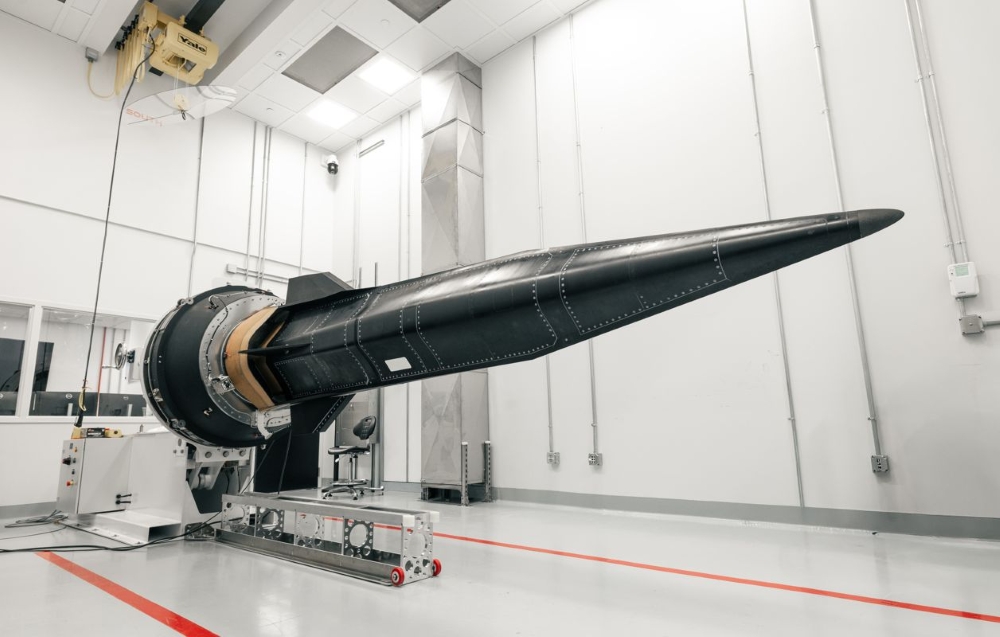
Following the success of the first flight test demonstration of their DART AE sub-scale hypersonic vehicle, the Australian start-up Hypersonix has announced the forging of a “strategic partnership” with MBDA UK to pursue together the opportunities that exist in Australia and in the UK through AUKUS Pillar II initiatives and the UK Hypersonic Technology Capability Development Framework. MBDA will also look to leverage Hypersonix’s technologies for projects within the framework of the European Long Range Strike Approach (ELSA). Germany and the UK have just decided that their cooperation within the ELSA precinct will be about developing a “family of future stealth cruise and hypersonic weapons”, for example.
On February 27, the Australian company Hypersonix achieved a significant success with the "Cassowary Vex" mission, which saw the launch of its hypersonic demonstrator on a Rocket Lab HASTE rocket from the NASA Wallops Flight Facility in Virginia. The mission was part of the US Defense Innovation Unit (DIU) program known as "Hypersonic and High-Cadence Airborne Testing Capabilities (HyCAT)." Launched in early 2023, HyCAT is a program aimed at accelerating the development, evaluation, and maturation of new hypersonic technologies by providing a low-cost and readily available space launch schedule.
The US Department of Defense is providing support to 70 different hypersonic programs of all types, and HYPERSONIX is one of them. The Australian company Hypersonix, founded in 2019, aims to develop hypersonic aircraft powered by sustainable hydrogen fuel. The main product of Hypersonix, and the true focus of this experiment, is the SPARTAN scramjet, a reusable 3D-printed engine that uses "green" hydrogen as fuel and can sustain speeds of up to Mach 12 without the use of moving parts.
The DART AE (for Additive Engineering) demonstrator, approximately 3.5 meters long, is a sub-scale prototype ahead of a more ambitious 8-meter hypersonic re-usable aircraft designed for reconnaissance, space experimentation, and ultra-rapid deliveries called VISR (Velos, Intelligence, Surveillance, and Reconnaissance). VISR is expected to be be powered by 4 SPARTANs and to reach Mach 12.
The sharp lines of the DART AE inspired the mission's subtitle "that's not a knife". The cassowary, on the other hand, is a large, powerful Australian bird that does not fly, but represented an ironic name choice for an Australian mission that did want to fly, and at very high speeds. The DART AE was released as planned and flew at hypersonic speeds exceeding Mach 5. The maximum speeds reached have not been disclosed. The expected range is between Mach 5 and 7. In-depth studies on the volume of data collected will last for several weeks.
The DART AE mission was supported by 46 million Australian dollars (approximately 30 million US dollars) raised through a Series A investment round. The Australian startup has therefore convinced private investors to put money into the project: in particular, the fundraising was led by the British investor High Tor Capital, followed by funds from the Swedish company Saab and a Polish company, as well as Australian government funds.
The main mind behind SPARTAN is Dr. Michael Smart, co-founder of Hypersonix, previously the director of Hypersonic Propulsion Studies at the University of Queensland and formerly a research scientist at NASA. Although not formally an AUKUS project, the Hypersonix campaign thus already sees Australia, the United States, and the UK involved, at various levels.
Through the cooperation with MBDA UK, Hypersonix’s technologies could find a quicker exploitation within plans for development of hypersonic strike weapons.
Follow us on Telegram, Facebook and X.




Privacy Policy

Powered by © Mobilbyte s.a.s. Information Technology