



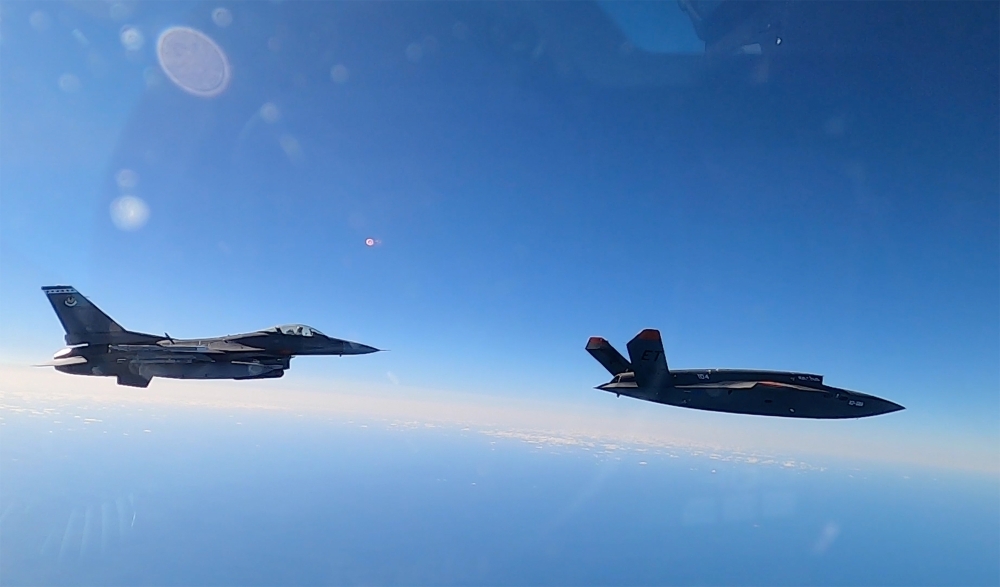
Airbus and Kratos first announced their teaming agreement in July 2025. The European company saw cooperation with the American Kratos as the best way to quickly mature a Collaborative Combat Aircraft solution for the needs of Germany and other European customers.
Kratos’s XQ-58A VALKYERIE is a mature CCA-type platform which has been involved in numerous experiments in the US with the American armed forces. While the USAF eventually moved beyond VALKYRIE to focus on the current CCA Increment 1 players from GA-ASI and Anduril, the VALKYRIE is the base for the US Marine Corps’ own collaborative combat air plans.
Earlier this month, Airbus revealed that work is already ongoing to fit 2 VALKYRIEs with its European mission system, called “Multiplatform Autonomous Reconfigurable and Secure”. It is an autonomy “core” that employs the MindShare machine learning software to help autonomous flying, operations and coordination between multiple CCAs.
The intent is to have a “ready to go” aircraft, fitted with a sovereign European mission system, so that Air Forces can rapidly adopt and field a relevant capability. Germany has already signaled that it wants to field a CCA capability alongside TYPHOON before the end of the decade and VALKYRIE comes with the advantage of having already worked quite extensively alongside the F-35 as well. Airbus is targeting the german requirement, but faces competition from Helsing, Rheinmetall and possibly others.
Outside of Germany, Italy’s Leonardo has great ambitions in the field of CCAs and has secured a large base of drone expertise with its joint venture with Turkey’s Baykar Technologies. Leonardo’s CEO, Roberto Cingolani, has in fact announced that already in May trials will begin that will see a Leonardo M-346 trainer jet work together with 2 Baykar-provided uncrewed aircraft. The Baykar line includes the KIZILELMA uncrewed jet, the most advanced in its catalogue and an ambitious CCA-type platform which has already carried out missions including a radar-guided air to air missile launch.
VALKYRIE is a choice that allows Airbus to build on all the work already done in the US, saving time and funds. Airbus also said that, in order to integrate TYPHOON with CCAs, it is working with Israel’s Rafael to integrate the necessary interfaces into an enhanced LITENING 5 targeting pod. The Rafael LITENING 5 has been integrated on TYPHOON some years ago, initially through the UK’s Royal Air Force Project JANUS, to replace the older LITENING 3.
Not only it serves to laser-designate ground targets, it is now regularly seen carried even in air to air missions, functioning as an adjunct IRST complementing Typhoon’s PIRATE on-board sensor. LITENING V is also presumably going to serve to laser-designate targets in flight for the APKWS rockets that the RAF is urgently working to integrate on TYPHOON as cheap, high-density counter-drone solution.
It therefore makes for a particularly smart choice if it can integrate CCA-control functionality. Having to replace LITENING 5 with a dedicate pod for control of adjunct drones would hurt Typhoon’s mission capability in significant ways. Germany’s Parliament approved a 90 LITENING V pods order in August 2025.




Privacy Policy

Powered by © Mobilbyte s.a.s. Information Technology