



In the early hours of March 16th, Russian forces carried out a new drone attack on Kyiv and its surroundings, launching over 30 drones of various types.
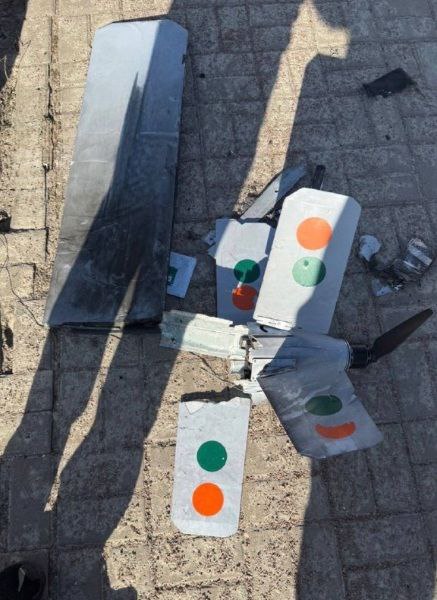
The episode that drew the most attention was the presence of fragments identified as belonging to a LANCET loitering munition in the central area of the capital, near Independence Square, the famous Maidan Nezalezhnosti.
What is striking is, precisely, the presence of a LANCET — of which several photographs have circulated (it remains unclear how many individual units they refer to) — the well-known loitering munition developed by the Russian company ZALA Aero Group, a subsidiary of the Kalashnikov Group, which does not have — at least in theory — sufficient range to reach the capital.
The munition is recognisable by its characteristic double X-tail profile and rear pusher propeller, and is primarily employed to strike tactical targets close to the front lines, such as artillery, radars, electronic warfare equipment and light armoured vehicles. Launched from a small catapult, it can remain airborne for approximately 40 minutes with an operational range of around 50 km — a figure referring to the radio control radius, not the absolute distance it can cover. Russia has claimed that certain variants can reach up to approximately 130 km, with a declared average range of 90 km. From Kyiv to the Russian border, however, the distance exceeds 200 km (though reduced to 90 km from the Belarusian border, should one hypothesise Minsk's involvement in this episode). How, then, did the LANCET manage to reach Kyiv?
A potential increase in operational range, however, is not the only novelty. According to Defense Express, the fragments recovered on Maidan would present characteristics consistent with an updated LANCET variant equipped with autonomous capabilities, potentially assisted by artificial intelligence. Furthermore, the use of mesh modem architectures appears to be confirmed — that is, decentralised, self-organising radio communication systems in which each node (in this case, each device within the swarm) simultaneously acts as receiver, transmitter and radio relay for the others, following approaches similar to those already identified on the Russian V2U autonomous drones (and the LANCET units in question bear the same identification markers — coloured dots — previously observed on such drones). Ukrainian analysts had recently flagged modifications to the LANCET's control antenna and video transmitter, at least consistent with a possible increase in operational range, which, at this point, may well be confirmed.
Nonetheless, there are those who have expressed significant doubts regarding the narrative of an autonomous LANCET capable of reaching central Kyiv from Russian territory. Serhii Beskrestnov, an adviser to the Ukrainian Minister of Defence, notably stressed that the LANCET lacks the battery capacity to cover such a distance, and suggested that the recovered fragments may have been deliberately dropped from a SHAHED drone during its overflight, as part of a Russian disinformation operation aimed at sowing panic and disorientation.
We venture an alternative hypothesis: what if some SHAHEDs (and their GERBERA copies) had genuinely been modified as motherships for LANCET deployment? After all, similar experiments — involving more modest FPVs and UAVs, but also air-to-air missiles and even MANPADS — have long been underway (including at combat-test level) on both the Ukrainian and Russian sides, and it is not inconceivable that the latter may be moving towards an operational phase for long-range strike munitions, such as the SHAHEDs themselves. As these are increasingly falling prey to Ukraine's diverse air defence network, if adapted to deploy loitering munitions such as the LANCET, they could once again change the dynamics of a contest that has so far seen Ukraine in occasional difficulty, but never on the verge of collapse.
The LANCET, in fact, carries a significantly lower radar and thermal signature than the SHAHED/GERBERA, which could release it from a safe standoff distance; the use of highly automated — and simultaneously redundant, as already noted, self-reconfiguring — guidance systems could also render the electronic warfare component of air defence less effective; and Ukrainian interceptor drones, too, would likely need to be partially redesigned to hunt aircraft considerably smaller than the SHAHEDs. Equally lower, however, would be the destructive payload, given that the LANCET carries a warhead of approximately 3 kg — which could, at most, replicate over Kyiv as well those "human safari" dynamics (consisting of the deliberate engagement of civilians via drones) that the Russians have long been carrying out over Kherson, and which have recently expanded to Kharkiv and parts of the Sumy Oblast.
Ultimately, this is an episode worth following closely in its future developments — provided there are any, and that they confirm the achievement of a genuine technological capability on Moscow's part, rather than a — sophisticated as it may be — psychological operation.
Follow us on Telegram, Facebook and X.




Privacy Policy

Powered by © Mobilbyte s.a.s. Information Technology