



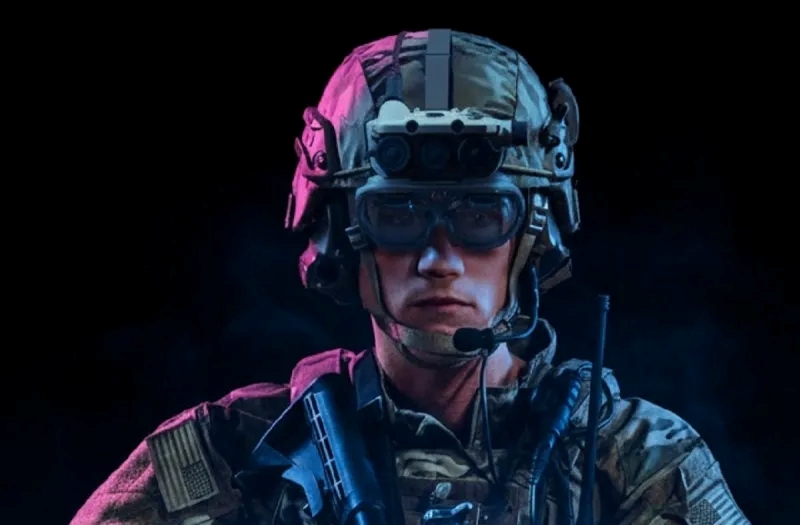
On March 10, Elbit America announced the award of a $120.5 million Other Transaction Authority (OTA) contract from the US Army that will see the company develop the Soldier Borne Mission Command (SBMC) solution.
The SBMC solution is meant to “fuse live multi-spectral sensors feed with assured positioning into an intuitive, head-borne experience”. By using helmet mounted sensors and visor, SBMC has to ensure “total connectivity, sharing visual intelligence and threat data across the unit in real time”.
Elbit America in the occasion also announced it has teamed up with advanced technology company Booz Allen, a leading provider of AI to the federal government, to build SBMC’s software backbone, “including advanced extended reality solutions, networking frameworks, and AI-enabled insights”.
As of Fiscal Year 2026 budget request, Soldier Borne Mission Command effectively supersedes the program previously known as Integrated Visual Augmentation Systems (IVAS). According to US Army budget documentation, “IVAS is transitioning to Soldier- Borne Mission Command (SBMC), which builds on IVAS by delivering a modular, fused digital awareness system that enhances lethality, mobility, and situational awareness for dismounted Soldiers”.
IVAS, which is a system now completely owned by Anduril which took over the entirety of the project from Microsoft, takes a significant hit in terms of FY 2026 procurement: the previously planned acquisition of 3,162 IVAS 1.2 sets is completely eliminated and the budget is re-allocated to development of SBMC.
Activities on IVAS are not, however, ending. While procurement of new sets is brought down to 0, test and evaluation are to continue with substantial research and trials funding allocated. IVAS 1.2 is now indicated as “SBMC Surrogate” and between the 4th quarter of 2025 and the 4th quarter of 2027 is meant to support software development, implementation, and reliability. The budget allocated will “develop and validate the SBMC Architecture through software extensibility and mission thread/application development”. It will also support SBMC development with a focus on “improving form factor through modularity and updating software for improved command and control through Artificial Intelligence (AI)-enabled data fusion and real-time situational awareness”.
IVAS 1.2 itself was realized as a technology insertion to the base production agreement awarded in Dec 2022. Initial 1.2 prototypes were delivered in 4QFY2023, while an IVAS 1.2 phase 2 Technology Insertion (TI) was awarded in 4QFY2023. IVAS 1.2 SBMC Surrogates will now be evaluated in Continuous Operational and Learning (COLT) assessments, starting in 3QFY2025 to “validate system improvements, incorporate new extensible applications, and inform a mission-driven architecture for multi-domain operations”.
The ambitious IVAS visor was to provide both real mission, real time situational awareness and integrated Synthetic Training Environment capability so that the same sets would enable Training, Rehearsal and Fighting. IVAS comprises a Heads-Up Display (HUD) with local processing as the base system along with supportive Soldier power equipment, IVAS network components, and other elements. The HUD is a low-profile, see-through display system providing 24/7 advanced situational awareness (SA) in all operating environments, fused vision capabilities, and passive targeting.
Altogether, the system provides movement of information, high level processing, and displays augmented reality information (Blue force tracking, Navigation, etc.) intuitively in three-dimensional space from mission planning data and real-time data including shared coordinate terrain data and machine learning/artificial intelligence processing enabled by tactical cloud package, shared information for mounted soldiers, "See Thru" armor functionality, and advanced network services.




Privacy Policy

Powered by © Mobilbyte s.a.s. Information Technology