



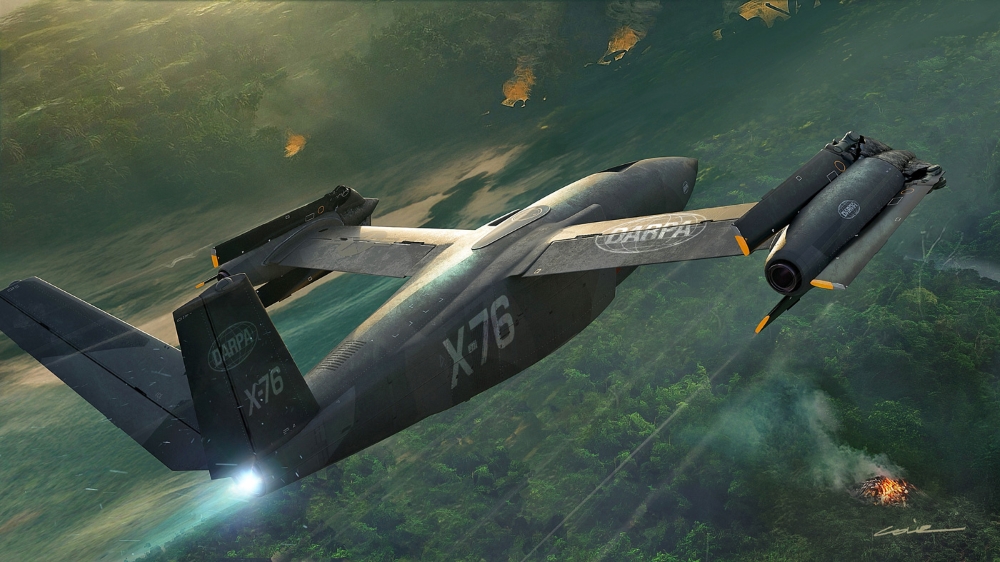
On March 9th, DARPA announced the conclusion of the Critical Design Review for the SPeed and Runway INdependent Technologies (SPRINT) project. The successful clearing of this key milestone has led to the decision to continue with the build of an X plane demonstrator, to be made by Bell Textron. DARPA has chosen the moniker X-76 for this new demonstrator, in a nod to “the revolutionary spirit of 1776” in the year when the United States celebrate their 250th anniversary.
SPRINT is a joint program launched by DARPA and US Special Operations Command (USSOCOM) to mature technological solutions to mix the high speed of fixed wing aircraft and the runway-independence typical of vertical takeoff and landing platforms, almost exclusively rotary wing.
The X-76 is meant to advance runway-independence for vertical lift capability with “jet-like” cruise performance. The technologies proven with the X-76 demonstrator are meant to be scalable to different future aircraft designs meant to hover and operate in austere environments from unprepared surfaces while also ensuring cruise speeds between 400 and 450 knots “at relevant altitudes”.
Bell Textron had been awarded Phase 2 design work for SPRINT back in July 2025. In the precedent Phases 1A and 1B, Bell had carried out conceptual and preliminary design efforts for the prospective X-plane. Phase 1 began on November 1st, 2023, while the contracts for Phase 1B were awarded in May 2024: at the time, funding went to Aurora Flight Sciences as well as to Bell Textron. The sole Bell was eventually awarded for Phase 2 work, which has seen the design matured in detail plus build of the prototype and ground testing.
The conclusion of the CDR can now be followed by Phase 3 which will culminate with the X plane proceeding into flight testing. The first flight is anticipated for early 2028.
In the concept art used to illustrate the X-76, we can observe an hybrid tilt-rotor jet with a jet engine for cruise flight and podded, tilting rotors at the extremities of the wings. The rotors are shown folded with blades “closed” upon the pod for flight in fixed wing mode.
The cruise speed of over 400 to 450 knots is significantly higher than the 280 knots cruise speed of the MV-75 tilt-rotor in build for the Future Long Range Assault Aircraft program. DARPA concept art for future exploitation of the SPRINT technology depicts sizeable VTOL transports with some apparent low observability features: it is probable that the US SOCOM hopes to see this experimentation feeding into the machine that will eventually one day have to replace the CV-22 OSPREY operational with AFSOC.




Privacy Policy

Powered by © Mobilbyte s.a.s. Information Technology