



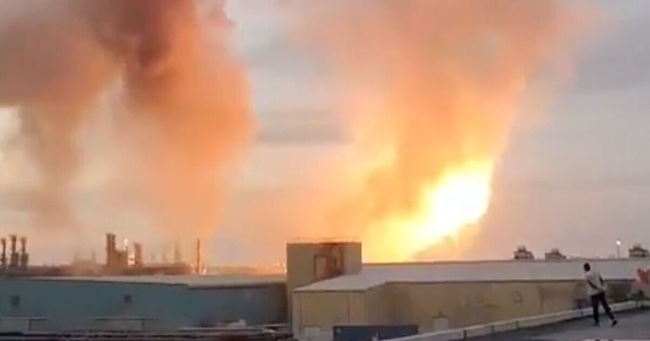
The Third Gulf War - allow us to name it so for simplicity —is now escalating to alarming levels. The Strait of Hormuz remains closed for the time being, and the Iranian forces are striking refineries in neighboring Arab countries, while Israel attacked Iranian oil depots in Tehran for the first time yesterday.
This morning, an Iranian attack on the BAPCO refinery in Bahrain (pictured) occurred, the largest in the country, while the oil price has now broken past $110 per barrel, with $150 in sight. This is a catastrophe. Countries in the region, primarily Kuwait and Iraq, have begun cutting oil production as storage facilities are full, and countermeasures taken so far - such as boosting Saudi exports via pipeline toward the Red Sea - have been having limited impact.
The fundamental issue is that under these conditions, insurance premiums for cargo ships and tankers have skyrocketed, and today no private entity is capable of sustaining them: consequently, everything is at a standstill. This has prompted the intervention of the US Federal Government and the DFC (Development Finance Corporation), which announced a maritime "reinsurance" plan of up to $20 billion to provide insurance coverage against war risks. The timeline for implementation is critical, now, but it is clear that US Navy escorts for tankers and military protection of traffic are required. This remains not viable until the threat of Iranian anti-ship missiles and mines has drastically diminished.
In short, the war is causing a significant shock to the economy, also because high oil and gas prices are influencing other sectors, starting with food, due to the impacts on fertilizer costs, not to mention the transport sector and traditionally energy-intensive ones, such as the steel industry (which is also impacted by the fact that Gulf countries produce nearly 10% of global aluminum).
The fundamental theme, therefore, becomes the duration of the war. The US and Israel have achieved undeniable tactical results in the first 10 days - neutralizing Iran's air defenses and heavily degrading its missile capabilities - but arsenals of interceptors and bombs are thinning, and the war bears costs for them, too. Initial estimates tell us that for the US alone, a single day of war costs over 1 billion dollars—while the Iranians, for now, are not backing down. The regime is resilient, deep-seated, and rooted, with a significant hard core and a security and repression apparatus that remains substantially intact. At some point, there will have to be a turning point...
Seguiteci sui nostri canali Telegram, Facebook, X, YouTube e Instagram.




Privacy Policy

Powered by © Mobilbyte s.a.s. Information Technology