



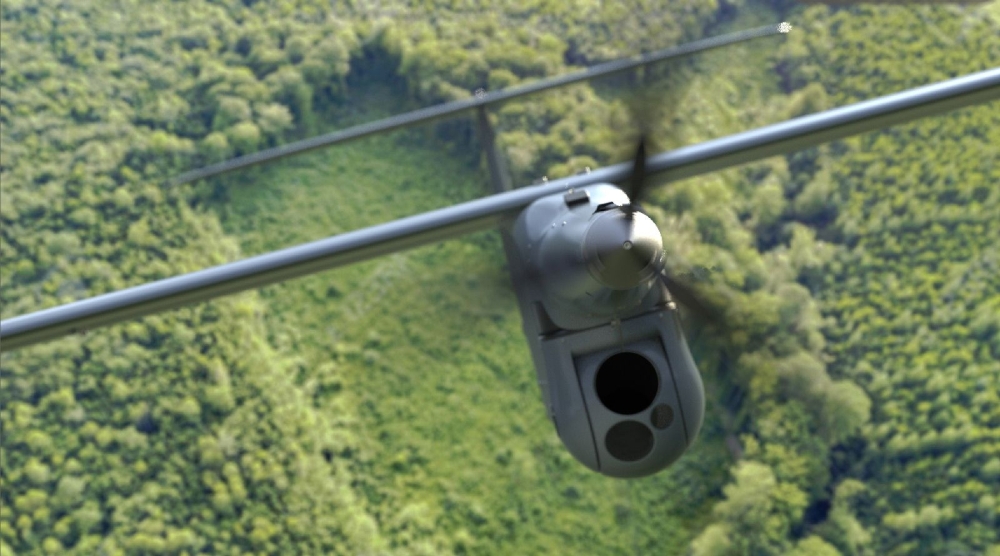
WB Group’s presence at Enforce Tac 2026 underlined how far the company has travelled from its origins as a Polish artillery start up to one of Europe’s big cheeses in loitering munitions, C4I and small calibre effectors.
Behind the familiar narrative of combat proven drones and battlefield experience sits a set of rarely discussed design choices – from power architecture to staffing and doctrinal roots – that now give WB Group a distinctive position in the European defence ecosystem.
Today the group encompasses around 25 companies, structured as a mid cap but still deliberately kept flexible to move faster than traditional primes and to integrate external partners without diluting its core C4I focus. That core is unambiguous: drones, loitering munitions and small calibre turrets are built as extensions of the C2 environment rather than standalone products.
WB Group’s story begins in 1997 with a small team building ballistic calculators for Polish artillery, a niche that forced the young company to internalise Soviet era gunnery methods and blend them with local innovation. This environment gradually expanded into battle management systems and then into the TOPAZ family, embedding a great deal of Polish and Russian content – in the sense of procedures, workflows and gunnery logic – that remains largely unknown in Western European C2 culture.
A company spokesperson explained to FW MAG that “this ‘Polish Russian’ heritage makes TOPAZ fundamentally different from many Western C2 suites because it is optimised from the outset for full scale, high attrition war rather than expeditionary crisis management. Instead of assuming relatively sparse artillery and uncontested communications, TOPAZ bakes in workflows for massed fires, rapid re tasking and constant loss and regeneration of units, which is much closer to what NATO now expects on its eastern flank”.
Consequently, for NATO or European forces, this would translate into several concrete advantages. First, artillery fire planning, counter battery and loitering munitions control are treated as one continuous process, shortening the sensor to shooter loop across guns, rockets, UAVs and WARMATE type systems.
Second, the system is built to keep working when things go wrong – triple redundant power, robust RF communications and pragmatic, field soldier friendly interfaces reflect experience of fighting under sustained enemy electronic warfare and kinetic pressure.
Third, because TOPAZ has evolved into a multidomain environment that already controls small calibre turrets and naval mounts, it offers European armies a ready made backbone for the ‘reconnaissance strike complexes’ they are now trying to build, without having to reinvent Slavic artillery logic from scratch.
This philosophy is visible in WB’s participation in the Polish “Future Task Force” framework, where artillery, reconnaissance and communications are treated as a single design problem rather than stove piped domains. It is also visible in the way the company approaches export markets: as a European entity with global reach, but one that insists on exporting an entire method of fighting, not just individual items of equipment.
WB’s cooperation with partners such as L3Harris – supplying headsets and an agnostic BMS layer in both ground and naval versions – fits into this logic of using TOPAZ as a backbone that can host third party elements rather than a closed ecosystem. Around 20 countries now use WB’s BMS solutions in one form or another, often with local customisation, but the underlying logic of fast kill chain closure across artillery, UAVs and loitering munitions remains constant.
ITAR free by design – not by afterthought
A detail often glossed over in European coverage is that WB’s ITAR free status was not an opportunistic re-branding but an early design constraint. The group has built its architecture – from command posts and radios through to drones and warheads – to avoid US controlled components, enabling an end to end ITAR free kill chain that is still unusual in Europe.
In a market dominated by Israeli derived loitering munitions, this makes WB arguably the only European player offering a genuine system level alternative, from C2 to effectors. The industrial model mirrors that sovereignty logic. WB remains a growing mid cap, but it distributes manufacturing to partners such as its Ukrainian facilities, where it can combine scale with proximity to frontline feedback. This also buffers the company against single nation export constraints, giving European customers more confidence that supply will survive political turbulence.
Loitering munitions as an industrial cycle, not a product
Thousands of WARMATE loitering munitions have now been delivered, particularly into Ukraine, but what differentiates WB’s approach is the way it has organised the full ‘cycle’ around them. The Ukrainian operation employs around 100 people, many of them former or serving soldiers on a constant turnover, whose operational experience feeds directly back into design decisions in Poland. This living feedback loop shapes everything from RF communications – which allow 10–12 UAVs to be controlled by a single operator – to details such as vehicular launch ergonomics and warhead configuration.
At Enforce Tac, WB underlined that the WARMATE family’s standard 10 kg warhead benchmark is chosen explicitly with the artillery user in mind, positioning loitering munitions as a complement to 155 mm guns rather than a separate niche. WARMATE 3 and WARMATE 5, with ranges of up to 70 km and 100 km respectively, slot into this fire support lattice as flexible, precision “rounds” that can be cued by artillery observers or by dedicated reconnaissance assets.
In effect, the SAFE initiative (EU’s new Security Action for Europe financial instrument, heavily shaped and championed by Poland), which WB describes as ‘of paramount importance’, is intended to frame loitering munitions within a coherent reconnaissance strike construct – illustrated by the company’s GLADIUS complex and associated optical intelligence solutions – rather than treating them as isolated drone buys.
Germany, UVision and India: laboratories for doctrine
Germany is emerging as a crucial test case, where WB is trying to dislodge or at least contest UVision’s entrenched position. Both companies arrive with outstanding operational track records, but WB is betting that a fully ITAR free stack and deep C2 integration will appeal to a Bundeswehr increasingly conscious of industrial dependence and data sovereignty issues. Its ability to hook WARMATE and FLYEYE into existing and future German battle management environments – potentially via agnostic BMS layers – will be watched closely.
India plays a quieter but strategically important role in WB’s thinking. A joint venture there is not only an industrial vehicle but a doctrinal laboratory, where challenges such as launching UAVs at 4,000 metre altitude force re-thinking of propulsion, comms and mission profiles. Lessons from such environments feed back into designs intended for European customers, who are preparing for operations in extreme climates and complex terrain from the Arctic to high altitude flanks.
At Enforce Tac, all of this sat behind the more visible headlines: the international debut of the FT-5 SAR UAV with its synthetic aperture radar, the display of IMINT and ELINT variants capable of cueing artillery and detecting enemy radars, and the ZMU-05 and ZMU-05N remote weapon stations bridging land and maritime applications. Yet what truly marks WB Group out among Europe’s big cheeses is less any single product than the combination of an ITAR free architecture, an artillery centric C4I logic rooted in Polish and Russian experience, and an industrial system built around continuous frontline feedback.




Privacy Policy

Powered by © Mobilbyte s.a.s. Information Technology