



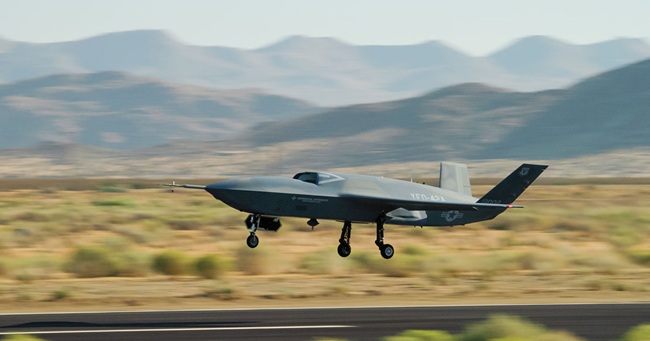
Contract awarded to integrate USMC mission payloads on the CCA already selected by the USAF. The US Marine Corps (USMC) has awarded a contract to General Atomics Aeronautical Systems, Inc. (GA-ASI), following competitive selection, for the company to provide its expertise and its YFQ-42A unmanned fighter as a surrogate platform in support of the Marine Air-Ground Task Force Uncrewed Expeditionary Tactical Aircraft (MUX TACAIR) Collaborative Combat Aircraft (CCA) project.
GA-ASI will proceed to integrate mission payloads specified by the USMC into its YFQ-42A to support testing and development activities. The YFQ-42A, as is known, is, along with the YFQ-44A (Anduril's FURY), the aircraft chosen by the US Air Force under the CCA Increment 1 program to become the first operational unmanned "fighter." The priority for Increment 1 is, in fact, the support of piloted aircraft in air-to-air missions, using sensors and missiles.
For the USMC, on the other hand, the YFQ-42A represents, at least for the moment, "only" a mature surrogate platform for experimentation. The Marine Corps will directly provide a mission "kit" to GA-ASI for onboard integration. The kit is described as "cost-effective" and "sensor-rich," "software-defined," and capable of developing "kinetic and non-kinetic effects," which implies a capacity to employ armaments as well as sensors and/or electronic warfare systems.
The YFQ-42A began flying for the USAF in August 2025 and for GA-ASI represents a starting point for the rapid development of additional modular variants, suitable for other missions and requirements.
The USMC will use the "surrogate" platform to continue defining the missions and characteristics of the MUX TACAIR, for which the platform that has been worked on so far is the XQ-58A VALKYRIE by Kratos. In the annual Aviation Plan for the Corps, 2026 edition, the USMC highlights its intention to develop its MUX TACAIR aircraft in successive increments. For MUX, intended to support the F-35B and C, there is a strong focus on Electronic Warfare capabilities, reaffirmed in the document.
GA-ASI obviously aims to secure a role that goes beyond that of a surrogate platform.




Privacy Policy

Powered by © Mobilbyte s.a.s. Information Technology