



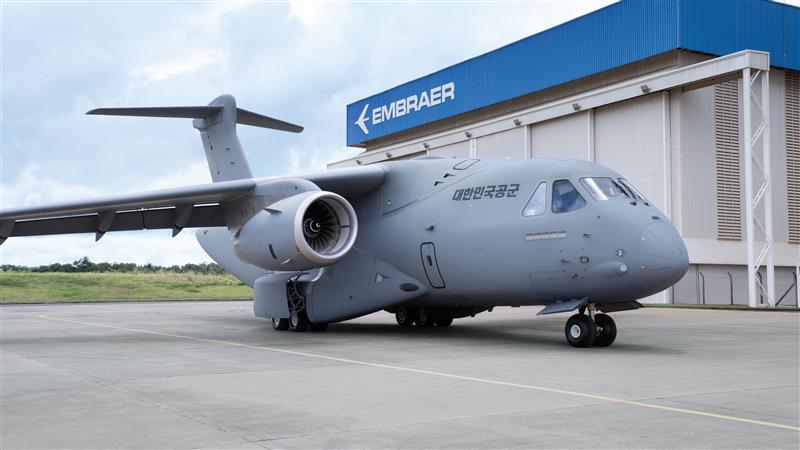
Embraer announced significant progress for its KC-390 Millennium programme at the Singapore Airshow on 3rd February, revealing both a major production milestone for the Republic of Korea Air Force and disclosing Uzbekistan as a previously undisclosed customer.
The first ROKAF KC-390 has reached the final stage of assembly and will now proceed to production flights ahead of the integration of mission-specific systems to meet South Korean requirements. This milestone demonstrates accelerated progress under the Large Transport Aircraft (LTA-II) programme, which saw Seoul select three KC-390s in December 2023 for W710 billion (approximately $544 million). The Republic of Korea becomes the first Asian nation to operate the type, marking a strategic victory for Embraer in a region where the C-130 platform has maintained overwhelming dominance for decades.
Simultaneously, Embraer disclosed that Uzbekistan is the customer behind a previously announced undisclosed order for two C-390 MILLENNIUM aircraft. The Uzbek Air Force will primarily deploy the aircraft for transport and humanitarian missions, becoming the first Central Asian operator. This revelation expands the KC-390's geographical footprint beyond its established customer base.
These orders carry strategic weight beyond their numerical value. South Korea's selection is particularly noteworthy given the nation's existing C-130J fleet acquired under the earlier LTA-I programme and decades of operational experience with the C-130H. DAPA's decision to diversify its tactical airlift capability represents a rare instance of an established C-130 operator selecting a competing platform, signalling confidence in the KC-390's maturity and capability.
For Uzbekistan, the acquisition enables fleet modernisation within a constrained budgetary environment. Both contracts include comprehensive industrial cooperation agreements. South Korea's package involves significant local manufacture of C-390 components by Korean partner companies and development of indigenous MRO capacity, integrating Korean aerospace firms into Embraer's global supply chain. This approach mirrors successful arrangements with Portugal and Hungary, where Embraer has positioned operators as regional sustainment hubs and component suppliers.
As of January 2026, the KC-390 family has accumulated 42 firm orders with 14 aircraft delivered and a backlog of 28. The operator roster now includes 11 nations: Brazil (19 aircraft), Portugal (6 with 10 options), Hungary (2), South Korea (3), the Netherlands (5 with 9 options), Austria (4), Czech Republic (2), Sweden (4 with 7 options), Uzbekistan (2), with Slovakia (3) and Lithuania (3) in advanced negotiations.
The KC-390's most significant near-term opportunity lies in India's Medium Transport Aircraft (MTA) programme, which seeks 70 to 80 aircraft to replace ageing AN-32 and IL-76 fleets. The Defence Acquisition Council was expected to approve Acceptance of Necessity by December 2025, with a global tender anticipated in early 2026. Embraer has partnered with Mahindra Defence Systems and established a wholly owned subsidiary in Aerocity, New Delhi, to position the KC-390 against competition from the C-130J and Airbus A400M. The programme is valued at $6–8 billion, with deliveries potentially beginning around 2028
Poland represents another critical market where Embraer is offering also a potential European final assembly line. Warsaw, operating elderly C-130E/H aircraft and expanding its airlift requirements as a frontline NATO member, has received intensive KC-390 marketing, including demonstrations at Powidz Air Base and Warsaw Chopin Airport in December 2025. Embraer signed five Memoranda of Understanding with Polska Grupa Zbrojeniowa, positioning Poland as a potential second European industrial hub alongside Portugal's OGMA facility.
Embraer is competing in an environment where the traditional C-130 replacement market, with over 1,100 ageing HERCULES aircraft in service globally, is fragmenting between multiple platforms. The KC-390's success in securing NATO members Portugal, Hungary, the Netherlands, Austria, Czech Republic, and Sweden demonstrates its acceptance as a viable tactical airlift solution within alliance interoperability frameworks, with Poland, Slovakia, and Lithuania in advanced negotiations. Nevertheless, the C-130J's established global sustainment network, mature supply chain, and proven operational record across multiple mission configurations continue to drive selections, particularly among Special Operations and coalition partners prioritising seamless interoperability.
The Singapore Airshow announcements reinforce the KC-390's trajectory from regional contender to credible global alternative, though Lockheed Martin's entrenched market position, production experience spanning decades, and comprehensive operator network ensure the C-130J will remain the dominant medium tactical airlifter in the short term. Embraer's strategy of targeting cost-conscious operators, offering comprehensive industrial participation, and emphasising modern design and performance continues to yield results, positioning the KC-390 as the most successful new entrant in the tactical transport market since the C-130J's own introduction three decades ago (70 years if we consider the base C-130 design).



Privacy Policy

Powered by © Mobilbyte s.a.s. Information Technology