



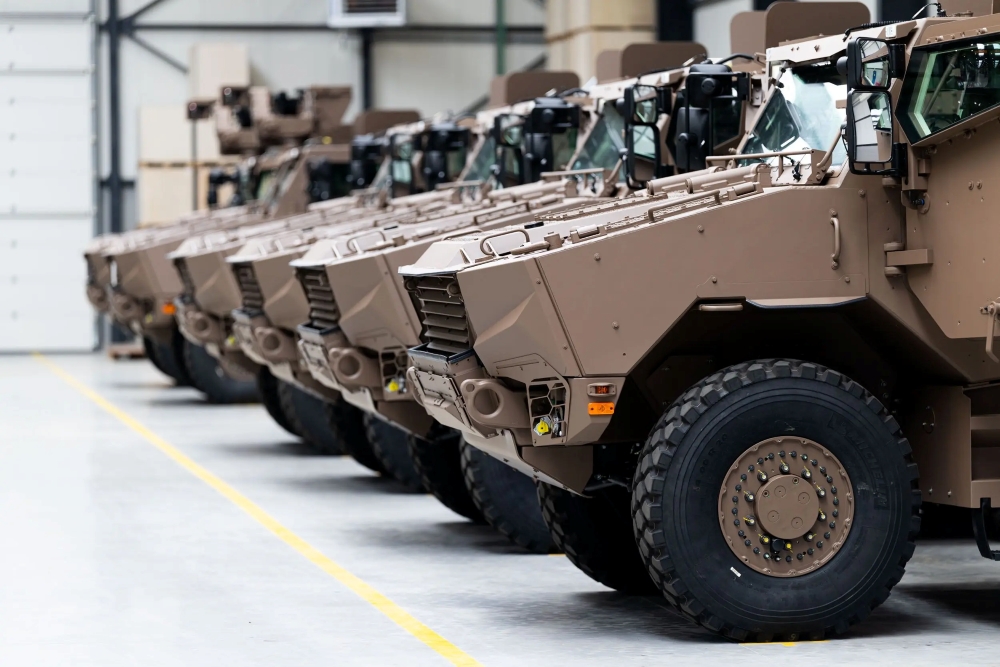
Belgium and Luxembourg have ordered 269 armoured vehicles from KNDS under the CaMo (Capacité Motorisée) programme, with the French DGA notifying KNDS France of the contract on 30 December 2025. The acquisition comprises 92 GRIFFON and 123 SERVAL vehicles for Belgium, alongside 38 JAGUAR and 16 GRIFFON platforms allocated to Luxembourg's Guide-Chasseurs Battalion, thus representing a significant capability injection for both nations.
For Belgium, the inclusion of 123 SERVAL vehicles marks the first acquisition of this reconnaissance platform, completing its access to the full SCORPION family after previous GRIFFON and JAGUAR procurements. This grants Brussels a degree of operational flexibility and interoperability within the French-led SCORPION ecosystem, directly supporting NATO capability commitments under the NATO Defence Planning Process (NDPP). Luxembourg's entry into the programme (acquiring vehicles through the Belgian contract) similarly addresses NDPP obligations while reinforcing interoperability with Belgian forces, a pragmatic approach for a micro-state with limited defence industrial capacity.
From an industrial perspective, KNDS France and its consortium partners (Arquus, Thales, and Texelis) secure a modest but symbolically important export order beyond the French Army's SCORPION programme. The arrangement promises "high societal return" for Belgian industry, with final assembly conducted at MOL CY and remote weapon stations supplied by FN Herstal. KNDS France and Texelis have reportedly extended Belgian assembly responsibilities for the SERVAL beyond what was undertaken for earlier GRIFFON variants, suggesting a degree of workshare negotiation to sweeten the deal politically.
However, the cascading effects reveal familiar European limitations. While KNDS touts pan-European credentials (citing operations in 24 European armies and revenue of €3.8 billion) the reality is one of a national programme with peripheral export uptake rather than integrated multinational procurement. Belgium and Luxembourg are joining an existing French programme, not co-developing a genuinely European platform from inception.
For the broader European defence landscape, this order offers limited transformative potential – unlike officially proclaimed. It incrementally expands the SCORPION user base and may facilitate future coalition operations, yet it does not address the fragmentation that continues to plague European land systems procurement. Competing platforms - Germany's BOXER, Italy's FRECCIA and CENTAURO families, and various Eastern European acquisitions -persist in parallel, diluting economies of scale and interoperability gains. KNDS' order backlog of €23.5 billion suggests commercial health, but this remains distributed across disparate national programmes rather than consolidated European demand.
Indeed, KNDS' dominance in wheeled armoured vehicles faces an emerging challenge from Czechoslovak Group (CSG), the Czech conglomerate positioning itself as a potential disruptor to Europe's established defence hierarchy. CSG announced its Amsterdam IPO in January 2026, with valuations ranging from €22 billion to €50 billion (depending on figures) that would place it in direct competition with Rheinmetall and KNDS for European market leadership. Founded in 1995 and built through aggressive acquisition, CSG generated €5.2 billion revenue in 2024 across 14,000 employees, leveraging assets including Tatra Defence Vehicles and a diversified portfolio spanning ammunition, artillery, and vehicle platforms.
The implications for KNDS are non-trivial. While KNDS' €23.5 billion order backlog and €3.8 billion 2024 revenue currently exceed CSG's scale, the Czech group's IPO war chest could fund acquisitions targeting niche capabilities or distressed Western assets, particularly as European governments diversify supply chains beyond Franco-German primes. CSG's Central European positioning offers political advantages in procurement debates increasingly sensitive to geographical balance within NATO and the EU. Moreover, CSG's lower labour costs and willingness to pursue non-Western markets provide commercial flexibility that legacy Western primes cannot easily replicate without reputational risk.
The Belgium-Luxembourg order thus arrives amid shifting tectonic plates in European defence industry consolidation. KNDS' success in securing incremental export contracts may prove insufficient if competitors like CSG leverage financial engineering and geopolitical repositioning to capture emerging demand from Eastern flank NATO members or breakout programmes in traditionally non-aligned states.
Ultimately, the Belgium-Luxembourg order is a pragmatic, incremental step for smaller NATO members seeking capability renewal within constrained budgets. For KNDS, it validates the SCORPION export proposition and deepens Franco-Belgian industrial ties. Yet it also reflects the persistent reality of European defence: cooperation remains transactional and programme-specific, falling short of the structural integration required to genuinely challenge extra-European competitors or deliver strategic autonomy at scale.



Privacy Policy

Powered by © Mobilbyte s.a.s. Information Technology