



Northrop Grumman's Integrated Battle Command System (IBCS) is undergoing a fundamental transformation, already. What began as the US Army's programme of record for Integrated Air and Missile Defence (IAMD) modernisation is evolving into a globally sought-after capability that promises to reshape how nations defend against increasingly sophisticated aerial threats. With over 20 countries now formally expressing interest through Foreign Military Sales channels and Poland achieving full operational capability, IBCS has transcended its origins to become an emerging international standard for air defence command and control.
Yet even as the system proves itself in deployment across three combatant command theatres, Northrop Grumman is not resting on its laurels. In an exclusive briefing attended by Future Warfare Magazine, company executives Ken Todorov and John Ferko revealed their vision for the next evolution of IBCS: a lighter, more mobile, and fundamentally more adaptable architecture designed to meet the harsh lessons emerging from Ukraine's battlefields.
Lessons from Ukraine drive transformation
The strategic imperative driving IBCS evolution is brutally simple: fixed targets are not survivable in modern conflict. Ken Todorov, Sector Vice President and General Manager of Northrop Grumman's C2 and Weapons Integration Division, pointed to Ukraine as the exemplar of contemporary air and missile defence demands. "Think about what's going on there," Todorov explained during the briefing. "Constant drone attacks, constant fast-moving missile salvos, and the need to fight from dispersed positions. We're finding that fixed targets are often not survivable."
This operational reality is reshaping air defence doctrine globally. The patchwork of legacy sensors and shooters (each operating in stovepipes with dedicated command nodes) cannot meet the speed, resilience, and flexibility that contested environments demand. As FW MAG explained, IBCS addresses this challenge by serving as connective tissue across disparate systems, linking sensors and effectors across multiple domains from the maritime environment to space. Rather than the traditional pairing of one sensor, one effector, and one command node, IBCS enables a truly networked defence where any sensor can guide any shooter across the battlespace.
The system's combat credibility is well established. IBCS has achieved a perfect 32-for-32 record in live fire engagements conducted in deliberately stressing test environments that included electronic attack, cyber intrusion attempts, and sensor degradation. This resilience under pressure has proven the architecture's fundamental soundness. Now, Northrop Grumman is building upon that foundation to make IBCS lighter, faster, and more adaptable to the mobile warfare that modern threats demand.
The adaptive framework: modularity at every layer
The concept Northrop Grumman terms the "adaptive framework" represents a fundamental rethinking of how air defence command and control deploys and operates. At its core, the adaptive framework recognises that missile defence forces will fight across a spectrum of environments and mission sets, from static installations in fixed facilities to highly mobile expeditionary operations where survivability depends on constant movement and dispersion.
"What we're trying to create, working with the Army and with the warfighters, is an air missile defence capability that is adaptive to the environments," John Ferko, Head of Strategy, Marketing, Business Development explained. "We've already created an air missile defence capability that is adaptive to any sensor and any effector that you want to plug into it. Now let's take that integrated fire control system and make it more mobile, more survivable."
The adaptive framework operates across three interconnected dimensions: communications architecture, physical form factor, and software modularity.
Communications flexibility stands as the first pillar. In some scenarios, units may employ hardwired fibre optic cables connecting sensors, effectors, and engagement centres across dispersed positions. In others, satellite links or RF communications provide the necessary connectivity. The framework is designed to support hybrid approaches, mixing transmission methods based on tactical requirements, available infrastructure, and electronic warfare considerations. This communications agility ensures that degrading one link does not collapse the entire defensive network.
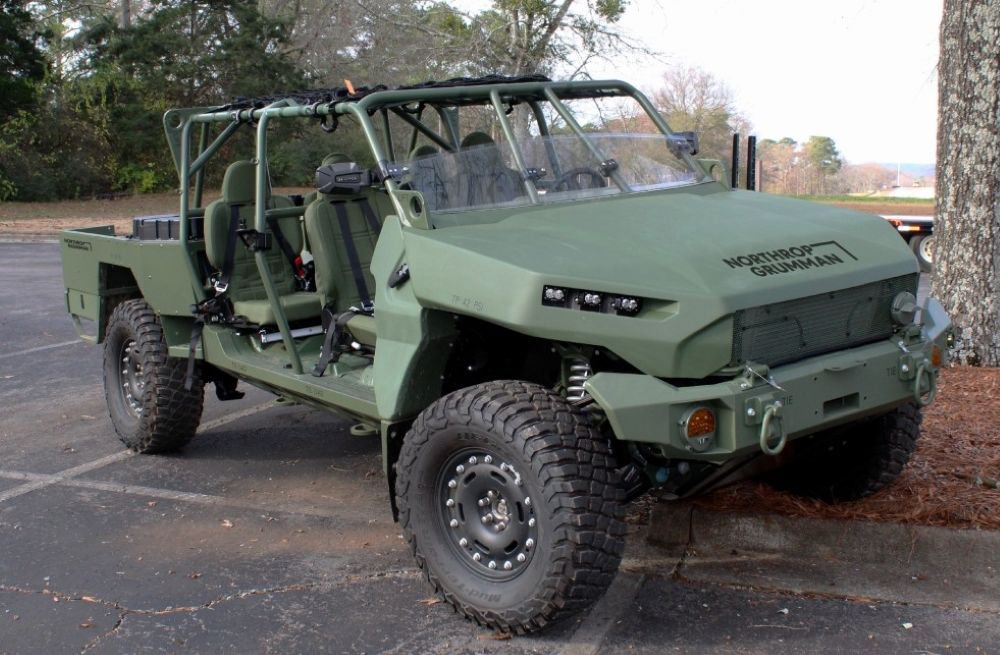
Form factor scalability represents the second pillar. Current IBCS deployments centre on the Engagement Operations Centre (EOC), typically housed in shelters or fixed facilities with substantial server infrastructure. The adaptive framework reimagines this architecture for environments where such static installations present unacceptable vulnerabilities. The system can scale from rack-mounted servers in protected facilities down to ruggedised processors mounted on highly mobile tactical vehicles. As Ferko emphasised, the goal is "not transportable, but very mobile systems." This scalability manifests most dramatically in Northrop Grumman's Infantry Squad Vehicle integration concept. The company purchased 3 ISVs (the lightweight tactical vehicle developed by GM Defence and now proliferating across US Army formations) as a demonstration platform for IBCS mobility. The concept envisions IBCS capabilities distributed across multiple ISV variants, with operators working in a mobile environment using various communications methods including RF masts and satellite links.
The ISV integration represents an intentionally ambitious mobility target. These vehicles, designed for rapid infantry transport in austere environments, lack the size and weight capacity of traditional command vehicles. By demonstrating IBCS on this platform, Northrop Grumman is establishing a baseline that proves the system can adapt to virtually any tactical vehicle the Army or international partners might employ. "The idea is create an adaptive framework to adapt to whatever the mobile or transport means are, whatever the conditions are," Ferko noted. "So if the Army envisions eventually moving this into armoured vehicles or future ground combat vehicles, IBCS will be able to adapt to it."
Software containerisation forms the third pillar enabling this adaptability. IBCS currently comprises 5.7 million lines of code organised into 110 different modules. The evolution toward containerised software architecture will enable the system to scale across diverse form factors while accelerating the integration of new sensors and effectors. This software transformation is largely invisible to operators but fundamental to the adaptive framework's promise. Containerisation allows functionality to be distributed across networks of smaller, more survivable nodes rather than concentrated in large, vulnerable command posts. The transition away from static structures is already underway. Current IBCS configurations often employ ICE tents - Integrated Cooperation Engagement platforms that add 10 operators to the baseline two-operator Engagement Operations Centre. The future envisions far more flexible configurations: perhaps an "expando-van" EOC paired with several ISVs, or a purely mobile force of four to five tactical vehicles, with the exact composition determined by mission requirements and threat conditions. "We're trying to build an adaptive framework that we could put that engagement on the move instead of being static," Ferko explained. "Operators could be in ISVs, they could be in any type of vehicles."
Automation enhances operator effectiveness
Mobility and dispersion create new challenges for operators managing complex air defence engagements. The adaptive framework addresses this through enhanced automation and artificial intelligence, fundamentally shifting the operator's role during high-intensity attacks.
When defence systems face overwhelming salvos mixing theatre ballistic missiles, cruise missiles, and multiple classes of UAVs, human operators can be saturated by the decision tempo required. IBCS automation addresses this by enabling operators to establish engagement rules that the system executes autonomously. "The system is able to automate and say, 'All theatre ballistic missiles are bad. We're going to put that on automatic and the system will weapons pair,'" Ferko explained, referencing the OODA loop concept. "We take them out of the loop, we put them on top of the loop, and they oversee the automation of the system, especially when you're being overwhelmed."
This is not autonomous engagement in the sense of removing human authority, but rather pre-authorised automation that allows operators to focus on the most complex decisions while the system handles clear-cut threats according to established doctrine. The human remains in ultimate control, but with enhanced tools to manage saturation attacks that would otherwise overwhelm manual engagement processes.
The automation capabilities also reduce manning requirements, a critical consideration as nations face constrained personnel pools. By enabling smaller crews to manage defensive operations previously requiring larger teams, IBCS helps address the reality that modern militaries often face personnel shortages even as threat complexity increases.
Production capacity meets global demand
The international interest in IBCS creates both opportunity and challenge. With over 20 nations formally expressing interest, the production tempo must accelerate to meet demand without compromising capability or quality.
Northrop Grumman's Enhanced Production Integration Center (EPIC) facility outside Huntsville, Alabama provides the foundation for this expansion. The 175,000-square-foot facility currently produces two battalions' worth of IBCS major end items per month in full-rate production, having successfully completed low-rate initial production with 142 major end items delivered on time or ahead of schedule.
More significantly, EPIC was designed with expansion capacity built in from the outset. The facility can scale to four times current production rates when demand signals justify the investment. "We're in conversations with our US Army and US government customer about doing just that," Todorov stated, noting that increasing international demand is accelerating these discussions.
This production flexibility creates a virtuous cycle. International sales increase production volumes, which generate economies of scale that reduce unit costs for the US Army and international partners alike. Faster production also accelerates capability delivery to allies and partners at a time when, as Todorov noted, "given what's going on in the world today, the need is very, very real."
The facility has already added shift work to meet growing demand, and executives indicated readiness to expand the workforce substantially as firm orders materialise. This production scalability is particularly important as the adaptive framework concepts transition from demonstration to fielding the lighter, more mobile variants will require parallel production lines that can deliver at scale without cannibalising production of conventional IBCS configurations still required for many deployment scenarios.




Privacy Policy

Powered by © Mobilbyte s.a.s. Information Technology