



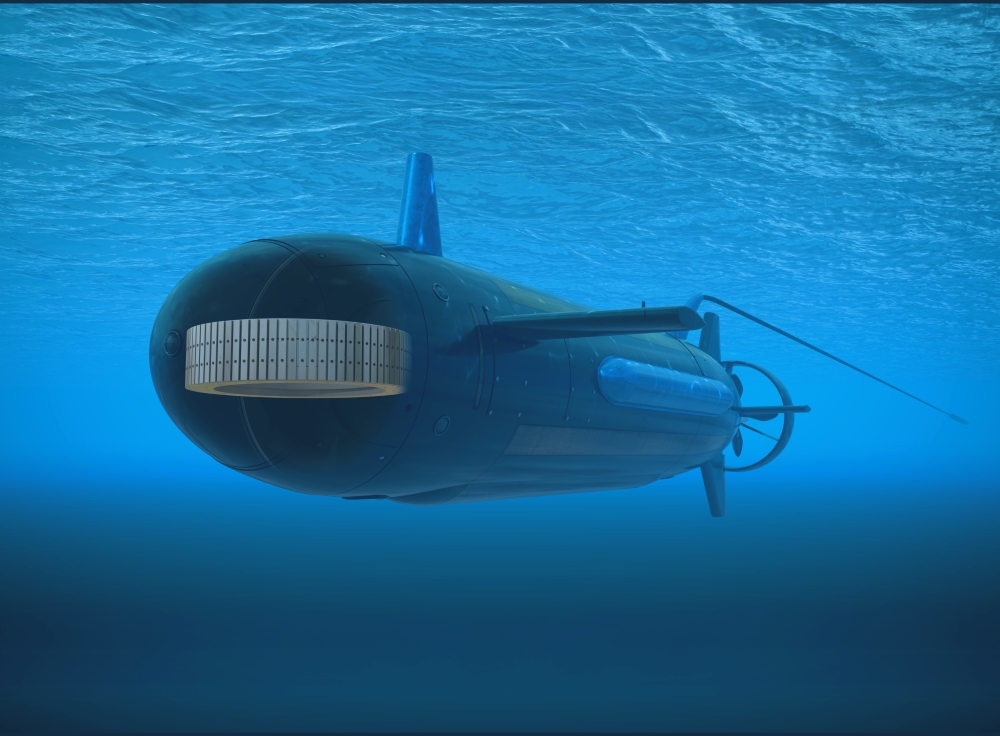
Israeli company DSIT Solutions has completed a strategic evolution from protecting harbours against underwater intrusion to equipping unmanned platforms with submarine-hunting capabilities. The January 2026 launch of GhostFin, a comprehensive multi-mission sonar suite for unmanned underwater vehicles (UUVs), represents the culmination of 30 years of acoustic expertise and signals the company's ambition to narrow the capability gap between crewed submarines and autonomous platforms.
From diver detection to domain dominance
Founded in 1985, DSIT established itself as a specialist in underwater security systems, building a reputation protecting critical offshore infrastructure (ports, energy terminals, and naval bases) from swimmer and small submersible threats.
The company’s AQUASHIELD diver detection sonar became a global reference system, able to handle more than 1,000 contacts simultaneously while keeping false alarm rates extremely low. Contracts with the Indian Navy for 78 POINTSHIELD portable diver detection sonars under the ‘Buy Make India’ programme, alongside deployments protecting coastal and offshore critical sites worldwide (including also installations safeguarding Israeli offshore gas infrastructure), provided strong commercial validation of DSIT’s acoustic signal-processing algorithms.
Rafael Advanced Defense Systems acquired a 50% stake in 2016 at a $15 million valuation, recognising strategic value in DSIT's accumulated underwater acoustic data library and processing expertise. Two years later, businessmen Mani Wasserman and Dany Sides purchased the remaining shares at a similar valuation. This partnership provided DSIT access to Rafael's artificial intelligence capabilities and defence industry networks whilst maintaining operational independence. In November 2024, the company appointed Vice Admiral (res.) Eli Sharvit, former commander of the Israeli Navy (2016-2021), as president.
The company progressively expanded beyond point defence. SEASHIELD, a fixed seabed surveillance system combining active transmit arrays with passive receive hydrophone strings, extended DSIT's operational envelope to coastal surveillance missions. With low-frequency active/passive operation and AI-enhanced automatic classification distinguishing submarines from benign contacts, SEASHIELD addressed maritime domain awareness requirements for navies monitoring territorial waters and strategic chokepoints. The system's ability to cover the full water column from surface to 300 metres-plus provided the technical foundation for DSIT's subsequent move into mobile ASW platforms.
Strategic rationale: riding the unmanned wave
GHOSTFIN's development responds to converging operational and economic pressures reshaping anti-submarine warfare. UUV installations represent the fastest-growing platform segment in the sonar systems market, expanding incredibly and outpacing traditional crewed platforms. This growth reflects fundamental shifts in ASW economics: unmanned systems deliver roughly 90% cost savings compared to manned alternatives while enabling persistent presence in contested waters without risking crews.
Major naval powers are fielding extra-large UUVs (such as Boeing's Orca XLUUV with its 6,500-nautical-mile range and 34-foot modular payload bay) to conduct extended ASW patrols. Yet these platforms require sensor suites approaching submarine capability to justify autonomous operations. DSIT identified this capability gap as GHOSTFIN's market opportunity: providing UUVs with the multi-sensor architecture traditionally exclusive to crewed submarines.
The Israeli defence context provided additional impetus. Rafael and DSIT have prioritised AI-enabled underwater systems in response to proliferating subsurface threats in the Eastern Mediterranean. GHOSTFIN's autonomous decision support, target detection, tracking and classification capabilities reflect this operational requirement for systems capable of independent action in communications-denied environments.
GHOSTFIN's competitive positioning
GHOSTFIN comprises an integrated suite combining active arrays, two-sided flank array sonars, passive towed array sonar, and bow array sonar in modular configurations scalable from medium UUVs to extra-large platforms. This multi-array architecture mirrors crewed submarine sensor fits - bow, flank and towed arrays working cooperatively- but packaged for unmanned integration. The modular approach addresses the diverse UUV market, from mid-sized platforms conducting littoral missions to large-displacement vehicles undertaking blue-water patrols. Three capabilities differentiate GHOSTFIN within an increasingly competitive landscape.
First, fully autonomous operation powered by AI-based decision support eliminates requirements for continuous operator oversight, enabling genuinely independent missions. Thales demonstrated comparable ambitions with its NANO76 prototype in December 2025, developed in 10 months for £2 million-plus and featuring 75×75cm tiles with synthetic aperture sonar capability.
Second, bistatic operation would allow GHOSTFIN-equipped UUVs to exploit active transmissions from remote sources (ASW surface vessels or DSIT's own SEASHIELD fixed arrays) providing covert detection without compromising platform stealth. This network-centric approach aligns with emerging distributed ASW architectures, exemplified by the Royal Navy's Atlantic Bastion strategy deploying disaggregated sensor networks against Russian submarine incursions.
Third, GHOSTFIN integrates navigation and safe diving/surfacing control, addressing the autonomous vehicle challenge of operating independently whilst managing energy budgets and collision avoidance. The system enables cooperative operations alongside crewed submarines and ASW platforms, receiving mission updates and instructions via underwater communications.
Market test ahead
GHOSTFIN enters a market where established players (Thales, Raytheon, Atlas Elektronik, and Kongsberg) dominate submarine and UUV sonar supply. Thales secured contracts exceeding €300 million for French nuclear submarine sonar suites and over £330 million for UK Dreadnought-class systems, demonstrating the financial scale required for tier-one naval programmes. DSIT's competitive advantages rest on specialisation, modularity and accumulated acoustic libraries from two decades of operational deployments across varied maritime environments.
Boeing's ORCA XLUUV carries Raytheon's PROSAS PS60-6000 synthetic aperture sonar for ocean-floor mapping, illustrating payload integration approaches for large platforms. GHOSTFIN must demonstrate comparable performance whilst offering cost advantages reflecting DSIT's position outside traditional prime contractor structures. The company's three-decade acoustic heritage, Rafael's AI capabilities, and proven SEASHIELD/AQUASHIELD operational records provide technical credibility. However, GHOSTFIN's value proposition ultimately depends on converting modular design claims into platform-integrated reality - a challenge requiring partnerships with UUV manufacturers and naval validation programmes.
DSIT's evolution from harbour guardian to autonomous ASW supplier exemplifies defence industry adaptation to unmanned warfare's ascendance. Whether GHOSTFIN captures meaningful market share depends on execution: translating acoustic expertise and AI autonomy into operational systems that navies trust to hunt submarines without human oversight.




Privacy Policy

Powered by © Mobilbyte s.a.s. Information Technology