



January marked an intense month for Spanish state-owned shipbuilder Navantia, showcasing the company's dual-track strategy of consolidating its British operations while aggressively pursuing new European export opportunities. Three press releases issued between 23 and 28 January reveal a shipbuilder simultaneously delivering on existing commitments and positioning itself as a credible partner for NATO-aligned navies seeking rapid capability regeneration in an increasingly contested security environment.
UK operations: from acquisition to execution
Navantia UK commemorated the first anniversary of its Harland & Wolff acquisition on 27 January with tangible evidence of industrial transformation. The £115 million recapitalization programme across four sites—Belfast, Appledore, Arnish, and Methil - has moved beyond stabilization to active modernization, with workforce numbers exceeding 1,100 and 222 apprentices representing 20 percent of total headcount. This apprentice ratio signals genuine commitment to sovereign skills regeneration rather than merely asset-stripping a distressed competitor.
The Fleet Solid Support (FSS) programme serves as the anchor for this investment. Steel cutting ceremonies held at Appledore in December 2025 and module construction commencing at Puerto Real in January demonstrate cross-border industrial collaboration at scale. Each 216-metre vessel - displacing 39,000 tonnes and second only to the Queen Elizabeth-class carriers in UK Defence service - represents a programme management challenge requiring coordination between Spanish yards, Navantia UK's Appledore facility, and Harland & Wolff Belfast for final integration. The first ship, RFA Resurgent, will enhance the Royal Navy's Carrier Strike Group by enabling extended at-sea operations without port calls, a critical enabler for persistent forward presence in contested environments.
Belfast's £90 million investment merits particular attention. The installation of a 5,000-square-metre extension and PEMA automated panel line positions Harland & Wolff as one of Europe's most advanced yards, capable of supporting programmes beyond FSS. At Methil and Arnish, Navantia UK is leveraging Scotland's offshore wind expansion, particularly the ScotWind Array Release 7, to diversify revenue streams and maintain yard utilization between defence contracts. This dual-use approach - alternating between naval and renewable energy fabrication - mirrors strategies employed successfully by Nordic yards and provides financial resilience against defence procurement cycles.
Strategic marketing: the Swedish campaign
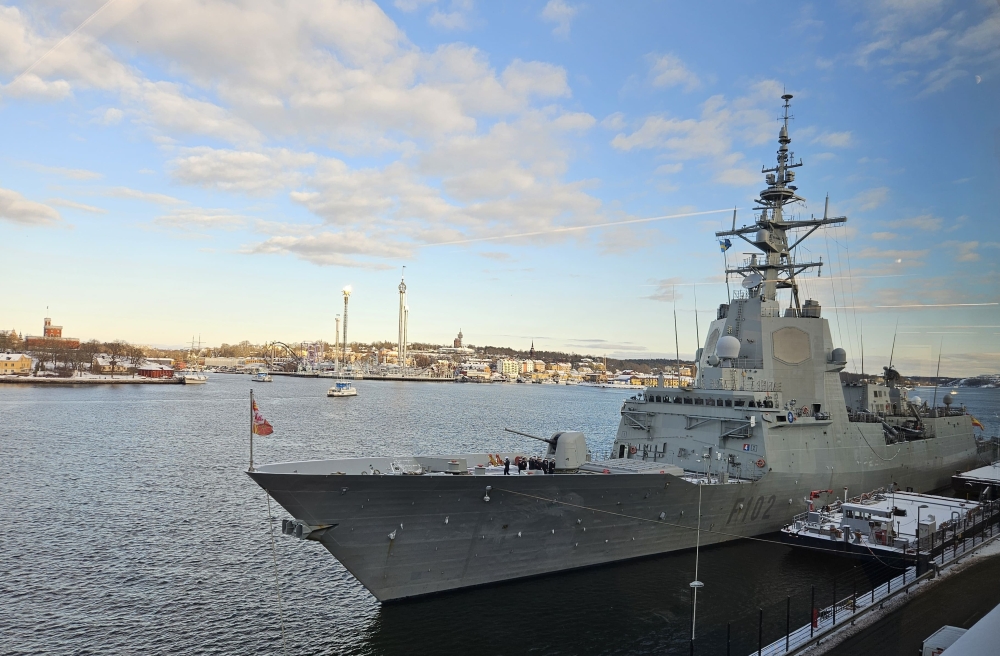
Navantia's 27 January Stockholm engagement illustrates export campaign sophistication. The visit of frigate F-102 ALMIRANTE JUAN DE BORBÓN (currently serving as NATO Standing Naval Group 1 flagship) has been used by the company as a floating demonstration platform for Navantia's operational credibility. Hosting Swedish Defence Minister Pål Jonson, Royal Swedish Navy Chief Rear Admiral Johan Norlen, and Defence Materiel Administration (FMV) Director Rear Admiral Fredrik Linden aboard a NATO-tasked asset enabled discussions grounded in operational reality rather than marketing abstractions.
Sweden's LULEA-class requirement represents one of the most strategically significant European frigate competitions in decades. The four-ship programme - driven by post-Ukraine threat perceptions and NATO accession commitments - marks Sweden's largest surface combatant acquisition since the early 1980s. With a decision expected in early 2026, Navantia faces stiff competition from France's Naval Group (offering the FDI frigate), UK's Babcock (potentially partnered with Saab), and domestic champion Saab Kockums.
Navantia's ALFA 4000 proposal, displacing 4,080 tonnes with integrated electric propulsion, emphasizes rapid delivery aligned with Sweden's ambitious timeline of two frigates operational by 2030 and two more by 2031. This schedule-driven approach contrasts with competitors offering larger, more complex designs requiring extended development. By positioning the offering as a "capability-based programme rather than a platform delivery," Navantia signals willingness to integrate Swedish national combat systems and prioritize operational effect over proprietary systems lock-in. The emphasis on digital twins, predictive maintenance, and through-life support is a cascading effect of Navantia's institutional experience with the F-100 AEGIS frigate programme, where sustainment in NATO multinational operations has been validated over two decades.
What comes next
The Swedish decision, expected within weeks, represents Navantia's most significant near-term inflection point. A LULEA-class contract award would validate the company's proposition that a mid-sized, state-owned European yard can compete against larger transatlantic primes and national champions by emphasizing schedule certainty, NATO operational experience, and industrial partnership flexibility. Conversely, losing to Naval Group or Babcock would test Navantia's export momentum despite the UK consolidation success.
FSS programme execution will be scrutinized as a bellwether for Navantia UK's long-term viability. The Ministry of Defence delayed first-ship operational capability from 2028 to 2031, creating narrow schedule margin. Demonstrating on-time, on-budget delivery would position Navantia UK for future Royal Navy programmes, potentially including Type 32 frigates or future amphibious vessels. Failure would reinforce historical UK shipbuilding scepticism about foreign ownership models.
Nonetheless, Navantia's trajectory faces structural headwinds rooted in its business model as systems integrator rather than platform prime with in-house technology sovereignty. The company's reliance on Lockheed Martin's AEGIS combat system and radars for its F-100 and F-110 frigates creates dependencies on US export controls and technology transfer approvals that competitors can exploit. While AEGIS integration has been Navantia's historical differentiator (making it the only European yard fielding AEGIS on medium frigates) this also limits its ability to offer truly sovereign solutions to customers prioritizing strategic autonomy. Sweden's competition exposes this vulnerability acutely. The ALFA 4000 proposal, if based on AEGIS architecture, would perpetuate Swedish dependence on US government approvals for system modifications, upgrades, and operational employment - precisely the strategic constraint NATO accession was meant to reduce, not replicate. Saab's partnership with Babcock offers Swedish-developed combat systems with full national control, while Naval Group's FDI relies on French sovereign systems with minimal US content. In an era where European strategic autonomy and reducing extra-EU dependencies are explicit policy priorities for both Brussels and national capitals, Navantia's US-centric combat system architecture may prove strategically misaligned.
In sum, as European NATO members confront post-Ukraine rearmament imperatives amid constrained national budgets, companies capable of cross-border programme execution, technology transfer, and multinational interoperability will capture disproportionate market share. January 2026 demonstrated that Navantia has moved beyond opportunistic acquisition to systematic industrial strategy. Whether that translates to sustained export success and operational delivery will define the company's role in the European shipbuilding sector.
Follow us on Telegram, Facebook and X.



Privacy Policy

Powered by © Mobilbyte s.a.s. Information Technology