



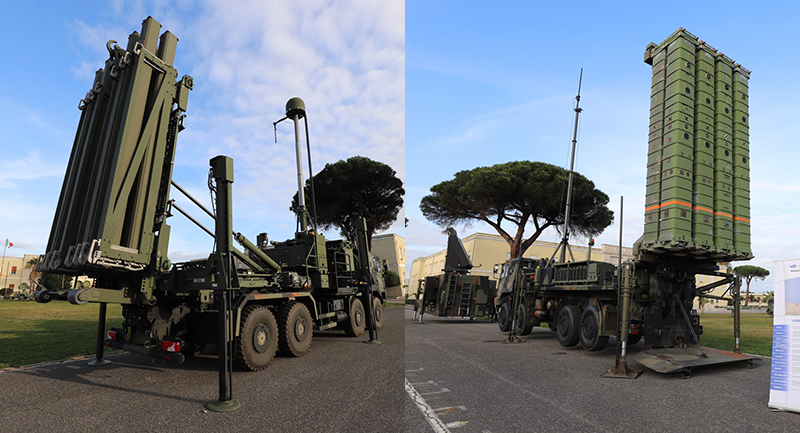
On 22 January, at the Italian Army Air Defence Artillery Command in Sabaudia (Latina), in the presence of the Chief of Staff of the Italian Army, Gen. Carmine Masiello, the first examples of the new SAMP/T NG and GRIFO missile systems were formally delivered to the Italian Army. These are two air defence and missile defence systems intended to strengthen the Italian Army’s surface-to-air capabilities and mark the beginning of a broader renewal of Italy’s ground-based air defence (GBAD) portfolio.
SAMP/T NG: medium–long range, anti-ballistic layer
The SAMP/T NG (New Generation), developed by EUROSAM (a joint venture between MBDA Italy, MBDA France and Thales), employs Leonardo’s new KRONOS GRAND MOBILE HIGH POWER radar and the new ASTER 30 Block 1NT missile by MBDA. The system provides medium- to long-range air defence and anti-ballistic capabilities, combining extended engagement ranges, 360-degree coverage and integrated battle management to counter aircraft, cruise missiles and certain classes of ballistic missiles.
SAMP/T NG is designed for full integration into national air defence networks and NATO’s Integrated Air and Missile Defence (IAMD) architecture, enabling cooperative engagement and coordinated tasking with allied sensors and shooters. Within the Italian Army, the service plans to field 6 SAMP/T NG batteries, providing the upper ground-based layer of its land component’s air and missile defence posture. Italy originally had 5 legacy SAMP/T batteries in service (before donations to Ukraine). The Army donated at least two batteries to Ukraine (one jointly with France in 2023, and a second one in 2024), which has reduced the operational inventory. The 6 SAMP/T NG batteries will therefore replace entirely the legacy ones.
Under current contracts, Italy has ordered at least 9 SAMP/T NG systems (4 for the Italian Army and 5 for the Italian Air Force), marking a comprehensive renewal of the nation's medium- and long-range air defence capabilities. Hence, 2 additional batteries are to be ordered to complete the Army's desired modernisation.
GRIFO and MBDA’s EMADS-driven multi-layer focus
GRIFO, positioned within the short to medium range air defence segment, is part of a family of systems developed by MBDA using the CAMM and CAMM-ER missiles. In the Italian configuration, it employs the PCMI (Engagement Module Command Post) developed and produced by Leonardo, integrating Rheinmetall Italia’s X-TAR 3D and providing a mobile, networked capability optimised against (relatively) low-altitude and time-sensitive threats. The Italian Army plans to acquire 9 GRIFO systems, which will complement SAMP/T NG and contribute to a common Italian–European approach to modular, layered GBAD.
While GRIFO serves the Italian Army's ground-based air defence requirements, the Italian Air Force is concurrently implementing the Medium Advanced Air Defence System (MAADS), a parallel SHORAD capability also based on the CAMM-ER missile but optimised for air force operational needs. MAADS utilises Leonardo's KRONOS LAND radar (deployed within an MBDA BMC4i SIRIUS detection centre) to deliver medium-range air defence capabilities, replacing the Italian Air Force's legacy SPADA system based on the ASPIDE missile. The successful qualification of both systems (GRIFO in May 2024 and MAADS in 2023) confirms that CAMM-ER can be flexibly integrated across different sensor and C2 suites, validating MBDA's EMADS philosophy and providing a European template for multi-service, multi-layered air defence architectures.
Indeed, in recent years, MBDA has progressively shaped its portfolio around the Enhanced Modular Air Defence Solutions (EMADS) architecture, centred on the CAMM family and designed to deliver scalable, multi-layered solutions. EMADS emphasises modular launchers, open C2 interfaces and the ability to integrate different effectors – from very short-range to long range – within a common, networked framework, enabling customers to tailor layered architectures to national requirements and existing sensors. GRIFO can be seen as a national instantiation of this EMADS philosophy, pairing CAMM-ER with Italian-developed command, control and sensor components to deliver a short-to medium-range layer that is both exportable and fully interoperable with NATO networks.
A fully European layered architecture
The induction of SAMP/T NG and GRIFO represents a significant step forward in the Italian Army’s transition towards a layered and integrated air and missile defence architecture, combining SHORAD and medium/long-range systems under a network-centric approach. Crucially, Italy is fielding a complete land-based architecture built around European missiles (ASTER, CAMM ER), radars (KRONOS GM HP, X-TAR 3D) and C2 modules, providing a prominent example in Europe of a multi-layered GBAD system that is entirely designed, developed and produced on the continent. This choice has strategic and industrial significance: it reinforces European technological sovereignty in a critical capability area while feeding investment and workload back into Italian and wider European industry. Operationally, the Italian solution demonstrates how European nations can assemble a coherent, cradle-to-grave IAMD architecture by combining national command and radar assets with MBDA’s effector family and EUROSAM’s medium/long-range layer.
Upper and lower echelons: AQUILA, MISTRAL 3 and FULGUR
At the upper echelon, Italy is examining the potential role of the AQUILA programme as a future high-tier interceptor and sensor layer, complementing SAMP/T NG by extending engagement ranges and enhancing capabilities against advanced air-breathing and ballistic threats. If realised, AQUILA would sit above SAMP/T NG in the national IAMD construct, providing Italy and potentially other Europeans with an indigenous, next-generation upper-tier solution aligned with NATO’s evolving ballistic missile defence concepts.
At the lower echelon, the architecture can be completed by very short-range (VSHORAD) effectors such as MISTRAL 3 and the new Italian-led FULGUR missile. MISTRAL 3, already widely exported and combat proven, offers a highly mobile VSHORAD layer with a fire-and-forget IR seeker and a reported success rate exceeding 96 per cent, suitable for dismounted, vehicle-mounted and naval applications.
FULGUR, unveiled by MBDA Italia as a new VSHORAD missile, is intended to restore an Italian national design and production capability in the MANPADS segment and is being developed at high pace, with a first live-fire launch expected around 2028.
Lessons learned and operational implications
The delivery ceremony included a brief operational employment simulation, underlining the emphasis placed by the Italian Army on realistic, networked training as new systems enter service. The programme clearly reflects lessons learned from recent high-intensity conflicts, particularly the growing importance of mobile, survivable and interoperable air defence assets capable of protecting both deployed forces and critical infrastructure against a full spectrum of threats, from crewed aircraft and cruise missiles to UAVs and loitering munitions.
Taken together, SAMP/T NG, GRIFO, prospective AQUILA developments and the VSHORAD layer provided by FULGUR position Italy at the forefront of European ground-based IAMD, showcasing a scalable, all-European architecture that other regional actors are likely to study closely.




Privacy Policy

Powered by © Mobilbyte s.a.s. Information Technology