



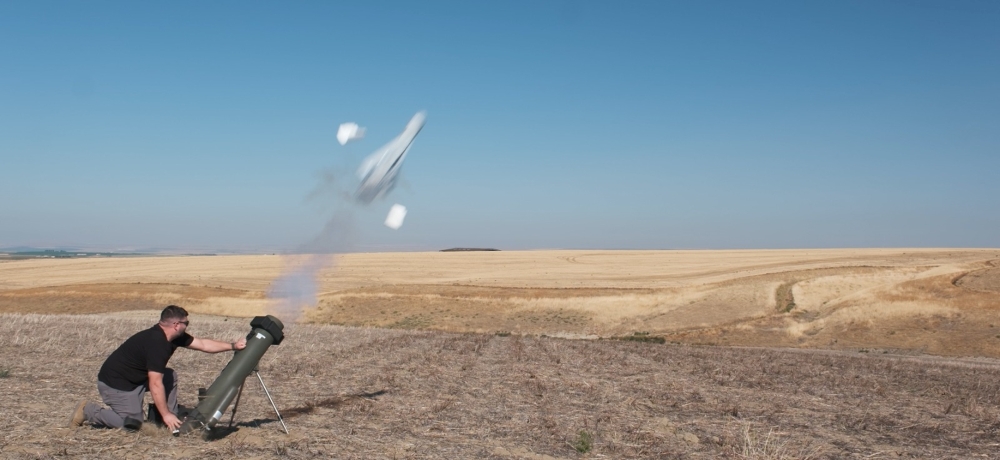
The U.S. Army’s selection of the HERO 90 loitering munition for its Low Altitude Stalking and Strike Ordnance (LASSO) programmes marks an inflection point in how US Brigade Combat Teams (BCT) will hunt armour, as well as in how UVision and Mistral position themselves in the rapidly consolidating loitering munitions market.
A strategic win for UVision and Mistral
For UVision, HERO 90’s selection crowns a decade of incremental combat validation of the HERO family and secures a flagship US reference for its newest anti armour design. The system now moves from export niche to the centre of the world’s most demanding land combat modernization effort, dramatically strengthening UVision’s hand in future US and allied competitions.
For Mistral, the decision validates its strategy of pairing soldier centric targeting solutions with partner effectors. As prime in the US framework, Mistral becomes the integrator that connects HERO 90 into the Army’s sensor to shooter architecture, from Product Manager Soldier Precision Targeting Devices through to brigade kill chains. That role positions the company for follow on work in fire control software, common control stations and MOSA compliant interfaces across multiple effector families.
For the Army, the award is about more than acquiring another drone. LASSO is an urgent programme designed to give dismounted infantry a true man portable, precision anti armour capability, closing a gap exposed repeatedly in Ukraine and the Middle East: small units need organic, beyond line of sight (BLOS) top attack effects against armor and high value targets, without waiting for artillery or aviation.
Meeting LASSO’s demanding requirements
LASSO sets a demanding profile: a single soldier must be able to carry, quickly launch and control a loitering munition able to stalk and destroy armoured vehicles at tactically relevant ranges. HERO 90 is engineered around that exact use case.
First, portability and speed of action. The munition and tube launcher are backpack portable and can be brought into action by a single operator in under two minutes. That aligns with LASSO’s requirement for rapid, on the spot employment by dismounted teams operating in dispersed formations.
Second, lethality and flexibility. HERO 90 offers multiple warhead options, including dedicated anti armour and high explosive variants, enabling top attack kills against MBTs and IFVs while retaining flexibility for softer tactical targets. Mission abort and re engagement features give the operator the ability to wave off when the tactical picture changes, reducing fratricide and collateral damage risk.
Third, integration and digital architecture. The Army has made Modular Open Systems Approach (MOSA) compliance and “Common Control” central to all new soldier borne systems. HERO 90 was designed with open architectures, secure BLOS communications and man in the loop control that can be natively integrated into existing and future soldier systems. Mistral’s experience in precision targeting devices and fire control solutions is key here: it provides the glue between the loitering munition, the soldier’s sights and the wider C4I ecosystem.
Finally, survivability in complex environments. AI assisted tracking and an EO/IR sensor package allow the munition to prosecute moving armour and camouflaged targets in cluttered terrain and degraded visibility, an explicit priority for formations expecting to fight under EW pressure and in urban or wooded battlespaces. Collectively, these attributes explain why the UVision–Mistral bid stood out: it was not simply a ‘drone plus warhead’, but a fieldable, integrated anti armour capability aligned with the Army’s digital fires roadmap.
Battlefield and roadmap implications
On the battlefield, HERO 90 will fundamentally reshape how US Brigade Combat Teams plan and execute anti armour fights. Platoon and company level leaders gain an organic, precision top attack option that can loiter, confirm targets, and strike from angles traditional direct fire weapons cannot achieve. The ability to rapidly launch from a lightweight tube, observe via EO/IR, and dive onto targets with man in the loop control compresses the sensor to shooter timeline and complicates enemy armour manoeuvre.
For UVision and Mistral, LASSO is a springboard. Operational feedback from US soldiers will feed directly into the HERO family roadmap: improved autonomy, extended range, refined warheads and deeper integration with US and NATO digital fires architectures. Success in LASSO will also reinforce their position in parallel programmes worldwide, from European land forces loitering munition tenders to potential naval and SOF adaptations.
In strategic terms, the HERO 90 decision confirms that loitering munitions are no longer a niche adjunct to artillery, but a core building block of Western ground combat doctrine. By securing the Army’s LASSO slot, UVision and Mistral have placed themselves at the center of that doctrinal shift — and put a man portable, precision anti armour ‘sniper round in the sky’ into the rucksack of the US infantryman.




Privacy Policy

Powered by © Mobilbyte s.a.s. Information Technology