



For decades, the European Union has carried the label coined by Belgian politician Mark Eyskens: a “giant economic power and a political dwarf”, sometimes mockingly extended to a “military worm”. Whether fair or not, the formula captured a long-standing paradox: immense economic weight paired with an inability – or unwillingness – to translate it into political and strategic power. The recent crisis between the EU and the United States over Greenland did not overturn this paradigm. But it cracked it, visibly.
When pressure from the United States on Denmark over Greenland escalated – first with territorial demands and then with explicit tariff threats of 10%, potentially rising to 25% – Europe was forced to confront its strategic posture head-on. This was not a routine trade dispute or a rhetorical flare-up. It touched sovereignty, alliance credibility, and the foundations of the transatlantic relationship. For the first time in years, the EU reacted not as a collection of nervous capitals but as a coordinated political actor, deploying its economic power deliberately and consciously, as a weapon.
Europe’s first move was limited but symbolically significant. Ten European (among them eight EU) countries, including France, Denmark, Germany, the UK and the Netherlands, contributed to a joint token military deployment to Greenland. The force was small, operationally negligible, and carefully calibrated. Its purpose was not deterrence in the traditional military sense, but the classical showing the flag(s) . It raised the political cost of any unilateral move and made clear that Greenland was no longer a bilateral issue between Washington and Copenhagen, but a European one. The effect was immediate: expansionist rhetoric gave way to economic coercion. The battlefield shifted from territory to trade, the weapons being tariffs.
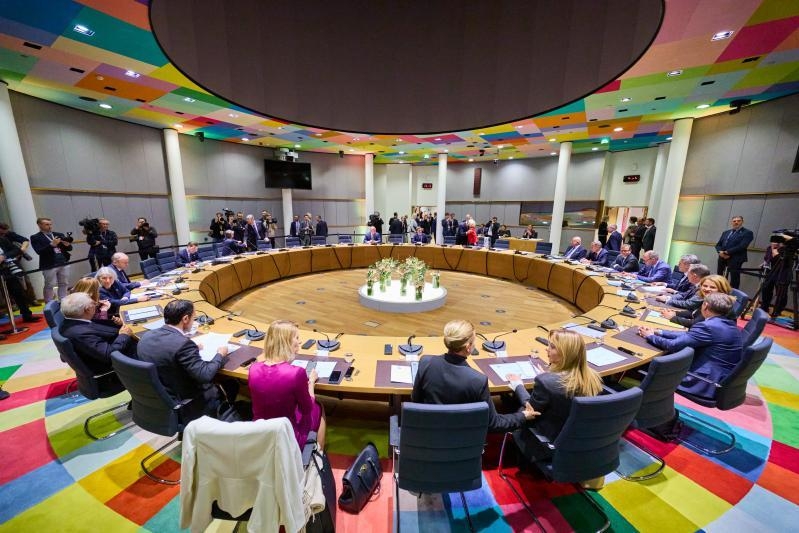
That shift played directly to Europe’s strongest hand. Tariff threats were met not with panic or concessions, but with preparation. At the World Economic Forum in Davos last Wednesday, French President Emmanuel Macron openly invoked the EU’s Anti-Coercion Instrument (ACI) – originally designed to counter Chinese economic pressure – signalling that Europe was prepared to use its most powerful economic defence mechanism even against its closest ally. The political signal mattered more than the instrument itself: Europe was willing to treat economic coercion as a hostile act, regardless of its source. Macron left no room for interpretation: “No intimidation or threat will influence us – neither in Ukraine, nor in Greenland, nor anywhere else in the world when we are confronted.” Whether due to market pressure, political costs, or both, Washington ultimately backed off the tariff threat, referring instead to an understanding reached through talks with NATO Secretary General Mark Rutte.
Despite this de-escalation, Europe did not stand down. An extraordinary European Council confirmed the change in posture. Leaders were prepared to deploy the so-called “trade bazooka”: a €93 billion retaliatory tariff package, prepared the year before and never used. It did not need to be. Its credibility rested on two elements Europe has often lacked in the past – unity and political will. Crucially, leaders acknowledged that the worst-case scenario had been avoided, while agreeing that similar pressures were likely to return. The significance lay less in the conclusions than in the process: no fragmentation, no side deals, no quiet attempts to placate Washington individually. Economic power was being treated as collective strategic capital.
The day after, the European Parliament reinforced this logic by suspending the ratification of a pending trade agreement with the United States. Invested with a direct political mandate and traditionally more outspoken than other EU institutions, the Parliament demonstrated that trade could no longer be insulated from geopolitics. Commercial relations, it made clear, would not proceed under threat. Once again, Europe was speaking with one voice – across institutions.
Diplomacy continued in parallel. NATO Secretary General Mark Rutte and the European Commission worked to stabilise the situation without retreating on substance. Ursula von der Leyen framed Greenland within a broader European Arctic strategy, combining security, investment, infrastructure and integration. The message was layered but coherent: Europe would defend, invest and remain present. Power was no longer singular, but coordinated across economic, political and strategic dimensions.
Meanwhile, the “military dwarf” is beginning – quietly – to grow. European defence initiatives remain limited, but their political meaning is increasing. Even previously taboo debates are resurfacing. Germany is now openly discussing a European role in deterrence alongside France and the United Kingdom, while London itself is moving closer to European defence frameworks. The shift is gradual, but real.
The Greenland episode was therefore both a test and a learning moment. Europe demonstrated that when threatened, it can integrate economic leverage, institutional power, diplomacy and limited military signalling into a coherent response. The battle for Greenland is not definitively won. But the first and most important contest – the battle for credibility – has been.
If sustained, this approach could finally erode Europe’s old label. The Greenland crisis suggests that the familiar formula – giant in economics, dwarf in politics – is beginning to break down. As unity holds, economic power increasingly converts into political weight, revealing an EU that is no longer just economically influential, but increasingly strategic.


Privacy Policy

Powered by © Mobilbyte s.a.s. Information Technology