



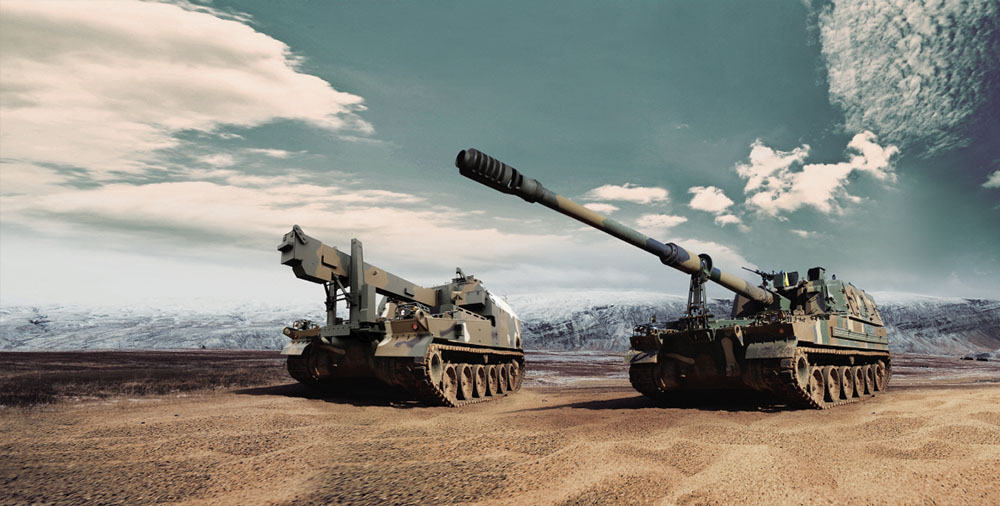
The U.S. Army Combat Capabilities Development Command Armaments Center (DEVCOM-AC) has assigned the US branch of South Korea’s Hanwha (Hanwha Defense USA) a Cooperative Research and Development Agreement (CRADA) to integrate the US government-designed 58-caliber 155 mm cannon into the K9 self propelled howitzer “family”.
Readers will probably remember that the US Army had initially planned to install the 58-calibre ordnance into a modified M109A7 PALADIN, creating the M1299 Extended Range Cannon Artillery (ERCA). The M1299 project was eventually terminated in 2024 after trials were assessed to show unsatisfactory maturity of the system. One particular issue flagged at the time was excessive wear of the barrel, a problem that would not immediately be solved by changing the base vehicle. Compared to the M109 base, however, K9 has probably greater weight margins to accommodate adjustments.
Following the cancellation of the original ERCA plan, the US Army has been looking for alternatives and already in late 2024 it had assigned funding for trials and demonstrations of solutions proposed by Hanwha, BAE Systems, Rheinmetall, Elbit Systems, and General Dynamics. Against this project, now known as the Self-Propelled Howitzer Modernization (SPH-M) program, Hanwha initially proposed the K9 with the current, operational 52-calibre howitzer, itself an update on the 39-calibre of the baseline M109A7 although obviously more modest.
Rheinmetall had already earlier been working alongside BAE to prove that it is possible to retrofit the M109A7 itself with its 155/52 gun, mature from years of use in the PZH2000 and, more recently, in the BOXER RCH155. Firing trials were conducted. Rheinmetall has also entered the BOXER RCH155/52 for trials. BAE Systems Bofors brought its Archer 155 mm wheeled SPH to demonstrate to the US Army in late 2024.
In parallel to the ERCA effort, back in July 2020 the US Army also initiated the quest, still ongoing, for a 155 mm Wheeled Gun System (WGS) primarily aimed at enhancing the artillery component of the wheeled STRYKER Brigade Combat Teams (SBCTs). Hanwha is very much looking to this requirement as well and in October 2025 announced that a wheeled variation of its K9 howitzer is now in production and will be ready for testing in “early 2026”.
The turret developed, which is “platform-agnostic” and can be adapted to various truck bases, is a derivative variant of the turret being developed for the A2 upgrade of the K9, which is to introduce a full autoloader. The initial, Korean base vehicle is understood to be the Doosan DST K239L 8×8 armored chassis already employed by the K239 CHUNMOO rocket launcher. Korean sources have indicated that this A2 turret is already aiming for a new 58-calibre barrel. If confirmed, the Korean firm would have an alternative of its own to offer on the tracked side as well, was the US government-furnished ordnance prove to be a problem.
The separation between the two projects has become “blurred” with the passing of time, and with the proposal of wheeled solutions in the context of SPH-M itself.
The ongoing reduction to the number of STRYKER BCTs in future US Army structure plans might on the other side reduce the priority for the wheeled project.
Hanwha appears however well positioned regardless of how the 2 projects might develop or overtake each other in priority, with the work on 58-calibre ordnance going on in combination to the maturation of the A2 automated turret for both tracked and wheeled solutions.
Follow us on Telegram, Facebook and X.




Privacy Policy

Powered by © Mobilbyte s.a.s. Information Technology