



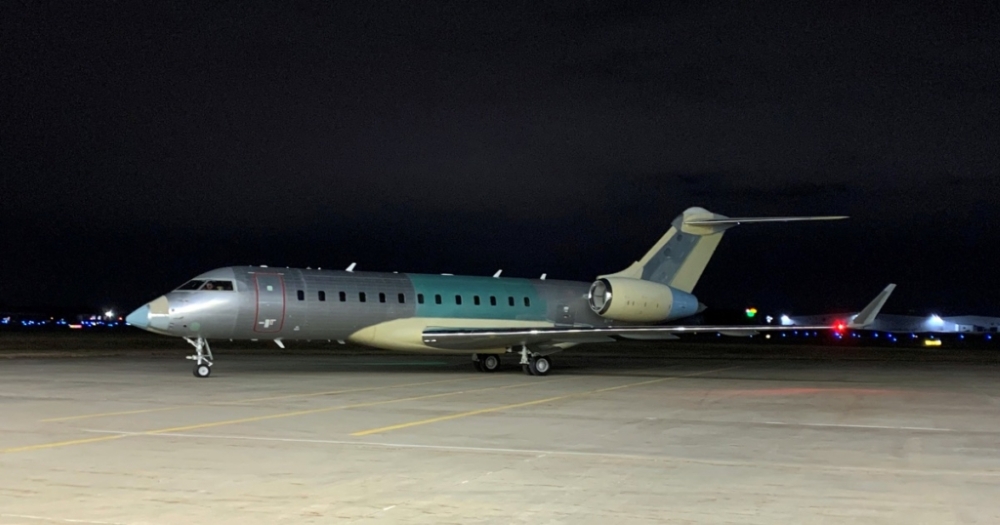
SNC has announced the use of its own funds to procure early a fourth Bombardier GLOBAL 6500 airframe which is destined to become the first “non-prototype” High Accuracy Detection and Exploitation System (HADES) platform for the US Army.
SNC said the early procurement is intended to “reduce integration risk, accelerate certification milestones and insulate the programme from potential supply-chain disruption”, even as the US Army has still to settle an objective size for the HADES fleet of next-generation high-altitude, long-range ISR aircraft.
So far, 3 HADES prototypes are in various stages of completion, with the first aircraft due to enter Army operational service later this year.
The US Army considers HADES the first true Program in its intended Multi Domain Sensing System (MDSS) family of systems, despite using, at present, other converted business jets with various mission systems and sensors, known as ATHENA and ARTEMIS platforms. These aircraft are contractor-owned and operated.
HADES is to deliver “mobile, long endurance converged deep sensing through the collection of Communications Intelligence (COMINT), Electronics Intelligence (ELINT), and Synthetic Aperture Radar/Moving Target Indicator (SAR/MTI) data, combining the various outputs currently separated across various ATHENA/ARTEMIS aircraft in different configurations.
The first 2 prototype HADES are “Increment 1” aircraft that will deliver an Initial capability including COMINT, ELINT, SAR/MTI; and a Modular Open Systems Approach (MOSA) digital backbone. The 3rd prototype, as described in US Army FY 2026 budget documentations, is a “Increment 2” machine meant to integrate “advanced COMINT/ ELINT sensors and modernization upgrades, such as Launched Effects, Electronic Warfare, Artificial Intelligence/Machine Learning (AI/ML).
The GLOBAL 6500 has an endurance of up to 18 hours and it is designed for high reliability and availability, expected to fly up to 750 hours between maintenance intervals with a 99.8% dispatch reliability.
The first HADES is only expected to become operational late this year, with the second following in 2027 and the third in 2028. SNC says that the early procurement of the airframe is the Company’s “response to the Pentagon calls for faster delivery of modern capabilities”. As requested by the Defense Secretary, the Company is taking risks and using own funds to help innovate “on behalf of the Nation”.
As lead systems integrator, SNC is responsible for integrating radar, signals intelligence and electronic intelligence payloads, as well as the onboard processing architecture that allows data to be exploited and disseminated in near real time.
The HADES final fleet size is yet to be decided as part of the Army Transformation Initiative, with initial plans for 12 possibly facing reduction to 6. The importance of the new flying sensors, however, might still lead decisions going ultimately in the opposite direction, especially as the Army at the same time has accelerated the withdrawal of legacy fixed wing aircraft for ISR, such as the RC-12 GUARDRAIL and others.




Privacy Policy

Powered by © Mobilbyte s.a.s. Information Technology