



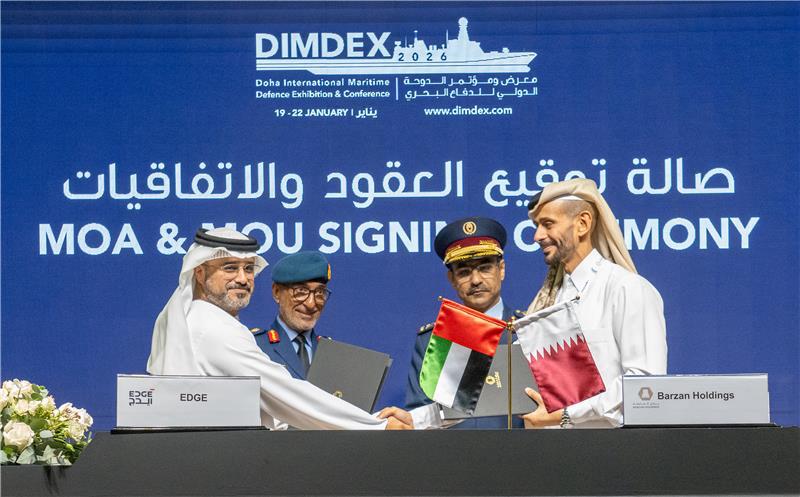
Qatar leveraged the opening days of the Doha International Maritime Defence Exhibition and Conference (DIMDEX 2026) to formalize two strategic partnerships that underscore the Gulf state's evolving approach to defence industrialization: a joint venture with the UAE's EDGE Group focused on advanced technology co-development, and a Memorandum of Understanding with General Atomics Aeronautical Systems (GA-ASI) centred on battle management software.
The agreements, both channelled through Barzan Holdings - Qatar's commercial gateway for military industry – can be read as part of Doha's broader strategic recalibration away from traditional procurement models toward hybrid frameworks emphasizing technology transfer, sovereign capability development, and operational autonomy.
The EDGE-Barzan joint venture: regional defence integration
Signed at DIMDEX 2026 on 20 January, the EDGE-Barzan joint venture establishes a collaborative platform for the co-development of advanced defence technologies across multiple domains. While specific details regarding location, equity structure, and capitalization remain undisclosed, the partnership is designed to support collaborative development in missiles, unmanned systems, satellites, and other critical capability areas.
The joint venture brings together complementary industrial strengths. EDGE Group - established in 2019 through the consolidation of more than 35 UAE defence entities - has rapidly positioned itself among the world's top 25 defence companies, with awarded contracts exceeding AED 60 billion and export sales to 20 countries spanning South America to the Asia-Pacific. The group operates across five core clusters: Platforms & Systems, Missiles & Weapons, Space & Cyber Technologies, Technologies & Industrialisation, and Homeland Security, with particular emphasis on Fourth Industrial Revolution technologies including autonomous systems, cyber-physical integration, advanced propulsion, robotics, and smart materials.
Qatar's Barzan Holdings, meanwhile, serves as the institutional nexus for defence capability development, prioritizing partnerships that deliver knowledge exchange, technology transfer, and long-term industrial sustainment. Through an expanding portfolio of international joint ventures - including established partnerships with Turkey's ASELSAN (BARQ joint venture), Italy's Fincantieri (Omega360 radar systems), and Rheinmetall (advanced technologies) - Barzan has systematically positioned itself as a regional knowledge and technology hub.
EDGE Group CEO Hamad Al Marar framed the agreement in strategic terms: "This joint venture with Barzan Holdings shows the importance EDGE places on trusted partnerships as we expand internationally. It establishes a framework to identify capability gaps across both portfolios and to jointly develop solutions".
Analysts view the partnership as significant for both technological and geopolitical reasons. Indeed, the joint venture could encompass co-development and co-production across small arms, ammunition, maintenance and overhaul capabilities, loitering munitions, and unmanned ground vehicles. The collaboration also signals deepening UAE-Qatar defence-industrial ties following years of regional diplomatic recalibration, with both nations seeking to build resilient, sovereign capabilities while maintaining strategic partnerships with traditional suppliers.
General Atomics-Barzan MOU: software-defined Command and Control
The second major agreement - signed on 19 January between GA-ASI and Barzan Holdings -focuses on the collaborative development of advanced battle management software capabilities. The MOU establishes a framework for cooperation between GA-ASI, its data-focused subsidiary GA-Intelligence, and Barzan Holdings to develop software solutions designed to enhance theatre-level situational awareness and enable efficient processing, correlation, and dissemination of intelligence across multi-domain operational environments.
The partnership is in line with General Atomics' strategic pivot beyond platform sales toward integrated mission systems and intelligence software. While GA-ASI is globally recognized for its PREDATOR family of unmanned aircraft systems - logging more than 9 million flight hours across platforms including MQ-9A REAPER, MQ-1C GRAY EAGLE, MQ-20 AVENGER, and MQ-9B SKYGUARDIAN/SEAGUARDIAN - the company has increasingly emphasized sensor integration, autonomy, and battle management solutions. GA-Intelligence complements these capabilities by integrating hundreds of commercial and government data sources (including intelligence collected by GA-ASI's unmanned platforms as well) to generate comprehensive operating pictures through advanced spatio-temporal data management, multi-source correlation, data fusion, tracking, entity resolution, and multi-domain global situational awareness.
GA-ASI CEO Linden Blue underscored the strategic significance: "Collaboration with Barzan and Qatar is central to GA's approach to delivering operationally relevant, next-generation capabilities. By combining GA's expertise in mission systems and autonomy with Barzan's regional insight and defense focus, we are positioned to advance battle management solutions that significantly improve situational awareness and intelligence exploitation".
The agreement aligns with Qatar's documented priorities for 2026, which emphasize military artificial intelligence, cyber defence, electronic warfare, and sovereign command-and-control systems. It also fits within General Atomics' broader partnership strategy in the region, including collaboration with EDGE Group on integrating UAE-developed smart weapons onto MQ-9B platforms, and agreements with the UAE's Calidus Aerospace on prospective co-production of MQ-9B aircraft and Gambit Collaborative Combat Aircraft.
Strategic implications
As FW MAG underlined in its Special Supplement, both agreements reflect a fundamental recalibration in Gulf defence strategy. Rather than pursuing full self-sufficiency (an economically and technologically unrealistic objective) Qatar is adopting a hybrid model that blends imported platforms with locally developed systems, emphasizing knowledge transfer, industrial localization, and operational autonomy. This approach addresses multiple strategic imperatives. First, it reduces political dependence on any single supplier while maintaining interoperability with allied forces. Second, it supports Qatar’s objectives for economic diversification and high-value job creation. Third, it positions Qatar as a regional hub for defence innovation and technology development, enhancing diplomatic leverage and strategic prestige.
For the broader Gulf Cooperation Council defence ecosystem, the agreements signal accelerating convergence around networked, software-defined capabilities; indigenous autonomous systems development; and joint industrial ventures that pool regional expertise, capital, and operational insight. As traditional procurement models give way to collaborative technology development frameworks, partnerships like those announced at DIMDEX 2026 may represent the emerging architecture of Gulf defence industrialization - one defined by strategic embedding within global innovation networks while building sovereign capacity in critical domains.




Privacy Policy

Powered by © Mobilbyte s.a.s. Information Technology