



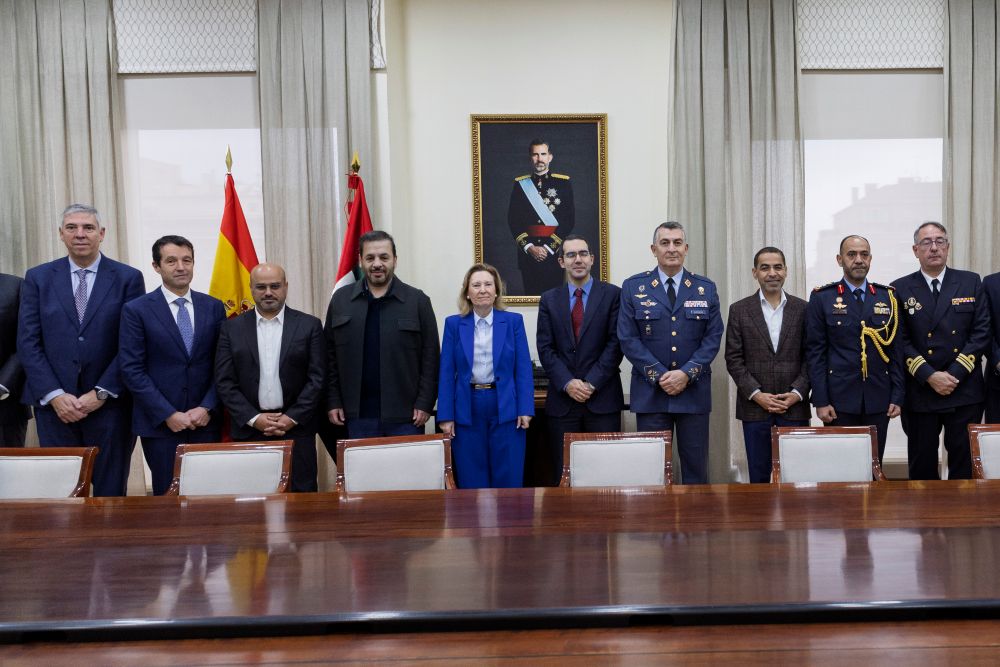
During a ceremony held at Spain's Ministry of Defence on 13 January 2026, UAE-based EDGE Group and Spain's Indra Group formalised an agreement to establish a joint manufacturing entity focused on loitering munitions and smart weapons systems for Spanish and European military programmes. The partnership, witnessed by Spanish Secretary of State for Defence Amparo Valcarce and UAE Ambassador to Spain Saleh Ahmad Salem Al Suwaidi, represents the convergence of strategic, technological, and geopolitical imperatives reshaping Europe's defence landscape in response to rapidly evolving threats.
The joint venture emerges against a backdrop of unprecedented demand for loitering munitions across European armed forces, a requirement accelerated by the lessons of the Russo-Ukrainian War. The partnership addresses this surging demand, with production centred on two new Spanish facilities. Indra will invest between €15-20 million to develop a dedicated drone manufacturing plant in Villadangos del Páramo, León, capable of employing 200 personnel at full capacity, while simultaneously establishing a cutting-edge micro-engine production facility in Valladolid. The León location holds particular strategic significance, as it houses the Udrume, Spain's specialised military drone unit, creating natural synergies between production and operational requirements.
EDGE brings expertise in autonomous loitering munitions through its HUNTER family of systems, which range from the man-portable HUNTER 2-S - with its 13kg maximum take-off weight, 2kg payload, and 50km range - to the more capable HUNTER 5 and HUNTER 10 variants that can strike targets up to 100km from launch. These tube-launched, fixed-wing systems incorporate autonomous navigation and man-in-the-loop target designation, capabilities that have proven decisive in contested environments from Azerbaijan's 2020 operations against Armenia to ongoing operations in Ukraine, and which lessons learned have been driving the development of plenty of loitering munitions worldwide.
For EDGE, the Spanish venture represents a "decisive step" in the company's aggressive European expansion strategy, according to Managing Director and CEO Hamad Al Marar. Established in November 2019 as part of the UAE's strategy to achieve technological sovereignty, EDGE has rapidly evolved from a domestic consolidation of more than 35 entities into an international defence conglomerate. EDGE's strategy emphasises joint ventures with foreign partners as vehicles for technology transfer and market penetration, with export revenues accounting for over 50 percent of total sales as the company actively seeks to become 'self-sufficient' through international markets
The Spanish partnership grants EDGE its first European manufacturing footprint for loitering munitions, positioning the company to address "the scale and urgency of European defence requirements" while building in-country production capabilities aligned with European sovereignty mandates. This approach mirrors EDGE's earlier successful collaboration with Leonardo, where a 51-49 joint venture secured access to Italian technology and markets, and its landmark $7 billion deal with Indonesia for localised production of air defence systems, infantry fighting vehicles, and cyber capabilities.
For Indra, the partnership advances CEO José Vicente de Los Mozos's ambition to establish the company as "a European reference in the drone industry". Indeed, Indra is executing its "Leading the Future" strategic plan through aggressive international expansion and technology acquisition. The company’s acquisition of Aertec’s drone division in 2025 and its strong footprint in the European Defence Fund – with participation in more than fifty EC funded defence R&D projects since 2018 – underscore its institutional capacity to lead complex, multinational defence programmes.
The loitering munitions venture enables Indra to "rapidly respond to the needs of the loitering munition market, a segment of strong attractiveness experiencing accelerated growth". More strategically, it positions Indra to capitalise on the transition from research and development funding under the European Defence Fund to large-scale procurement programmes under the forthcoming European Defence Industry Programme (EDIP), where Spain seeks to leverage its proven capabilities in command and control, naval systems, and air defence.
Spain-UAE relations: defence cooperation as bilateral cornerstone
The EDGE-Indra partnership represents the maturation of Spain-UAE defence relations that have evolved significantly since the Defence Cooperation Agreement of 21 October 2012. The entry into force in 2023 of the Classified Information Exchange Agreement (signed in Abu Dhabi in 2018) provided the essential legal framework for advanced technology collaboration, specifically to "guarantee the protection of classified information exchanged in the course of military, technical-military scientific-technical or any other type of cooperation".
For Spain, the UAE partnership aligns with Madrid's Defence Industrial Strategy 2023, which prioritises building Spanish defence technological and industrial base (DTIB) capabilities within the broader European context whilst maintaining national strategic autonomy. Spain's approach emphasises that "national strategic autonomy is to satisfy all possible industrial and military capabilities through the national defence budgets and the Spanish DTIB, without depending on third parties". The UAE collaboration provides capital, technology access, and export market opportunities without compromising Spain's autonomy within NATO and EU frameworks.
For the UAE, the Spanish partnerships is part of Abu Dhabi's strategy to diversify technological suppliers beyond traditional partners such as the United States, France, and the United Kingdom. With an annual defence budget exceeding $22 billion, the Emirates has shifted priorities toward establishing sovereign industrial capabilities and becoming a defence technology exporter rather than solely an importer. EDGE's collaboration with Indra (particularly the technology transfer inherent in joint production of advanced radars and loitering munitions) advances this objective whilst positioning the UAE as a credible industrial partner for European nations seeking to expand their defence industrial capacities.
The presence of senior government officials at the 13 January signing ceremony - including Spain's Secretary of State for Defence, the General Director of Industrial Programmes from the Ministry of Industry, and the UAE Ambassador- underscores the bilateral political commitment underpinning this industrial partnership. The ceremonial gravitas reflects recognition by both governments that defence industrial cooperation has become a cornerstone of Spain-UAE relations, transcending purely commercial considerations to encompass strategic alignment on European security, technological sovereignty, and industrial policy.
The success of this partnership will now depend on execution across manufacturing scale-up, technology integration, and navigation of complex European procurement frameworks that increasingly prioritise both sovereignty and interoperability. Yet the strategic logic is compelling: in an era of great power competition and technological disruption, European defence sovereignty may increasingly be achieved not through autarky but through carefully calibrated partnerships that expand industrial capacity, accelerate technology adoption, and diversify supply chains whilst maintaining European ownership of core capabilities.




Privacy Policy

Powered by © Mobilbyte s.a.s. Information Technology