



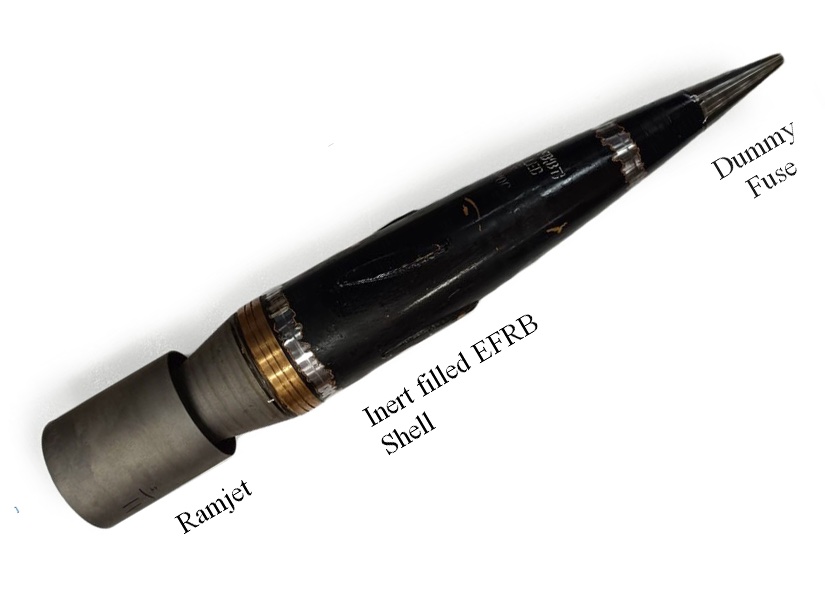
Researchers at the Indian Institute of Technology, Madras (IIT-M) have developed ramjet-assisted artillery shells for the Indian Army. Posting on its official X handle, @iitmadras, the institute stated that the ramjet-assisted artillery shells could extend the range of existing Indian artillery systems by up to 50%, without any loss in lethality.
In partnership with the Indian Army, IIT-M researchers replaced the conventional base-bleed unit in a standard 155 mm artillery shell with a ramjet propulsion unit. The principal design challenges associated with the development of the ramjet-assisted artillery shells included the limited combuster length available within the projectile, development of a suitable propellant and the extreme acceleration and G-forces experienced during firing.
The resulting projectiles are capable of achieving significantly extended ranges, enhancing the Army’s operational flexibility for long-range fires once development is completed and production commences.
Development of the ramjet-assisted artillery projectile commenced in 2020 with the support of the Indian Army. Initial trials were performed on a 76 mm gun (developed by IIT-M), followed by testing on 155 mm artillery guns. Developmental trials, including extensive gun and field tests were performed at the School of Artillery at Deolali and the Pokhran Field Firing Range in September and December last year, respectively.
According to IIT- M, these tests successfully validated clean gun exit, stable flight and reliable ramjet ignition of the modified artillery shells.
The trials demonstrated substantial range improvements when compared with conventional 155 mm artillery shells. When fired from India’s indigenously developed 155 mm/52-calibre Advanced Towed Artillery Gun System (ATAGS), the ramjet-assisted projectile achieved a range of approximately 70 km, compared with around 40 km for a conventional projectile. When fired from the K9 Vajra-T 155 mm/52-calibre self-propelled howitzer and the Dhanush 155 mm/45-calibre towed howitzer, the achieved ranges were 62 km and 55 km, respectively, compared with approximately 36 km and 30 km using conventional ammunition. The Dhanush is an upgraded version of India’s original 155 mm/39-calibre Bofors howitzer, which was acquired in the late 1980s.
IIT-M is also working on ramjet-powered Fin Stabilized Armour Piercing Discarding Sabot (FSAPDS) shells for Indian Main Battle Tanks (MBT), such as the Russian T-72/T-90. The institute also partnered in 2024 with Munitions India Limited, which is a state-owned armaments enterprise to develop precision-guided 155 mm 39 /45 cal artillery shells that would have a Circular Error Probable (CEP) of 10 metres.




Privacy Policy

Powered by © Mobilbyte s.a.s. Information Technology