



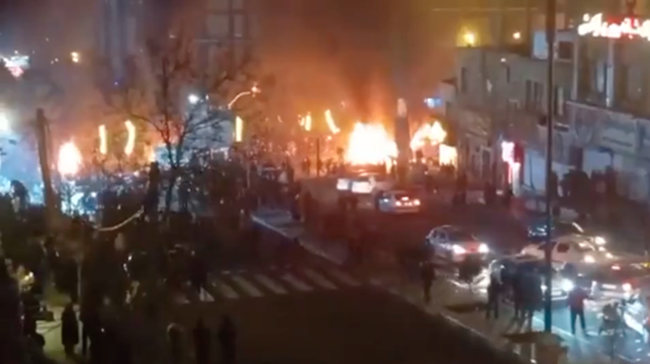
The Iranian regime is brutally suffocating the internal uprising. The internet blackout remains in place, and the Pasdaran are currently engaged in jamming Starlink in order to prevent those with access from continuing to document the slaughter.
Because this is, indeed, a slaughter: the number of fatalities is, regrettably, far higher than those reported so far, even by opposition sources. Moreover, jamming Starlink is by no means straightforward, and it cannot be ruled out that “some friends” may be lending a hand (Russians? Chinese?).
For the regime, however, the situation is anything but simple, and the Ayatollahs have never been as weak as they are today. The Twelve-Day War was devastating for the regime’s image; the so-called Axis of Resistance has been swept away; and the internal economic crisis is severe. The rial is virtually worthless, the water crisis - driven by drought and chronic mismanagement - is biting hard, while the energy sector is weighed down by embargoes, sanctions, and a lack of technological innovation. A clear indicator of the depth of the crisis is that, alongside the youth, the bazaaris have taken to the streets: the merchant class that has long formed the backbone of Iranian society and economy (and whose mobilisation was crucial to the success of the 1979 Revolution).
In short, the regime is on the ropes and likely only needs a shove to be knocked down. President Trump is weighing whether - and when - to deliver that push. Iran is a large, complex country with a deeply rooted imperial tradition. One possible strategy would be to dismantle the regime’s structure by striking the Pasdaran and the Basij through a prolonged air and missile campaign, aimed at accelerating the internal crisis. Not a single raid, but precisely a campaign - lasting weeks, if not months - persistent and deep.
Another option would be to avoid direct military intervention and instead pursue a multilayered hybrid and cognitive campaign (partly already under way), focusing on systematic cyberattacks, “wet operations,” the creation of structured internal opposition fronts, a further tightening of sanctions and embargoes, and so forth. A sustained crescendo of actions below the threshold of open conflict, designed to expose - up to the breaking point - all the internal contradictions of a regime that has lost strength and legitimacy, surviving only through bureaucratic sclerosis. The options, therefore, are many.
The real problem is the aftermath. The Shah’s son (expected tomorrow at Mar-a-Lago) does not appear to command broad support, nor does he seem capable of unifying the highly fragmented opposition. There is also another risk - which could, in fact, turn into an opportunity: a violent confrontation between the Pasdaran and the Artesh (the conventional Armed Forces). A bloody clash, resolved over the medium term, from which a nationalist figure might ultimately emerge - capable of stabilising the situation and very slowly steering the country out of the Ayatollahs’ era, while also normalising relations with the West. But nothing is guaranteed, not least because, in the event of external attacks, the Artesh has so far always sided the Pasdaran.




Privacy Policy

Powered by © Mobilbyte s.a.s. Information Technology