



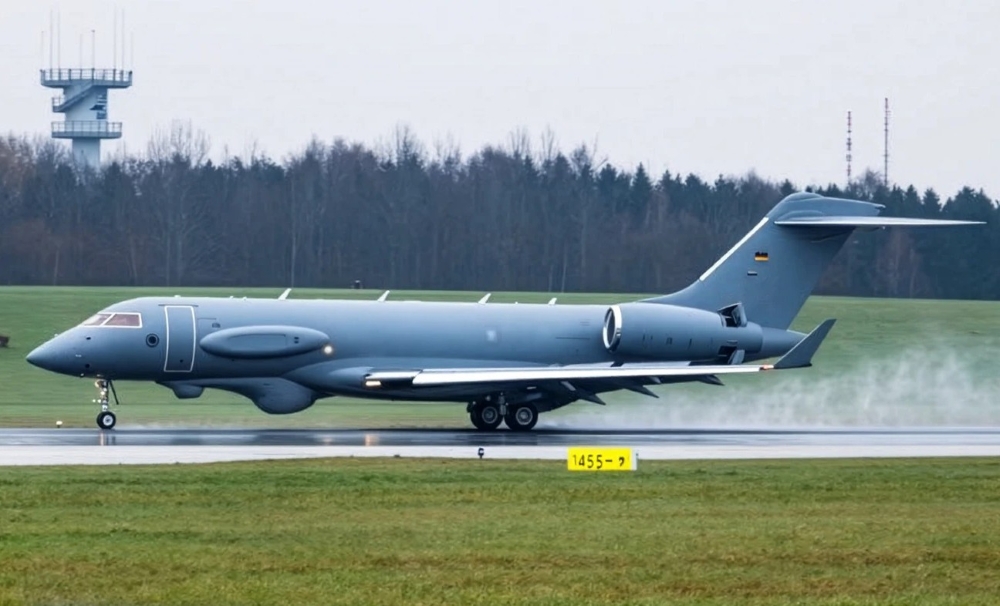
The first of three Bombardier GLOBAL 6000 aircraft destined for Germany's PEGASUS airborne signals intelligence programme has landed in Hamburg, marking a decisive step towards operational capability for the Luftwaffe. The aircraft touched down at Lufthansa Technik's headquarters last week following its transatlantic flight from Bombardier's Wichita, Kansas facility, where it underwent extensive structural modifications.
The arrival initiates the crucial phase of mission system integration and certification in Germany, transitioning the programme from platform design and development in the United States to full implementation at Lufthansa Technik Defense's Special Mission Aircraft Competence Centre. This milestone comes after the aircraft completed its maiden flight in September 2024, demonstrating the successful structural modifications required to accommodate the advanced SIGINT suite.
Configuration and capabilities
The PEGASUS platform represents a significant technological leap for the Bundeswehr, providing an entirely new strategic airborne SIGINT capability that Germany has not historically possessed. At the heart of the system lies Hensoldt's KALAETRON INTEGRAL reconnaissance solution, a fully integrated signals intelligence suite that seamlessly combines communications intelligence (COMINT) and electronic intelligence (ELINT) capabilities within a single platform.
The KALAETRON INTEGRAL system covers an exceptionally broad frequency range from 20 MHz to 40 GHz, providing continuous electromagnetic spectrum coverage. This wide-bandwidth capability enables the simultaneous detection and analysis of both communications signals and radar emissions, representing a fundamental departure from traditional approaches that treat COMINT and ELINT as separate domains. The system leverages artificial intelligence and machine learning to reduce operator workload, enabling faster decision-making and more efficient signal classification during operations. Visually, the modifications are substantial. The aircraft features distinctive sensor fairings mounted on the forward fuselage sides and a prominent two-pronged installation beneath the fuselage, housing the antenna arrays required for the wide-spectrum collection mission. These external modifications were completed at Bombardier's Wichita facility before the aircraft's return to Germany.
The GLOBAL 6000 platform itself provides exceptional operational characteristics for the intelligence mission. With a maximum range of 6,000 nautical miles, a service ceiling of 51,000 feet, and endurance characteristics suited to prolonged surveillance operations, the aircraft can maintain significant standoff distances from potential threat areas whilst conducting collection. Hensoldt claims the KALAETRON INTEGRAL sensors can detect emissions at ranges up to 250 miles, allowing the platform to operate safely beyond the reach of most tactical air defence systems. At Lufthansa Technik's Hamburg facility, engineers will now integrate the SIGINT mission cabin, install additional military communications systems, and complete both civil and military certification processes. Preparations for entry-into-service support are already underway, including training programmes for technical and flight personnel and the creation of comprehensive technical documentation.
Strategic importance to Hensoldt
For Hensoldt, the PEGASUS programme constitutes a cornerstone project that validates the company's position as Germany's national champion in electromagnetic warfare and a leading European sensor systems integrator. The contract, awarded in June 2021, is valued at approximately €1.05 billion and forms part of the overall €1.54 billion PEGASUS programme, which includes not only the airborne platforms but also ground stations, training facilities, and data analysis capabilities.
As general contractor, Hensoldt holds overall responsibility for the realisation of the complete PEGASUS weapon system, positioning the company at the apex of a sophisticated industrial consortium involving nearly 30 German firms. This leadership role reinforces Hensoldt's strategic positioning in Germany's defence industrial base at a time of unprecedented growth in European defence spending.
The successful development and delivery of KALAETRON INTEGRAL is key to the company to demonstrate its maturity in software-defined defence (a core element of the company's "North Star" corporate strategy). The system's fully digital architecture, AI-enhanced automation, and platform-agnostic design philosophy provide pathways for future applications across manned and unmanned platforms, potentially creating additional revenue streams beyond the initial PEGASUS order.
Financially, PEGASUS has contributed significantly to Hensoldt's robust performance. PEGASUS milestones, including customer acceptance testing of the mission system design in late 2023, triggered important cash payments that bolstered the company's financial position.
Beyond financial metrics, PEGASUS also enhances Hensoldt's credibility with international customers seeking advanced airborne SIGINT capabilities, particularly as Germany and European allies increasingly seek sovereign alternatives to dependence on external intelligence sources. Industry experts anticipate potential expansion of the Luftwaffe's PEGASUS fleet beyond the initial three aircraft, with reports suggesting Germany may order up to nine units total to address growing operational requirements and reduce reliance on allied intelligence.
Bombardier Defense's strategic positioning
The PEGASUS programme holds substantial strategic significance for Bombardier Defense as well, representing a high-profile validation of the company's renewed push into the military special missions market after years of relative dormancy in the defence sector. Bombardier formally established its Defense division as a separate entity in 2022 to capitalise on the growing adoption of business jets for intelligence, surveillance, and reconnaissance missions.
As FW MAG already reported, the GLOBAL 6000 platform's selection by Germany joins an expanding portfolio of military derivatives that demonstrate the viability of business jet platforms for demanding government missions. The special missions market represents a strategic hedge for Bombardier as military forces worldwide seek alternatives to traditional - and often more expensive - dedicated military airframes. Business jets offer superior fuel efficiency, lower acquisition costs, advanced avionics derived from commercial development, and access to Bombardier's global support network. With more than 500 special mission aircraft delivered and over three million operational fleet hours accumulated, Bombardier Defense can credibly position itself as an established partner for sensitive government programmes.
PEGASUS also provides international marketing leverage, particularly in Europe, where defence budgets are expanding and requirements for strategic ISR capabilities are growing. The programme showcases Bombardier's ability to collaborate with European partners - in this case, Hensoldt and Lufthansa Technik - on complex integration efforts whilst supporting sovereign industrial capabilities.
Path to operations
The three PEGASUS aircraft are destined for Tactical Air Force Wing 51 "Immelmann" at Schleswig-Jagel Air Base in northern Germany. The wing, which currently operates Panavia TORNADO aircraft in reconnaissance, electronic warfare, and maritime strike roles, will establish a third squadron specifically for PEGASUS operations.
The first aircraft is scheduled for delivery to the Bundeswehr in 2027, with the remaining two following in 2028. Basic operational qualification is planned for 2027, providing the Luftwaffe with a capability that directly fills the gap left by the retirement of the Breguet BR1150 ATLANTIC SIGINT aircraft in 2010.




Privacy Policy

Powered by © Mobilbyte s.a.s. Information Technology