



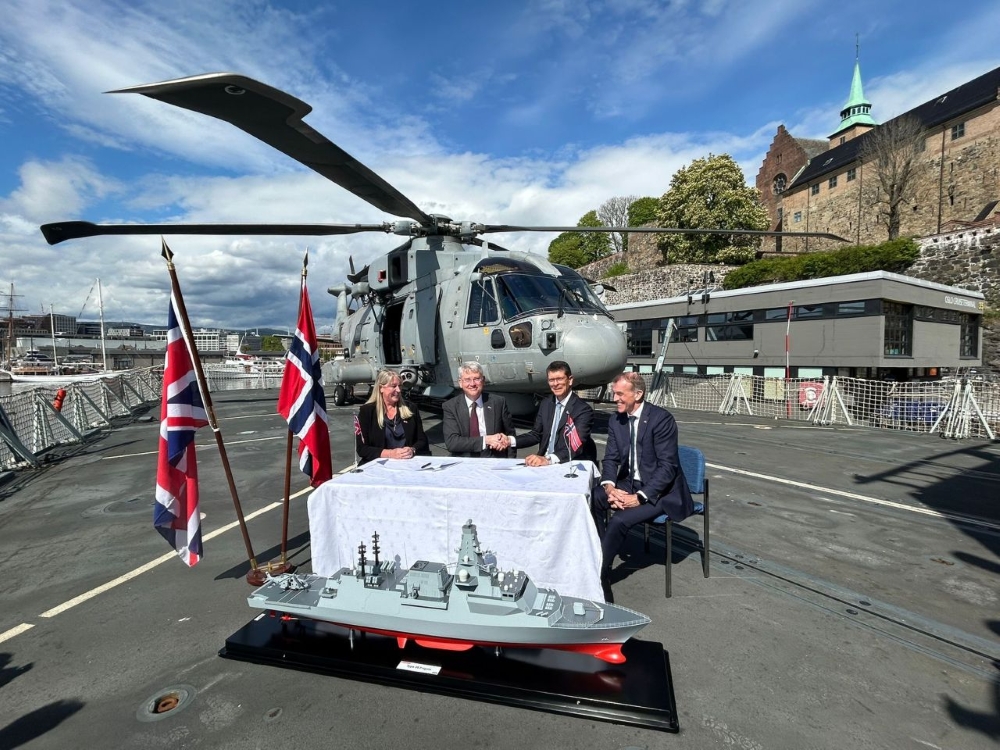
Norwegian Prime Minister Jonas Støre’s visit to the UK on December 4 marked the signing of the expanded Defence deal between the two Countries, which was being worked upon in particular following the official selection by Norway of the Type 26 frigate for its future needs.
The new deals have been called the “Lunna House Agreement”, from the name of the house in the Shetland Isles that served as headquarters in Scotland for the Norwegian resistance during the Second World War.
The most notable development is the confirmation that the UK will join Norway in the development of a new class of multirole, modular ships that the Royal Navy will, in particular, use as the motherships for its Mine Hunting Capability (MHC) program. Under known plans, the Royal Navy will be procuring at least 3 such vessels for entry in service between 2029 and 2031 as replacement for the current remaining HUNT and SANDOWN-class MCM vessels. The “Offshore Support Vessels” will serve as motherships for the MHC suite of mine-countermeasure drones for out of area operations, with HMS STIRLING CASTLE intended to deliver “home waters” service.
This official confirmation does not surprise and comes after the Royal Navy already last year had awarded Norway’s Kongsberg a first contract for a six months study over the organisation of modular spaces and launch & recovery arrangements. Kongsberg has a template for these necessities that it markets under the name VANGUARD.
The selection by Norway of the British Type 26 obviously reinforced expectations that a “return deal” would follow.
Building on the Type 26 and on P-8 POSEIDON, the two Countries have also agreed to work together on the BAE Systems STINGRAY torpedo. The UK already plans to integrate STINGRAY on P-8 and is also looking at developing a vertical launch, rocket-propelled, long-range STINGRAY variant for the Type 26 MK41 VLS.
The development of a new Mod 2 STINGRAY is underway and the torpedo had already been selected by Germany as well, under the auspices of the Trinity House bi-lateral agreement with London.
Wider cooperation on P-8 POSEIDON is unsurprisingly part of the deal and the two PMs have visited the RAF P-8 force in RAF Lossiemouth.
ASW and seabed security operations in the North Sea will see the two Navies operate a “common fleet” of (eventually) at least 13 Type 26 frigates, supported by uncrewed systems. Although details at this stage are scarce, Norway will adopt, wholly or partially, the systems that the Royal Navy will eventually adopt under project CABOT (ATLANTIC NET / ATLANTIC BASTION) to develop a persistent “ASW barrier” which is envisaged, in the longer term, to include autonomous surface vessels (“Type 92 sloops”) and uncrewed submarines (“Type 93 Chariot”). In the shorter term, smaller deployed sensors, UUVs and underwater gliders will be rolled into use, with systems such as Helsing’s FATHOM glider to begin experimentation already this month.
Norway is due to select a new ASW helicopter to embark on the new frigates and the Leonardo AW101 MERLIN, as used by the Royal Navy (and, in SAR variant, by Norway itself), is a contender, with the AW-159 WILDCAT a possible, if less likely alternative and the american MH-60 seen as favourite.
An early Norway-side press report suggested UK – Norway deal will soon extend to helicopters and not only in the ASW area: a joint AW-149 order has been flagged, which would signal the progression of the UK’s much delayed New Medium Helicopter project on one side and, apparently, the fulfilment of Norway’s Special Forces requirement (for which an FMS authorization from the US for 9 HH-60W helicopters was received earlier this year).
The article, which was soon taken offline, suggested British and Norway AW-149 would jointly operate out of Bardufoss, the base in Norway which routinely supports UK helicopters involved in Royal Marines training in the High North.
The deal does promise an “increased” UK commitment to the High North with “year-round training of Royal Marines in Norway” and, possibly, more forward storage of equipment (the UK already maintains some kit at Camp VIKING). In practice, at this stage it’s impossible to say how much of a change should be expected from the already regular pattern of key training exercises which make up the main events of the Royal Marines’s yearly calendar.
The deal also reiterates that the Royal Navy is “adopting advanced Norwegian Naval Strike Missiles” but it’s again impossible to say if this implies any extension to known (and slowly progressing) plans to fit 11 Royal Navy vessels with NSM. So far, 3 Type 23 frigates have received NSM.




Privacy Policy

Powered by © Mobilbyte s.a.s. Information Technology