



An explanatory statement released by the Senate Appropriations Committee alongside a draft bill over the proposed funding for the Department of Energy in FY 2027 contains a notable allocation of $77.1 million to a previously unknown B94 designation.
The B denotes an air dropped nuclear bomb, with 94 being the expected serial for a new development since there is already a 93, although a W: the W93 is the new warhead in development for the TRIDENT submarine-launched ballistic missile.
There is not yet a detailed official explanation of what the new bomb is and what are the requirements behind it, so only hypothesis can be advanced for the moment. There is only one known, operating project which is meant to deliver a new air-delivered nuclear weapon for the purpose of defeating hard and deeply buried targets.
This project, a newly launched activity within the Fiscal Year 2025 USAF budget, appears in documents as the ‘Nuclear Delivery System – Air (NDS-A)’ and is a new-start design responding to “a capability gap identified in the 2022 Nuclear Posture Review”. Congress mandated a study upon the concerns evidenced by the NPR which was eventually endorsed to give birth to the new nuclear project, nestled within the wider “Hard and Deeply Buried Target Defeat System prototyping” voice within the USAF’s Research, Development, Test & Evaluation budget.
Documents since March 2024 have detailed how the USAF will work with the Department of Energy to detail the “body” of the bomb and the necessary “environmental” data for the Nuclear Explosive Package (NEP) to be safe from storage to flight all the way to drop on target and detonation.
“Several” different NEP options would be modeled to determine the most suitable. From the very beginning, it was detailed that F-15E and B-2 test assets from the USAF would be employed for the necessary (obviously non-nuclear) tests with the final prototype demonstration planned specifically on B-2.
The project as listed in the FY 2025 documentation extended to FY 2029 with a projected overall budget of some 352 million. The objective was openly described as fielding a bunker-busting solution rapidly, within a compressed period of time. Knowing this, the apparition of a B94 is assumed to be directly related to the project and suggests a NEP design might have been firmed up.
Such a bunker-buster nuclear warhead would de-facto provide a specialized replacement for the B61-11 variant of the B61 family, the only one optimized for Hard and Deeply Buried targets.
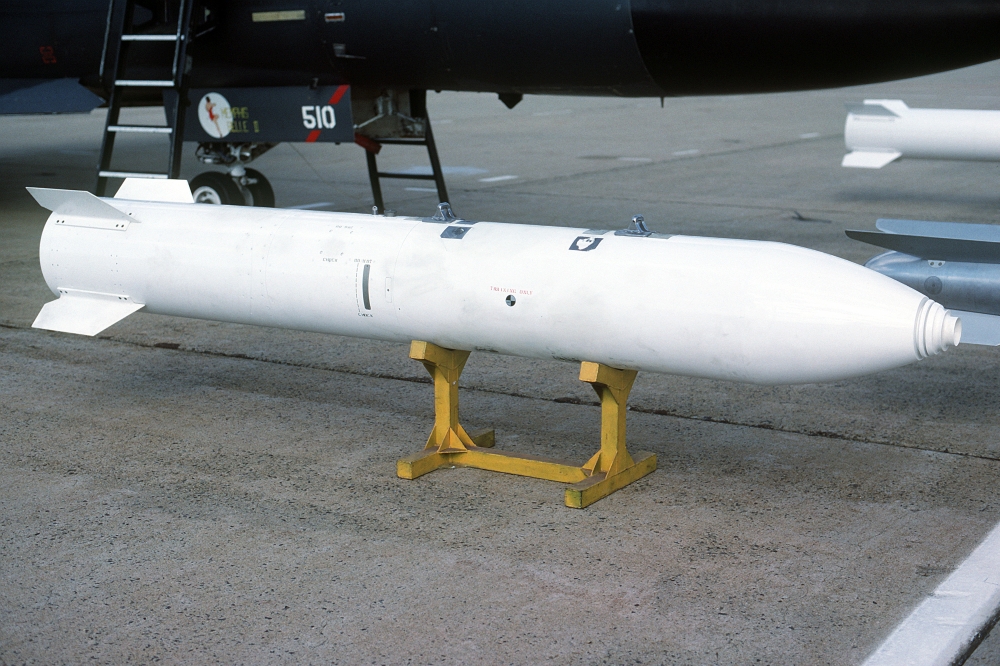
In some ways it would also replace the B83-1 (pictured), a bomb which is not really meant to penetrate deeply into targets, but which had an anti-bunker role by virtue of its massive Megaton-class yield. The B61-11 does not go beyond 400 Kilotons but has a hardened body meant to penetrate underground.
The same document also lists funding for the W80-5 in the context of the Submarine Launched Cruise Missile, providing another, definitive confirmation that the W80 family is intended to deliver the warhead for this new weapon system. The W80-4, a life-extension and rebuild of existing warheads, is to equip the air-launched LRSO cruise missile for the USAF.



Privacy Policy

Powered by © Mobilbyte s.a.s. Information Technology