



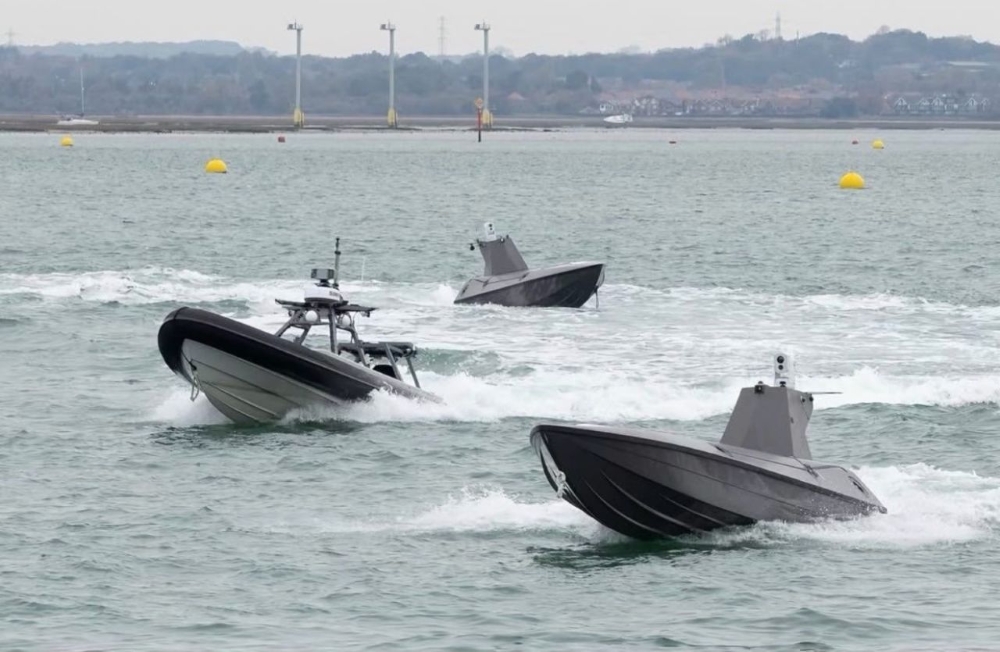
On November 5, the Royal Navy formally commissioned its 1st Autonomous Squadron, a unit base-ported in Portsmouth which is in charge of the Uncrewed Surface Vehicles used for experimentation and surveillance. The Royal Navy of course already operated USVs, before, in particular in the 3 Squadrons of the Mine & Threat Exploitation Group (MTXG) – Yankee Sqn, X-Ray Sqn and Zulu Sqn – for the Mine Counter Measures role, but those USVs are still most frequently seen with a crew onboard.
The 1st Autonomous Squadron operates fully uncrewed boats of essentially 2 types (at least those officially recognized as in service), the RATTLER and BEEHIVE. “At least 7” RATTLERs were procured months ago with the distinction of having been the first Royal Navy USVs to be entirely crewless by design, rather than optionally manned platforms. 7.2 meters long, the RATTLER is based on a rigid inflatable boat (RIB) hull fitted with autonomy packages and “a variety of other systems and services”. They can be pre-programmed with mission profiles, navigational routes and can work together as a ‘wolf pack’ on operations.
The RATTLER was quickly developed alongside a number of SMEs and delivered primarily through Syos Aerospace.
More recently, with a process initiated in late 2025, 20 BEEHIVE have been added. Those are K3 USVs by Kraken. The K3 family includes the SCOUT type, 8.4 meters long and displacing no more than 2500 kg, the HEAVY at 11.1 meters of length and the MAX which pushes dimensions up to 18.6 meters with a payload of up to 10 tons.
The SCOUT (which is believed to make up the entirety of the RN flotilla at present) has a payload of 600 kg, with some modular spaces available in the hulls which have been proposed for various uses, including for launch and recovery of DIODON small drones (a French design which can land on water). The SCOUT can sail at 55 knots speeds and travel up to 650 NM at 25kts. It is proposed for use in a multitude of missions, from anti-ship strike to casualty evacuation, with various ISR and EW fits in the middle.
The K3 series is low-observable and has been designed from the keel up for autonomous, crewless operations.
1 AS is described as having 180 personnel assigned, enough to operate “two watches to sustain operations around the clock”. The Squadron’s first commander, Cdr Helen Copson, has been charged with “building a fighting unit that turns autonomous systems into dependable operational advantage”, advancing the integration of USVs in Royal Navy operations and delivering surveillance in home waters in particular.
The full range of capabilities available to the Sqn, and the exact number of drones, remain undisclosed. One capability confirmed to be heading for active service is that of radar surveillance with the fitting of Saab GIRAFFE 1X radar onto the K3 USV. Experimentation has been carried out in the past few months and now a 15 million pounds order for new 1X sets has been placed, enough to equip “several” more of the drones.
It is believed that the GIRAFFE 1X fit has been born out of Project HORUS, initiated early in the year to urgently acquire a USV-mounted “early warning” capability to deploy up-threat for the detection of surface and air targets, in particular drones and sea-skimming missiles.
The GIRAFFE 1X-equipped K3 will soon be supported by a number of USVs fitted with kinetic counter-drone interceptors. The MoD has not yet disclosed the type of interceptor and the supplier selected, but it says trial firings of a UK-built counter-drone interceptor have already been completed, and the first launches specifically from the K3 will follow “shortly”.
The UK MoD already operates at least one C-UAS interceptor, the SKY HAMMER by Cambridge Aerospace, while also co-producing OCTOPUS with Ukraine.
In January, Project GOSHAWK was launched to look at another low-cost, low-level C-UAS interceptor development, and funding has also been awarded to Cambridge Aerospace, Greenjets and Frankenburg under the ‘Low-Cost Air Defence Effectors’ initiative by the National Armaments Director Group as part of a wider European effort known as Low-Cost Effectors and Autonomous Platforms, or LEAP.
SKYHAMMER is a subsonic, tube-launched interceptor powered by a turbojet engine. It weighs approximately 18 kilograms, measures under 1 metre in length with a wingspan of 1.3 metres, and reaches a top speed of 700 kilometres per hour. The system is equipped by an X-band radar seeker enabling all-weather operations and uses a blast-fragmentation warhead to destroy drones in flight. It has been extensively tested in the UK and also demonstrated in Jordan. The UK is believed to have urgently deployed it in the Gulf as part of wider efforts to defend bases and Allies in the region from the Iranian drone attacks.
Cambridge Aerospace claims is working at a new facility which is supposed to enable production to scale up to as many as “2,500 units per month”. Cambridge Aerospace also has plans for a more ambitious, supersonic interceptor with greater usefulness also against cruise missiles, the STARHAMMER. It’s not clear if the latest UK award will back this further development.
Greenjets is using MoD funding to further mature its KESTREL interceptor. KESTREL is electric powered and uses two ducted fans for propulsion. It is aiming at speeds as high as Mach 0.8. Frankenburg’s work under the MoD award was specifically focused on air-launched drone interceptors. In their press release they announced that they will “focus on “further developing, integrating and trialling the air-launched version” of their guided Mark I air defence missile”.
The Mark I is however also being proposed for naval applications, in particular in cooperation with Babcock. The interceptor soon to appear on K3 might be connected to any of these, or be a further, separate development.
Containerized launchers for an undisclosed drone interceptor have meanwhile been embarked on the Type 45 HMS DAUNTLESS, and this launcher is expected to appear on other destroyers going forward. The Royal Navy is not yet disclosing details but this containerized solution might have been spawned by Project METIS or TALON, RFIs released early this year with the aim of fielding similar solutions. METIS was particularly aimed at embarkation on medium-large USVs (which the Royal Navy does not yet field although a first is planned for the new year), while TALON specifically mentioned the use aboard existing warships.



Privacy Policy

Powered by © Mobilbyte s.a.s. Information Technology