



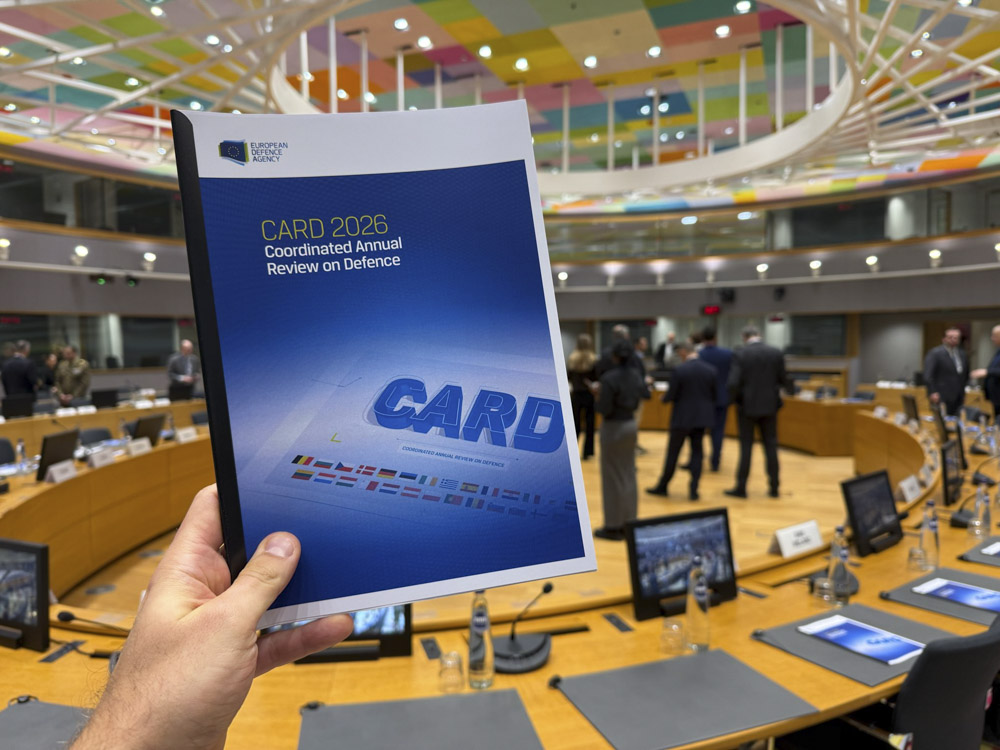
Space-based early warning, strategic air mobility and a European secure defence cloud. These are the three “strategic enablers” Europe must develop together to reduce its reliance on the United States. The 2026 Coordinated Annual Review on Defence (CARD) is explicit about the challenge, warning that “critical capability gaps exist across all domains including, notably, strategic enablers in anticipation of the likely drawdown of US capabilities from Europe”. This is not speculation about a US exit. It is the European Defence Agency’s assessment, endorsed by EU defence ministers on 17 November.
These capabilities let Europe gather intelligence, command operations and sustain deployments. They are essential for strategic autonomy but too costly and complex for any single country to develop alone. Their importance is growing as questions mount over the US military’s commitment to Europe. With Washington pivoting towards the Indo-Pacific and the Pentagon reviewing its global force posture, Europe needs to take on more responsibility for its own defence. EU defence ministers discussed these issues with Elbridge Colby, US Under Secretary of War for Policy, during their Brussels talks. Russia’s war in Ukraine and wider regional instability only add to the urgency.
Alongside the three enablers, described by EDA Chief Executive André Denk as “essential to strengthening Europe’s deterrence and defence capabilities”, ministers endorsed five further collaborative opportunities: a family of cruise missiles, long-range artillery, modular and interoperable unmanned ground vehicles, layered counter-drone systems for critical infrastructure and force protection, and a family of long-range air defence interceptors. Together, these eight opportunities cover everything from battlefield technology to the core infrastructure that keeps Europe’s forces effective.
But the real challenge isn’t what to buy, or even money. EU defence spending is set to reach €454 billion in 2026, with €163 billion in investment, yet fragmentation remains the sticking point. Sixty-eight percent of investment still happens at national level. CARD warns that “higher investment is very unlikely to close shared gaps unless it is spent together, consistently in a coordinated approach among Member States.”
The report also warns that an exclusive focus on the 2030 readiness objective could undermine Europe’s long-term strength. Governments shouldn’t focus solely on urgent deliveries but must also plan for future capability needs. Cutting corners now could mean steeper costs later. Readiness also depends on personnel, training and interoperability, not just equipment. CARD calls for earlier cooperation in planning and a quicker move from innovation to action, learning from Ukraine. The EDA’s budget will rise by 8.7% in 2027, reaching €78 million.
Overall, CARD’s message is that bigger budgets alone won’t make the EU stronger. Europe needs to turn spending into capabilities it can develop, sustain and rely on together.
Dependencies
Europe’s defence ambitions depend on more than military capabilities. They also require secure and reliable supply chains. Dependence on non-European sources for critical raw materials, chemicals and components leaves manufacturers exposed to shortages and decisions taken beyond the EU’s control. The joint ministerial statement warns that the “increasing weaponisation of trade dependencies by some third countries through export restrictions” has exposed the fragility of EU defence supply chains. Ministers want civilian EU policies to take defence requirements into account and ensure that, when supplies run short, “essential defence needs are adequately safeguarded and supported”.
This is where legislation like the Critical Raw Materials Act and the European Chips Act comes in. Designed mainly for civilian industries, these frameworks need to take defence requirements more systematically into account, even though military production depends on many of the same supply chains. Ministers also want both defence and non-defence EU funds, as well as the next multiannual budget, to strengthen supply-chain resilience and give industry more confidence to invest. In the meantime, companies should diversify suppliers and build strategic stockpiles where needed. Reducing dependencies means diversifying sources and building resilience, not cutting ties with global partners.
Ministers also discussed these vulnerabilities in the context of relations with China, a major trading partner and a source of critical supply-chain dependencies. Ireland’s Helen McEntee, Minister for Foreign Affairs and Trade and for Defence, said ministers had stressed the need to “reduce our own critical dependencies” and “strengthen our resilience”.
The discussion also turned to the United States. McEntee stressed that Europe must maintain close ties with Washington, its “most important security partner”. Colby, meanwhile, made clear that the US expects Europe to increase defence investment.

Privacy Policy

Powered by © Mobilbyte s.a.s. Information Technology