



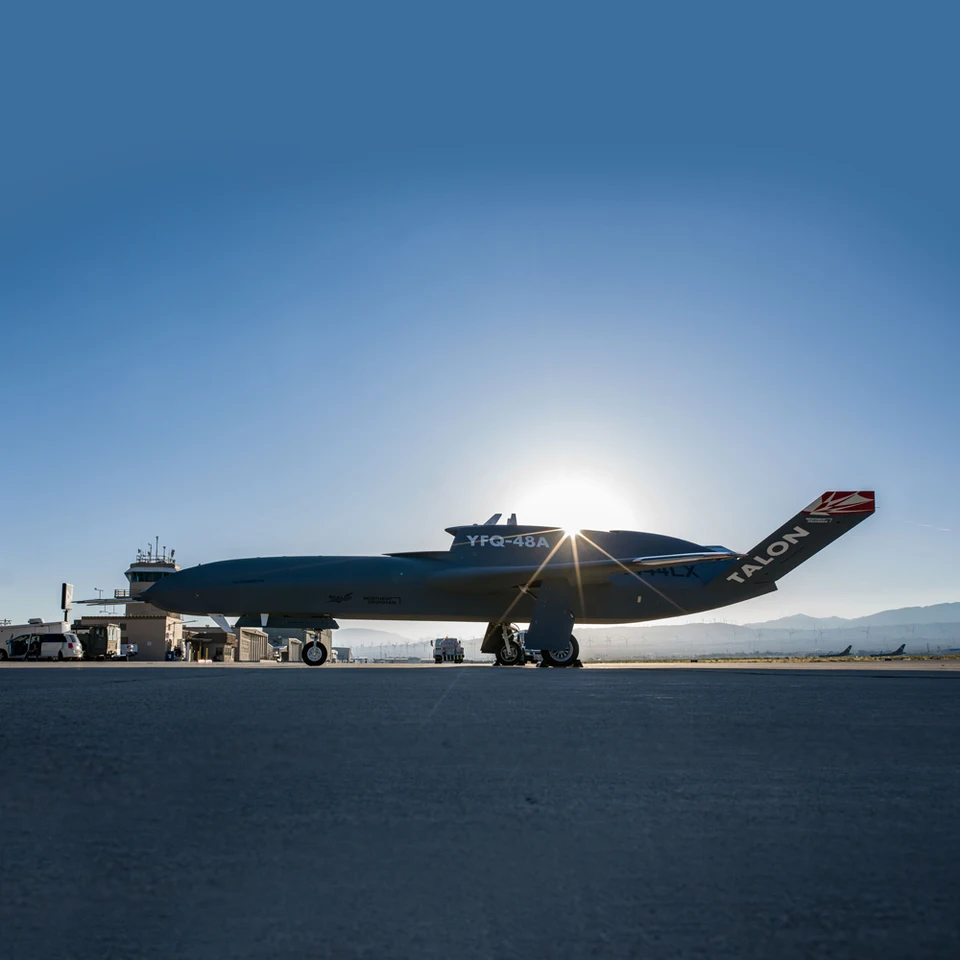
Speaking at the International Sea Power Conference aboard HMS PRINCE OF WALES in Oslo, General Sir Gwyn Jenkins, the 1st Sea Lord, announced the signing of a Statement of Intent with Northrop Grumman that is meant to lead to trials in UK waters sometime in 2027 of a YFQ-48A TALON BLUE aircraft from one of the Royal Navy’s aircraft carriers.
The trials will deliver the initial vision of Project VANQUISH, which was first launched in October 2025 with the aim of testing at sea an “attritable” (Tier 2 in RAF / MoD definitions) Fixed Wing Short Take Off and Landing Autonomous Collaborative Platform (FW STOL ACP).
The initial ambition called for a test embarkation already by the end of 2026, if possible, “with options for delivery within an 18-month window from the target date also considered”.
The intent at RFI release was that the air vehicle would have to be able to “launch and recover to QUEEN ELIZABETH-class carriers without Catapults or Arrested Recovery Systems and with a credible payload and endurance”. Whether this is feasible remains to be seen and the latest announcement focuses on “launch” but is suspiciously cautious when it comes to the landing part.
Many observers expect that operating large CCAs will eventually require arresting wires, and possibly a catapult. The Royal Navy wants a jet-powered CCA capable of high subsonic speed, which “in due course” would add ISR, strike and air-to-air refuelling roles to complement the F-35B LIGHTNING within the QEC and its Carrier Air Wing.
The role of embarked tanker, if it is ever to be realized, will impose a mass that makes pure STOL operations unfeasible. TALON BLUE has an all-composite airframe with outward-canted tail surfaces and a lambda-shaped wing. It uses a dorsal, high-position intake and a wide, sturdy undercarriage for operations on “undeveloped” surfaces according to Northrop’s website, but clearly the Company feels this can favour shipboard operations as well.
TALON BLUE is a development of an earlier CCA proposal by Northrop Grumman which was unsuccessful in securing a spot under the USAF’s CCA Increment 1 program. The redesign focused on a reduction in part count and in weight, reducing cost and complexity.
The USAF assigned the designation YFQ-48A to the TALON BLUE, which is among the candidate CCAs to be evaluated for possible adoption under Increment 2 of the CCA program. For now, Project TALON is a portfolio development driven by the Northrop Grumman’s own funding.
TALON BLUE first flew on October 3. It is powered by an undisclosed turbofan from the Pratt & Whitney PW500 family, which goes from the 2,887-lb.-thrust PW530A to the 4,200-lb.-thrust PW545D.
BAE Systems with its own BRONTANAX CCA proposal has highlighted the possibility of unassisted take-off from the carriers but cautioned that wires are “probably” required for recovery. The Royal Navy already did some early work on the possibility of retrofitting wires under Project ARK ROYAL, which has however, at least for the moment, been shelved.
So far, QEC-class aircraft carriers have recovered and launched a number of smaller, STOL fixed wing drones: Windracers’ ULTRA for small carrier-on board delivery tasks was demonstrated, followed by General Atomics’ MOJAVE which is hoped will in time lead to a solution (possibly the MQ-9B with STOL wingkit) for the embarked AEW requirement; and most recently by the Tekever AR5 which the British Army is acquiring to replace WATCHKEEPER. TALON BLUE is a step up in the type of drone, in mass, speed and ambitions.


Privacy Policy

Powered by © Mobilbyte s.a.s. Information Technology