



As tensions between Taiwan and the People’s Republic of China continue, the Taiwanese armed forces and defence industries are turning to US companies for technology and partnerships, particularly regarding maritime autonomous systems. Recent announcements between MARTAC and the Taiwan Coast Guard Administration, between Thunder Tiger and AeroVironment (AV), and Vatn Systems' interest in supporting Taiwan with uncrewed underwater vehicles, highlight this trend. These announcements can also be placed in a wider discussion about uncrewed maritime technologies and Asia-Pacific navies.
On 13 October, the US company MARTAC announced a contract to supply the Taiwan Coast Guard with an undisclosed number of DEVIL RAY T-24 autonomous surface vessels (ASVs). Several ASVs will be manufactured in MARTAC’s strategic partner’s facility in Edgewater, Florida, with the remainder built by Confucian Co., Ltd. in Taiwan.
In an exclusive interview with FW Mag, Seamus Flatley, Chief Growth Officer at MARTAC, explained that “the first 2 of 17 T-24S will be delivered in the next couple of weeks,” and “deliveries will continue in the first half of 2027.” As for USV production in Taiwan, it is scheduled to commence “in the first half of 2027.”
A day after the MARTAC announcement, on 14 October, the Taiwanese company Thunder Tiger announced it had signed a Memorandum of Understanding (MOU) with AV, which produces drones and loitering munitions. Via the MOU, the two companies will explore “multiple areas of cooperation,” including the potential integration of “select AV Switchblade Family of Systems configurations with Thunder Tiger’s unmanned surface and ground platforms.”
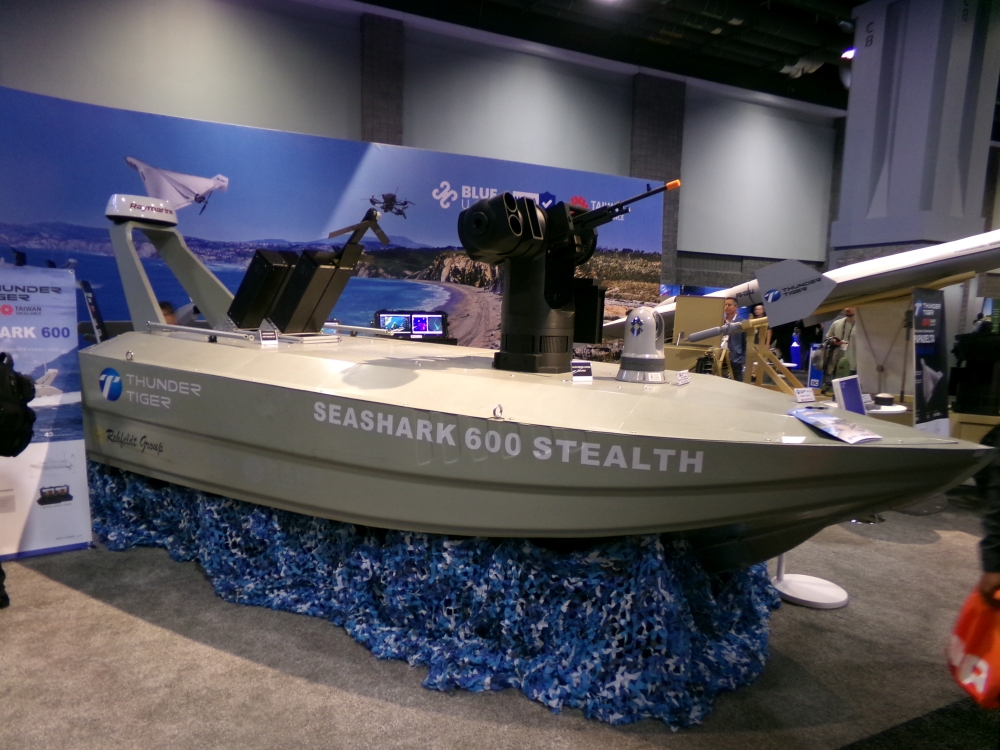
The MOU was signed during the Association of the United States Army (AUSA) exhibition in Washington, DC, on 12-14 October. FW Mag covered AUSA and visited the Thunder Tiger booth. At the high-profile event, Thunder Tiger displayed its SEASHARK 600 Stealth uncrewed surface vessel, which carried an AV loitering munition launcher (four canisters) and a remote weapons system by ACS. (At press time, the company had not replied to a request for comment for this story).
Another industry player interested in partnering with Taiwan’s Navy and Coast Guard is Vatn Systems, which produces UUVs. In an exclusive conversation with FW Mag, Tom Huntley, Chief Growth Officer at Vatn Systems, explained that the company’s small, modular UUV can carry out missions like mine countermeasures, seabed and harbor survey, and other security & defense missions. Given geopolitical tensions surrounding the Taiwan Strait, the executive explained, “we see Taiwan's defense budget proposal increases and shift toward autonomous systems as a strong signal they are taking the situation seriously.”
Huntley has travelled to Taiwan to participate in the marine tech & uncrewed robotics expo MATURE Taiwan on 3-5 November to explain how Vatn can help Taipei. Huntley also told FW Mag that the company has partnered with the National Chung Shan Institute of Science and Technology (NCSIST), a Taiwanese organization dedicated to researching, developing, manufacturing, and sustaining defense technologies for the Taiwanese Armed Forces.
Taiwan is not the only country in the Asia Pacific interested in uncrewed maritime technology. FW wrote in April of this year, during our coverage of the Sea Air Space exhibition, about MARTAC delivering DEVIL RAY T-38 and T-12 USVs to the Philippines. In FW Mag’s recent conversation with Flatley, the executive confirmed that “delivery of an additional six T-38s will begin before the end of the year and continue into early 2027.” On 9 November the company announced the delivery of two T-38 USVs to Philippine Marine Corps (PMC), in conjunction with opening an Unmanned Center of Excellence (CoE).
Manila wants to strengthen its navy to protect its territorial waters and exclusive economic zone in the South China Sea from Beijing's advances to expand Chinese control over this critical body of water. To increase testing and development of autonomous capabilities, the Philippines will open its Unmanned Warfare Training Center in Subic Bay this November.
Naval forces across Asia are showing increasing interest in USVs, though their choices regarding mission roles and deployment depend on specific mission requirements, available financial resources, and technological capabilities. For example, Singapore prioritizes USVs for maritime security and mine countermeasures; Japan prefers multi-mission USVs designed for surveillance or launching anti-ship missiles; and the new MARTAC USVs will help the Philippine Navy with domain awareness. Meanwhile, Vietnam is promoting research and indigenous USV production; however, this remains a relatively new field for the country.
While Asia’s navies are far from attempting to create hybrid fleets like the US Navy, interest in uncrewed maritime systems will continue. As a result, we can expect USV and UUV manufacturers to continue showcasing their systems to regional forces across the Asia-Pacific. For example, Flatley also confirmed that MARTAC is carrying out “discussions about participation in several exercises in the region,” while Vatn participated in MATURE Taiwan. Similarly, integrating new payloads like AV’s family of loitering munitions on USVs can be a force multiplier.


Privacy Policy

Powered by © Mobilbyte s.a.s. Information Technology