



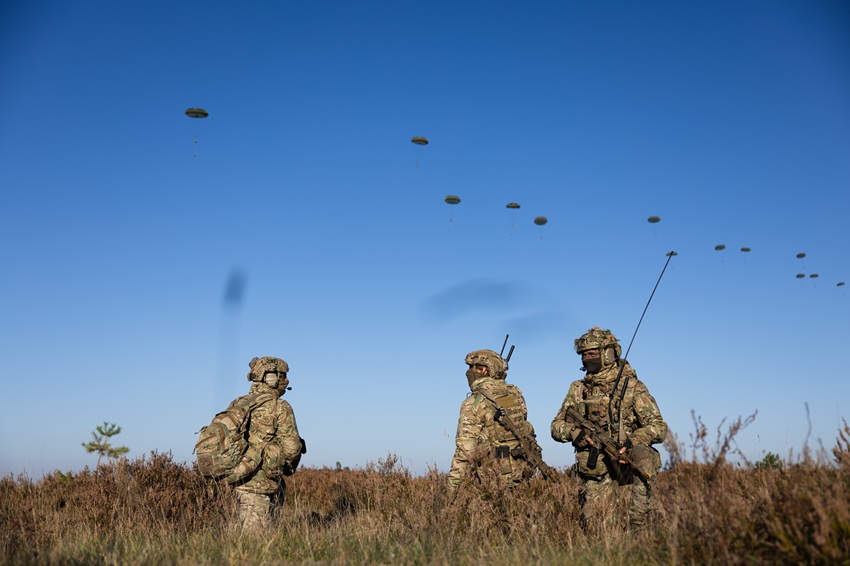
In the course of a long, 7-week exercise in Germany known as Exercise RHINO TITAN, the British Army’s Airborne Task Group, drawn from 16 Air Assault Brigade and supporting units, carried out its largest parachute drop in about 15 years.
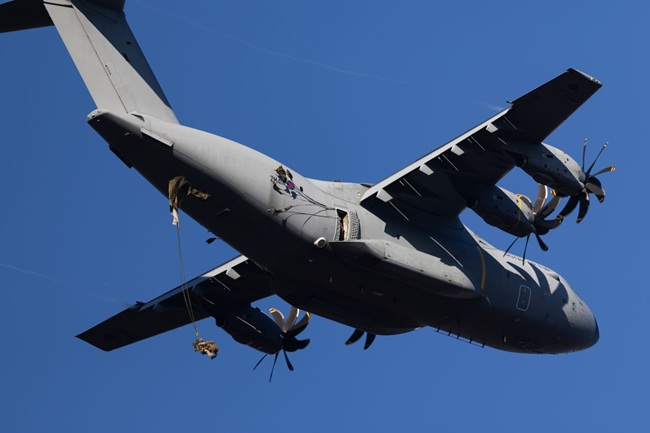
In total around 700 paratroopers took part, of which 570 to 600 British and the rest French. The British contingent was inserted, in 2 waves, by 4 Royal Air Force A-400M cargo aircraft which also delivered simultaneously 4 metric tons of stores.
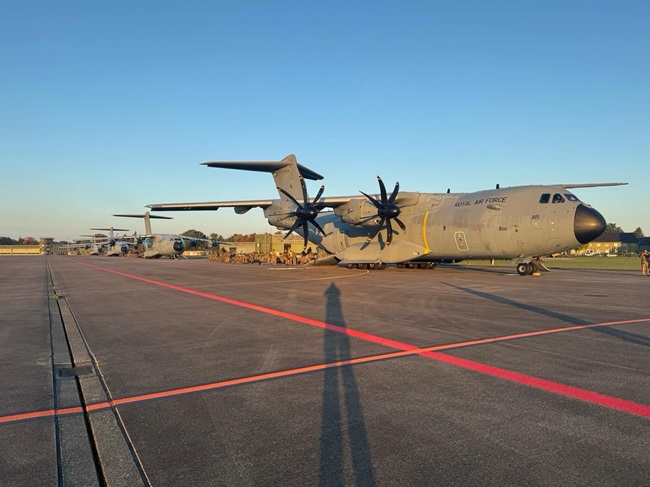
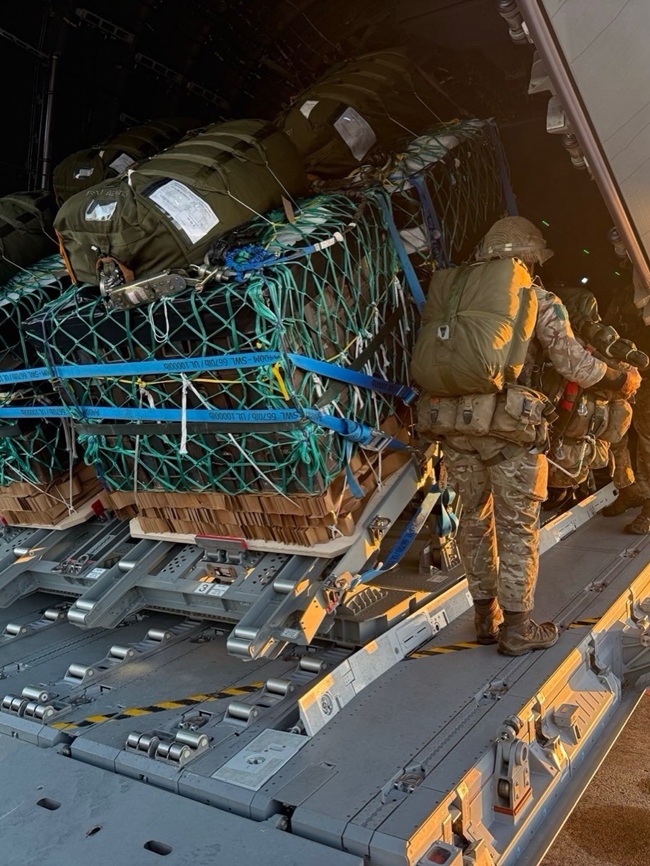
The capability to deploy simultaneously paratroopers and stores from the RAF A-400M is still relatively new. It involved, specifically, the use of the “para wedge”, an incline structure mounted on the A-400M’s ramp to drop pallets weighing up to 4 metric tons while delivering paratroopers from the side doors.
Smaller bundles of gear, weighing up to 320 kg each, can be dropped from the side doors. The parachute insertion was carried out via low-altitude drops from at around 800 feet.
The drop zone was previously marked and secured by the insertion of the elite British Pathfinders and their French counterparts, who flew out from Boscombe Down and Toulouse respectively and carried out a high-altitude launch from 12,000 feet, gliding in under freefall parachutes to find and mark the landing zone for the main force to follow.
The main force comprised paratroopers from 3 PARA battalion as well as elements from all supporting formations: 8 (Parachute) REME Company, 216 (Parachute) Signal Squadron, 7th (Parachute) Royal Horse Artillery (RHA) and UAV and surveillance and target acquisition elements from 21 Bty, 32 Regiment Royal Artillery and 53 Bty, 5 Regiment Royal Artillery, respectively.
The large airdrop was a highlight of an important year for the regeneration of the British Army’s Airborne Task Group capability following years of low activity levels and delays in various clearances of tactical capabilities for the A-400M.
2026 was nicknamed “the year of air manoeuvre” and elements of 16 Air Assault Brigade have been intensely preparing throughout the year, including with Exercise RHINO BIZZ in the summer in the vast expanse of BATUS, in Canada, and early in the year in Germany alongside US Army’s own paratroopers.
Plans for the year included also “proving the capability to deploy the L-118 Light Gun via air dispatch from A-400M”. This capability has been a gap for multiple years now due to long delays in acquiring suitable airdrop platforms for heavy payloads to certify and employ on the RAF’s A-400Ms.
In February, 7th RHA refreshed its competencies by taking part in the airdropping of the U.S. paratroopers’ own analogous L-119 Light Guns (from C-17), but there is for now no evidence of airdrops from British aircraft. Government has been asked in Written Questions about the L-118 air dispatch plans recently but refused to provide an answer.
Another serial that was planned, although it may have been abandoned given the well-documented cuts to training budget, is the move of a whole 8 L-118 gun battery by air in a single period of darkness. CHINOOK support and the move of the guns under slung is practiced relatively frequently but not at such scale.
Exercise RHINO TITAN was the occasion to observe the airborne force using the new Elbit-supplied Ground-Based Surveillance Radar sets as well as new Skydio X10D UAV, SCORPIO 1000 First Person View (FPV) strike drones and Elbit THOR quadcopters.
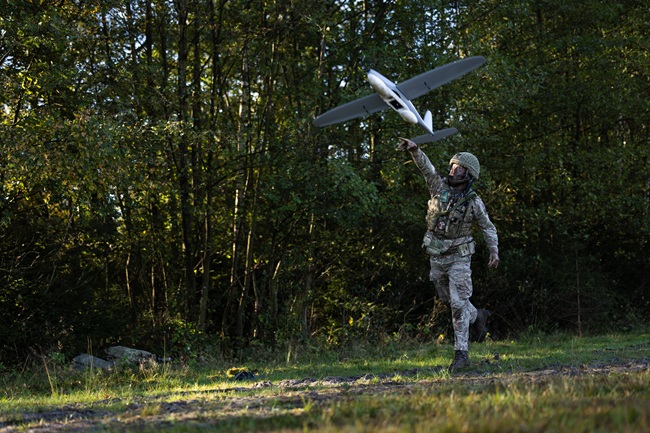
The 21 Bty, 32 Regiment Royal Artillery has also been shown operating with a new mini UAV, hand-launched, apparently named SAKER by the British Army. The images show it to be a SkyWatch RQ-35, a drone not known to have previously been in British use. It is possibly replacing, or at least complementing, the older, hand-launched AeroVironment WASP.
Another noticeable feature of the exercise was the use of short sticks of paratroopers from the side doors of the A-400M, requiring multiple passes per wave. The A-400M is supposed to be able to insert a full 116 paratroopers per sortie in sticks of 58 from each side, but in the past there have been well-known delays in achieving clearance for this, with airflow concerns. The use of short sticks might be a limitation specific to the exercise or drop zone or due to other reasons, but it might also signal enduring concerns for simultaneous, two-sided long-stick parachuting. Low-level parachuting clearance for the RAF’s A-400M with the Irvin GQ Low Level Parachute (LLP Mk-1) as used by the British Army had been first announced in 2024.
Another capability gap that had opened with the loss of C-130J ahead of the necessary clearances achieved on A-400M was closed last year with the order of new Irvin GQ PRIBAD paradrop platforms for the air dispatch of boats. This specific capability gap was particularly damaging to the UK’s submarine rescue group’s parachute intervention capability.



Privacy Policy

Powered by © Mobilbyte s.a.s. Information Technology