





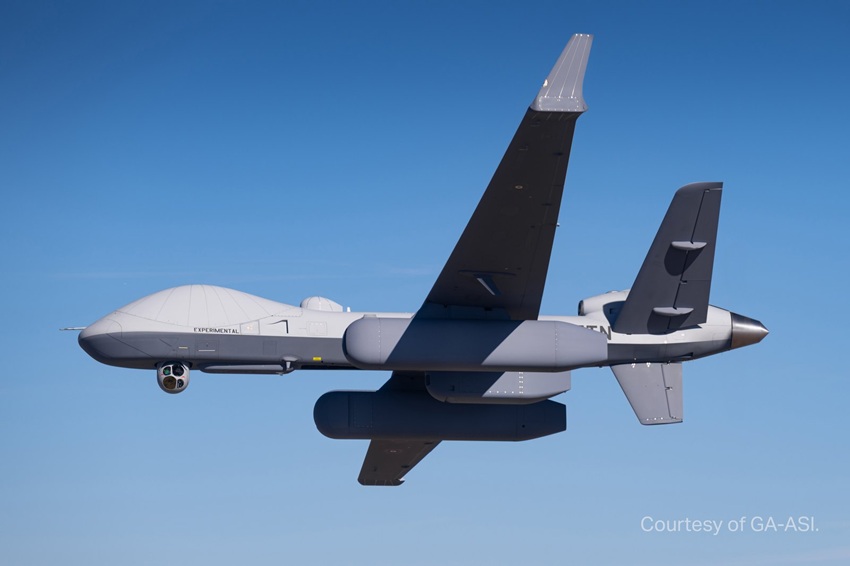
General Atomics Aeronautical Systems, Inc. (GA-ASI) and Saab have performed a first round of flight testing of their uncrewed Airborne Early Warning (AEW) solution based on GA-ASI’s MQ-9B UAV and a radar and datalink solution in pods by Saab.
The flight testing has been carried out “over the past few months” operating from GA-ASI’s own Desert Horizon flight operations facility in Southern California. The very first flight of the MQ-9B equipped with Saab’s LOYALEYE podded AEW solution had been announced back in May, which suggests mission system testing began soon after.
The testing “demonstrated simultaneous tracking of several airborne and maritime targets at long ranges. The airborne targets tracked included multiple instrumented red fighter jets and several commercial aircraft”, according to the teamed companies.
GA-ASI says it is “discussing unmanned AEW capabilities on MQ-9B with several customers”. GA-ASI President David R. Alexander declared that: “the level of customer interest in AEW capability on MQ-9B throughout the world is extremely high. It just makes sense.”
The MQ-9B provides long endurance at a high altitude, while Saab brings to the table the experience gathered in years of work on AEW radars for manned aircraft through the ERIEYE radar-mission system line which has culminated, at present, in the GLOBALEYE solution based on the Bombardier Global 6000 business jet.
The podded solution for MQ-9B has been baptized LOYALEYE and uses AESA type radars, with transceiver modules made with GaN (gallium nitride) semi-conductors. On the MQ-9B, 2 AESA arrays, one per side, are accommodated within special pods (developed by GA-ASI) carried under the wings, while a third pod, containing the common avionics for the entire AEW system, is installed on the centreline pylon.
The solution will be used stand-alone or in crewed-uncrewed teaming. GA-ASI has been pushing the idea for some time, notably presenting the concept also to the NATO AEW Force as part of the quest for a capability that can entirely replace the aging and increasingly obsolescent fleet of E-3 SENTRY aircraft.
GA-ASI and Saab’s AEW offering will span a wide range of applications, including early detection and warning; long-range detection and tracking; simultaneous target tracking and flexible combat system integration, all over line-of-sight and SATCOM connectivity.
It must be noted that transmitting the whole mass of target and surveillance data reliably and in real time will probably be one of the most challenging aspects of the idea. Once mature, however, the MQ-9B AEW might enable more early warning orbits, flying in places where the current, crew-intensive AEW aircraft would not venture due to unacceptable risks.
Importantly, the LOYALEYE solution might one day be suitable for embarkation on flat top ships without the need for catapults and arresting wires. GA-ASI has been testing the design of a STOL wing kit that should enable the MQ-9B to take off and land with very short runs, and the objective is to make the LOYALEYE kit compatible with STOL operations.
If this can be successfully demonstrated, one particularly interested potential customer would be the Royal Navy, which hopes to replace the CROWSNEST AEW pods on MERLIN HM2 helicopters with a UAV-based solution in the early 2030s.




Privacy Policy

Powered by © Mobilbyte s.a.s. Information Technology