





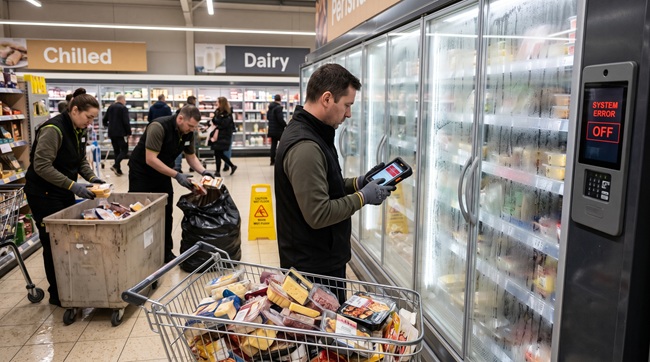
The hacker attacks that hit several supermarket chains in Europe yesterday - after similar incidents in France in mid-October - are a tangible sign of how deeply hybrid warfare can reach and how vulnerable our systems are.
The incidents showed that hackers can break into the control systems of supermarket fridges, freezers and cold rooms and manipulate cooling temperatures, literally sending food of every kind to waste. The result is a very strong psychological impact and damage worth millions of euros.
This is a deliberate strategy and campaign aimed at the food supply chain of our societies, one of their vital nodes, which has proved extremely vulnerable in this case.
We do not yet know the nature of these attacks or their level of sophistication. But the repetition of such events in less than a month makes it clear that there are flaws that someone from the outside is able to exploit, after carefully mapping the devices exposed online and understanding their vulnerabilities. These vulnerabilities are probably due to inadequate defenses, typical of chains and infrastructures that feel less exposed and, as such, often decide not to invest in cybersecurity as much as they should. The extensive digitization of our societies brings many benefits in speed and simplicity of processes, but it also exposes us to new risks and widens the perimeter of vulnerabilities.
It also requires investment in protecting Operational Technology (OT) and Information Technology (IT) infrastructures, whose necessity is often not culturally understood. That investment is far greater than the cost borne by the attackers, in an asymmetry that may prove unsustainable in the long run.
Our adversary knows this. He acts on this asymmetry to turn it to his advantage and operates deliberately, expanding enormously the gray areas of plausible deniability, to interfere 24/7 in our daily lives and alter our perceptions and the way we think.
This time it was the perception of food security. Next time, the target may be the perception of a state’s ability to guarantee essential services such as transportation, health care or energy supply.
Follow us on Telegram, Facebook and X.
(Image generated by AI)




Privacy Policy

Powered by © Mobilbyte s.a.s. Information Technology