





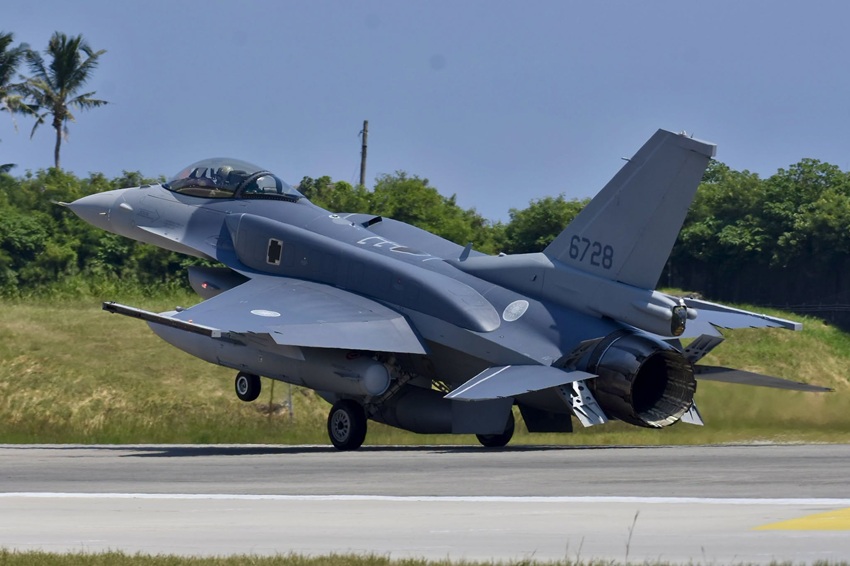
On October 2, at Chihhang Air Base, the Taiwanese Air Force received the first 2 of 66 new F-16C/D Block 70 fighters.
The delivery arrived about one month behind schedule and roughly 3 years behind the original timeline. The 2 fighters, originally expected in Taiwan between late August and early September, were held in Hawaii and Guam for weeks for unspecified reasons (reportedly severe weather). As is standard for delivery flights, the aircraft were ferried to Taiwan by U.S. pilots and formally handed over to the Taiwanese Air Force upon arrival.
The new aircraft will be based at Chihhang — where pilots and maintenance personnel will complete conversion training on the new variant — and assigned to the 7th Tactical Fighter Wing, replacing the F-5 TIGER II fighters retired by the unit in 2024. According to Taiwanese authorities, the new fighters will strengthen air defense along the island’s eastern coast — facing the Pacific Ocean — an area where Chinese aircraft and ships routinely operate during large-scale exercises around Taiwan.
The United States approved the sale of 66 F-16C/D Block 70 fighters, worth $7.8 billion, in 2019. Deliveries were originally scheduled to begin in 2023 and conclude by the end of 2026, but delays caused by the relocation of the F-16 production line from Fort Worth (Texas) to Greenville (South Carolina), supply chain disruptions, and software integration issues pushed the schedule back. Only in March 2025 did Lockheed Martin roll out the first newly built F-16C/D Block 70 destined for Taiwan.
The Block 70 is the latest iteration of the F-16. It is equipped with the APG-83 SABR active electronically scanned array radar, which enables detection, tracking, and identification of more than 20 targets simultaneously with greater speed and at longer ranges, while also providing high-resolution Synthetic Aperture Radar (SAR) mapping and robust electronic protection that allows it to operate in heavily contested electromagnetic environments.
In addition to the SABR, the new variant features the ALQ-254(V)1 VIPER SHIELD electronic warfare suite — equipped with jamming capabilities based on Digital Radio Frequency Memory (DRFM) technology, which provides advanced countermeasures against the most sophisticated threats — a next-generation mission computer, a new 6x8-inch high-resolution center display, the new APX-126 advanced IFF system, Link 16 datalink, full compatibility with night vision systems and the JHCMS helmet-mounted cueing system, a new integrated GPS/inertial navigation system, a high-capacity, high-speed data bus, and the Auto GCAS automatic ground collision avoidance system. The aircraft also features conformal fuel tanks that hug the fuselage to extend range without occupying weapons hardpoints, a reinforced landing gear designed to withstand higher takeoff weights and ordnance loads, and a General Electric F110-GE-129 engine, replacing the Pratt & Whitney F100 that powers the older aircraft in the Taiwanese fleet.
Taipei already operates 139 F-16A/B Block 20 fighters acquired in the early 2000s. Under a program completed in 2023, these aircraft were upgraded to the F-16V standard, notably through the integration of the APG-83 AESA radar, a new mission and electronic warfare suite, and improved avionics. The 66 new aircraft will bring Taiwan’s F-16 fleet to 205 units, forming the backbone of an air force called on almost daily to intercept and escort Chinese military aircraft.
Taiwanese officials have stated that additional F-16C/D Block 70 fighters will arrive by the end of the year, without specifying the number. The remaining deliveries are expected to continue at least through 2028.



Privacy Policy

Powered by © Mobilbyte s.a.s. Information Technology