



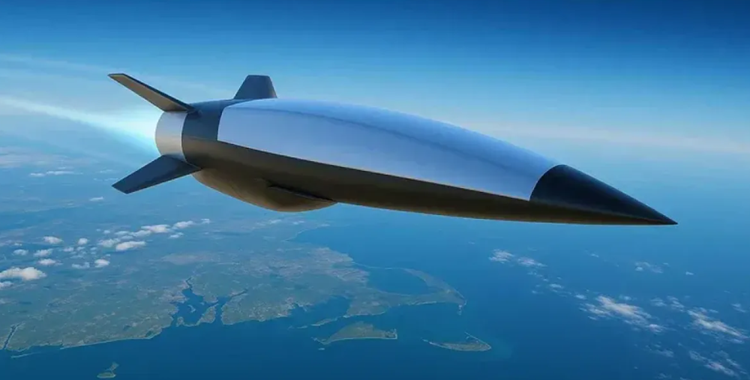
Between late September and early October, the US Air Force (USAF) and the Royal Australian Air Force (RAAF) conducted the first flight test of the AHM-4 Hypersonic Attack Cruise Missile (HACM), presumably at the RAAF Woomera test range in southern Australia.
The HACM is a scramjet-powered hypersonic cruise missile developed by RTX in partnership with Northrop Grumman. The test was carried out under the joint Southern Cross Integrated Flight Research Experiment (SCIFiRE), one of the main lines of US-Australian cooperation in hypersonic technologies. The USAF confirmed that the test collected data on the missile’s behavior under realistic flight conditions.
However, little has been disclosed about either the outcome of the test or the launch aircraft. The RAAF’s F/A-18F SUPER HORNET fighters had previously been identified as possible platforms for the HACM test phases, while the USAF selected the F-15E STRIKE EAGLE as the first aircraft for operational integration of the missile.
The HACM program traces its origins to earlier US air-breathing hypersonic efforts, starting with the X-51 WAVERIDER and, more recently, the Hypersonic Air-breathing Weapon Concept (HAWC) of the Defense Advanced Research Projects Agency (DARPA).
In 2020, the USAF launched the industrial process for the development of the new weapon system. In 2022, the HACM program was formally established, with RTX, then Raytheon, selected as prime contractor and Northrop Grumman selected to develop the scramjet engine.
The missile has a 2-stage architecture, consisting of a rocket booster and a scramjet-powered second stage. After launch, the booster accelerates the missile to the speed required for the air-breathing engine to operate. Once the required conditions are reached, the second stage separates and continues on scramjet power, reaching speeds above Mach 5.
The program has, however, suffered significant delays. Design issues caused a slip of about 1 year, and the USAF cut the number of flight tests planned for the rapid prototyping phase from 7 to 5. Despite these setbacks, the HACM remains one of the USAF’s main hypersonic programs, alongside the AGM-183 Air-Launched Rapid Response Weapon (ARRW).
In its fiscal year 2027 budget request, the USAF sought about $1.2 billion to complete development, begin fielding the missile and establish a dedicated production line. Of these funds, about $404 million would go to the first operational lot. Under current plans, the USAF aims to begin fielding the HACM in fiscal year 2027 and reach full-rate production by 2029.



Privacy Policy

Powered by © Mobilbyte s.a.s. Information Technology