



For the first time, Ukrainian defense companies had an entire pavilion at the Association of the United States Army (AUSA) exhibition in Washington, DC, on 12-14 October. Future Warfare Mag spoke with several companies to understand their systems and objectives.
The companies displayed drones, loitering munitions, one-way attack systems, ISR drones, electronic warfare systems, and uncrewed ground vehicles. Due to the sensitive nature of some systems and the ongoing war, some companies did not bring systems and platforms to display at AUSA, but several did.
One important agreement was signed at AUSA to promote cooperation between Ukraine and North America: on 13 October, the Ottawa-based defense company Dominion Dynamics and TENCORE signed a memorandum of understanding to integrate Dominion’s autonomy stack, AuraNet, into TENCORE’S TerMIT UGV. Dominion plans to manufacture TerMIT in Canadian facilities with initial production targeted for 2027.
At AUSA, TENCORE showcased the TerMIT UGV with eight 93 mm thermobaric flamethrowers, designed to “remotely neutralize enemy dugouts, urban strongholds and light armor.” The vehicle can also be used for non-combat missions like logistics and evacuation, among others. The basic system has a range of around 40 km, a max speed of 15 km/h, and can carry payloads of up to 400 kg.
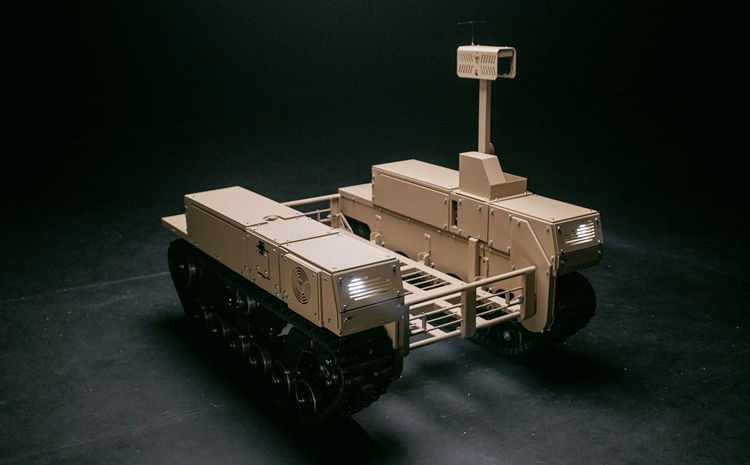
Another Ukrainian UGV developer present in the US capital is TarGun, which develops different UGV models, such as the TARGUN 200 and the TARGUN 1k. Since the beginning of the year, the company has manufactured over 2,800 vehicles, which have completed more than 25,000 missions, including evacuating over 615 service members and transporting over 2,800 kg of cargo.
Phantom Defense showed versions of its Specter, Specter Pro, and Vector Pro electronic warfare systems, command-and-control systems, and kinetic solutions like the Balaban interceptor, the Blade interceptor, and the Karakurt Net Launcher. A company executive highlighted how successful the systems have been in protecting Kherson, an area of 100 km2, with over 10,000 drones detected and over 7,000 platforms destroyed between 1 June 2026 and 24 June 2026. “Our systems can cover [and protect] military units and whole cities.”
The company is quite active and can produce “100 drones per day and 200 jamming systems per day,” FW Mag was told. In the US, Phantom Defense is already participating in US Drone Dominance competitions.
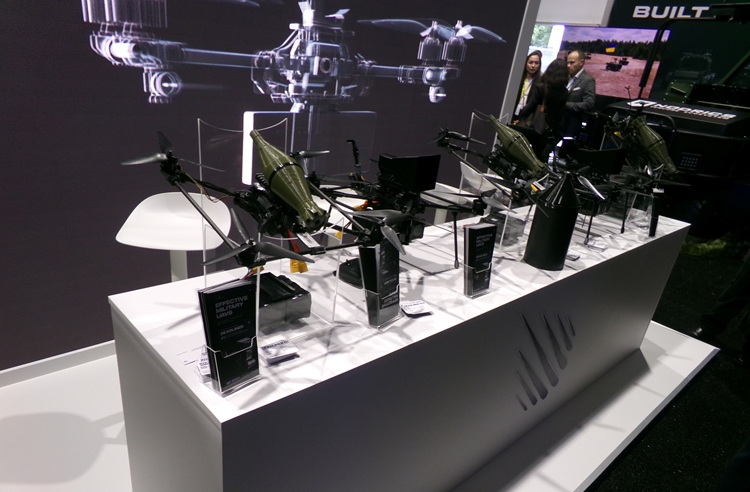
Another company present was Stellarion, which displayed some examples of its vast family of drones that can carry lethal payloads. The samples shown at AUSA had mock artillery shells. For example, the R10 DEADLINER can carry a 1.4 kg payload, while the R15 DEADLINER can carry 2.5 kg. A company executive added that their drones have a Picatinny rail “so the operator can add any payload they want.” The company also produces drones that can be controlled via fiber optics. “We produce more than 40,000 drones per month” in Ukraine, a company representative told FW Mag, adding “we have more than 50,000 confirmed kills.” The company has participated in a US Drone Dominance program.
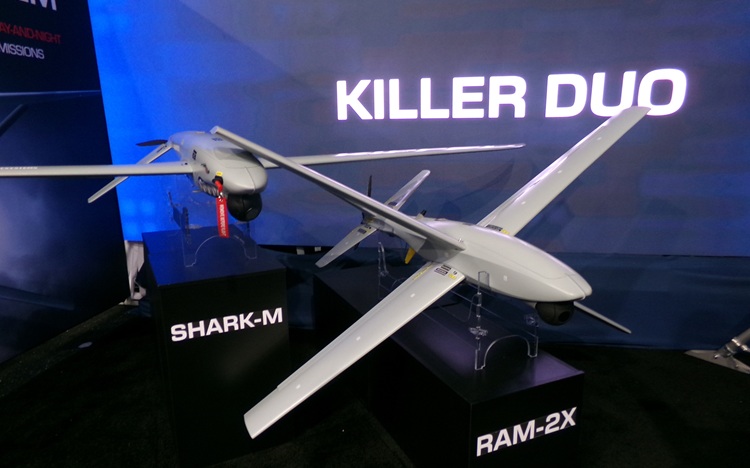
Ukrspec Systems also showed 2 of its drones: the SHARK-M, which has a flight endurance of 7.5 h and a communications range of over 180 km. The drone is designed for reconnaissance missions, fire adjustment, and strike-UAV support. Meanwhile, the RAM-2x has a 180 km communication range, over 2 hours of flight endurance, and can carry a 3.5 kg warhead.
As for electronic warfare, Unwave showcased its “full range ecosystem of EW and detection systems,” a company executive told FW Mag, which includes personal, vehicle, and infrastructure protection. “We have a 50% share of the market inside Ukraine,” right now, and “we are Ukraine’s leading EW company.” The company representative gave as an example that its systems are currently installed on the Ukrainian military’s KOZAK armored vehicle and one-way uncrewed surface vessels. The company produces systems such as the PASTKA C2 system, and the CHOVEN, a vehicle rooftop box counter-UAV system.
Meanwhile, Kvertus showed the Horizon UAS Detect system, the MIRAGE Intelligent EW Defeat system, and the GARUDA SIGNIT UAS. The Horizon, for example, has a max detection range of 30 km and can monitor up to 100 simultaneous targets with vertical coverage of 60° and horizontal coverage of 360°.
What were these companies' objectives at AUSA? The responses were generally similar as FW Mag chatted with many representatives at the Ukrainian pavilion. “We are here to share our experience. We are also looking for partners, for investors, as we would like to share our experience globally,” a Phantom Defense executive told FW Mag. The Unwave representative similarly noted that the company’s manufacturing capacity in Ukraine is only 39%: “We are looking for partners to manufacture outside of Ukraine and also enter the international market.” “We are really interested in having a contract with the US and find local partners for domestic production,” a Stellarion representative added.
After AUSA, the agreement between Canada’s Dominion Dynamics and Ukraine’s TENCORE may be the first of many other similar partnerships to support the European nation win the war.




Privacy Policy

Powered by © Mobilbyte s.a.s. Information Technology