



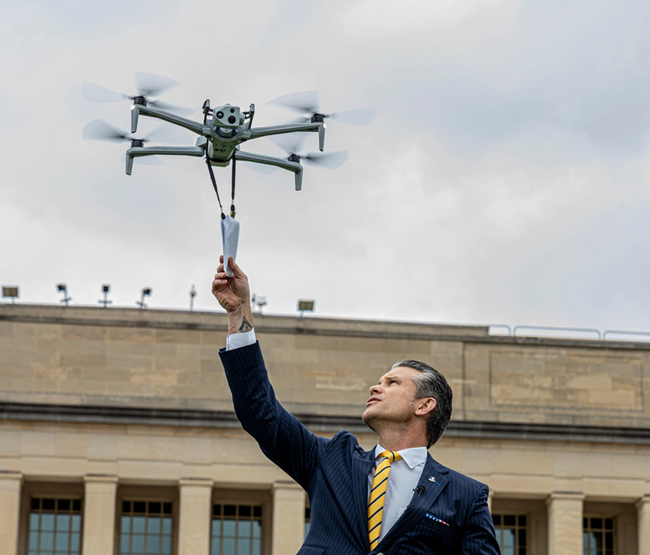
In his State of the Force address, delivered at Quantico, Virginia, US Secretary of War Pete Hegseth announced the creation of the Autonomous Warfare Command, a 4-star combatant command vested with authorities similar to those of the individual Armed Services, tasked with scaling up the use of drones, robotic systems and artificial intelligence across the entire US military.
Hegseth presented the new Command as the institutional response to a genuine “Revolution in Military Affairs”, which he described as “the fastest peacetime shift in modern military history”, and promised new career paths for personnel specializing in autonomous systems. Many aspects, however, remain to be defined (from who will lead the Command to how responsibilities will be shared with the Services), and the project will in any case require Congressional approval.
The Secretary built his argument around the speed factor. Hegseth argued that “the pace of war is changing faster than the process to support it”, since low-cost computing, advanced commercial manufacturing and artificial intelligence have made low-cost, high-precision strike capability accessible to practically anyone. In his view, drone warfare enhanced by AI-based targeting represents the most profound battlefield revolution in generations.
Hegseth was equally clear that technology alone is not enough: the autonomous and robotic revolution affects equipment, doctrine and organization, challenging assumptions that have shaped the conduct of war for decades. Hence his conclusion that the new tools must be embedded in the permanent structure of the Armed Forces because, as he stated, “lasting change must be anchored in military command structures”. A 4-star Command, rather than yet another program office, is therefore the solution Hegseth has chosen to ensure that this transformation outlasts individual budget cycles and leadership changes.
A memorandum released after the speech, titled Project AGINCOURT, outlined the path to the new Command. The document describes the Autonomous Warfare Command as a functional combatant Command, responsible for defining joint requirements and integrating the forces provided by the individual Services in support of the geographic commands that conduct operations in the various theaters. AGINCOURT also aims to thoroughly overhaul the way the Armed Forces procure, test and field drones and similar systems, while the memorandum set October 1, 2027 as the target date for standing up the Command.
On the financial side, the Fiscal Year 2027 budget request seeks approximately $54.6 billion for the autonomous warfare group, compared with roughly $226 million previously. On Capitol Hill, the Senate version of the 2027 National Defense Authorization Act already calls for the establishment of a combatant command for robotic and autonomous systems: a sign that the idea enjoys a degree of support, even though Congress has yet to approve the specific design proposed by Hegseth.




Privacy Policy

Powered by © Mobilbyte s.a.s. Information Technology