



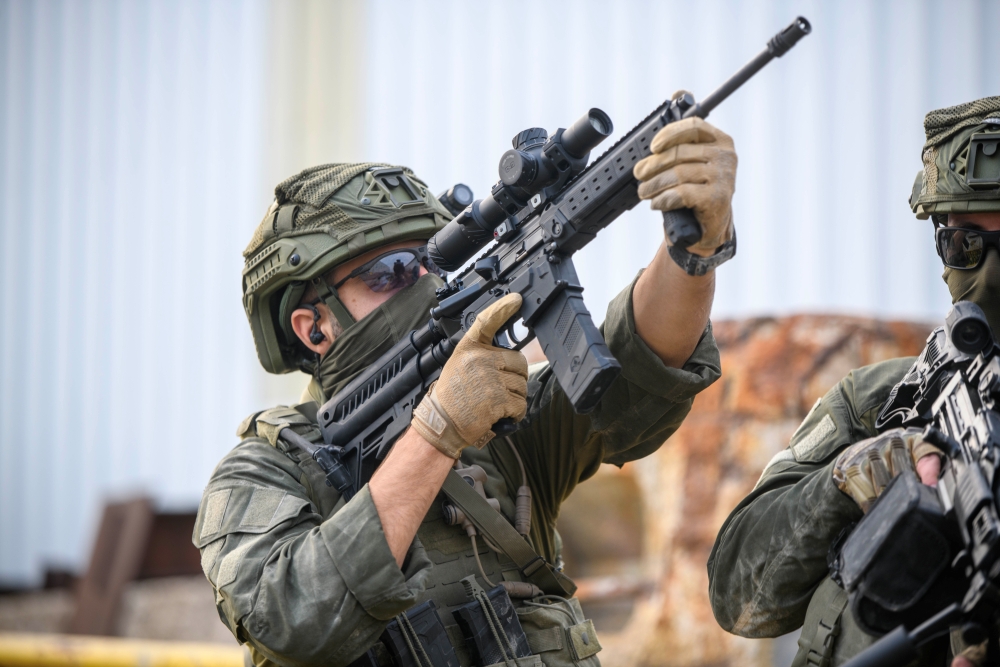
The Association of the United States Army (AUSA) exhibition will take place this coming October 12-14 in Washington, DC. Attendees will discuss the future of ground troops and warfare, with industries showcasing a variety of systems. Drone technology and counter-drone systems will be highlighted, given the ongoing evolution in drone warfare. As drones become more prolific and deadlier, dismounted troops (infantry squads, snipers, special forces, mortar teams, and any other soldier moving through the battlefield on foot) must be protected. Fire control systems for rifles are a special kind of equipment to monitor.
“Every soldier in the force should be equipped with a Counter-UAS weapon,” Semion Dukhan, a director at SK Group and Israel Weapon Industries (IWI) who also leads the ARBEL program, told FW Mag in an exclusive conversation. IWI will not participate in AUSA, but the company has developed its own counter-UAS fire control system for dismounted troops: Dukhan said the Arbel family of systems is already in use in over 25 countries. The system is designed for the AR-15 rifle, but other versions of the family suit other light guns, like machine guns.
Dukhan explained how easy it is to add the ARBEL to a rifle, as it takes “around 15 seconds” to install the 400-gram computer on the rifle's grip. “The system does not see the target,” Semion explained to FW Mag; rather, it “takes out the trigger work” for the soldier. The first shot fired at a drone is purely mechanical,” he added, “the computer takes over during the second shot and controls the trigger mechanism & controls the rate of fire.”
The IWI executive declined to name clients but shared that 25 countries have already implemented or are in various stages of implementing the system – 10-15 of which are European countries, he exclusively told FW Mag. Dukhan noted that additional orders are in the works, as those customers are currently testing the ARBEL. “This is a TRL-9, off-the-shelf product,” ready for delivery; “we can adapt it to other rifles too.” He confirmed to FW Mag that the US armed forces have “shown interest” and that demonstrations are ongoing.
One company that will be at AUSA and can confirm a new contract with the US military is Smartshooter, which produces the SMASH fire control systems. On 30 September, the company announced a 36-month, single-award indefinite-delivery/indefinite-quantity (IDIQ) contract by Joint Interagency Task Force (JIATF) 401, with a max order ceiling of $150 million. The Force leads the Domestic Shield program for global operational missions, addressing force protection, base defense, and counter-UAS requirements. This follows a JIATF-401 contract announced in March.
The company explained to FW Mag that the “IDIQ contract from the JATF401 is a blanket agreement,” adding that individual orders are placed “under this IDIQ based on demand from the services, which we expect to flow in as of Q4/2026.” The contract will be “mainly” for the company’s renowned SMASH 2000L Enhanced fire control system, “but it allows procurement of our other products from our offering,” a company spokesperson told FW Mag.
There is a growing catalog of weapons ground troops can operate to counter drone threats. Some companies manufacture jamming rifles that can turn off a drone or block the signal controlling it. Other companies are developing rifle rounds specifically designed for aerial drones. There are even net launchers, which are essentially rifles that shoot a net at a drone.
No soldier wants to carry additional equipment in their backpack or additional rifles to counter-UAS threats. Hence, soldiers on the battlefield will likely prefer a lightweight fire control system that can be easily added to a rifle and quickly turned on, such as the systems developed by IWI and Smartshooter.
The upcoming AUSA exhibition will feature a variety of counter-UAS systems for vehicles and bases. Protecting ground troops from drone threats presents its own kind of challenges, namely not overloading the soldier with additional heavy equipment. The US Army is awarding contracts to both drone and counter-drone producers to prepare the force for tomorrow’s wars, and protecting infantry squads and other ground troops from these aerial threats remains a priority.




Privacy Policy

Powered by © Mobilbyte s.a.s. Information Technology