



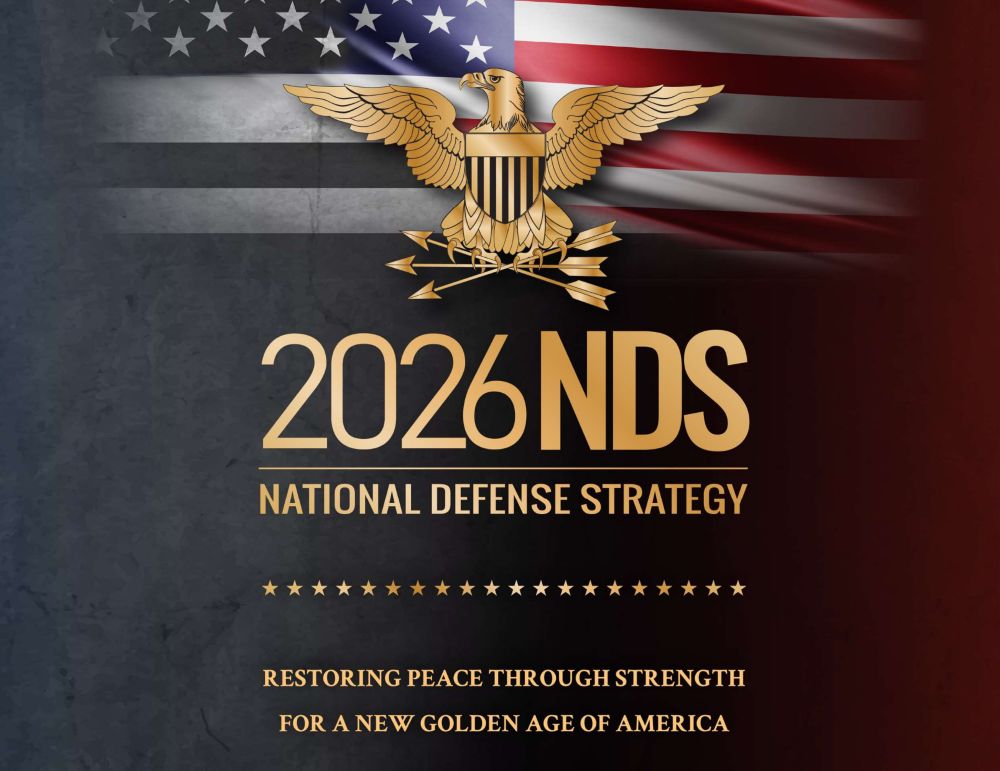
The Under Secretary of War for Policy, Elbridge A. Colby, delivered an update on the Implementation of the National Defense Strategy to the Senate Armed Services Committee. It’s an interesting point by point update on priorities and related actions.
Overall, the National Defense Strategy sets 4 priority objectives, in the order: Defending the US Homeland; deter China in the Indo-Pacific through strength, not confrontation; increase burden sharing with Allies and finally supercharging the US industrial base.
Defence of the Homeland is a wide-ranging objective not at all limited to physical defence of CONUS. The update begins by highlighting the effort to secure the US borders against illegal immigration and drug trafficking. It notes 16 consecutive months of zero releases at the border and a 94% reduction in daily apprehensions from the last Administration. It also notes how homicide rates within major American Cities have dropped by double digits: down 42% in Washington DC, circa 43% in Memphis, 32% in New Orleans and 18% in Los Angeles.
On the back of Operation ABSOLUTE RESOLVE, which led to the apprehension of Nicolas Maduro, “long wanted for his role in trafficking enormous amounts of cocaine to the United States”, the update notes the effects of Op SOUTHERN SPEAR which has resulted in the steady degradation of regional narcotrafficking operations, “driving historic reductions in cocaine shipments through major maritime corridors, including an up to 60 percent reduction in the movement of vessels with US bound cocaine”.
Building on the “Trump Corollary to the Monroe Doctrine”, DoW is investing in building partnerships in the region. The Americas Counter Cartel Coalition (A3C) is mentioned, as an “unprecedented” 19-Nations alliance going on the offense against narcoterrorism networks.
It also underlines efforts to “secure US access to the Panama Canal” through, including through the “reinvigorated” PANAMAX exercises. The 2026 edition was the first held in the field in Panama since 2012 after a long period of “tabletop only” editions. The 11-day event was held in August and saw the participation of elements from multiple A3C countries.
The document also notes “historic partnerships in the Caribbean, namely with Jamaica, the Bahamas, and the Dominican Republic, which will further enable us to protect U.S. commercial and military traffic through the Panama Canal”.
Key to Homeland defence is also the modernization of the Nuclear Forces. The document notes the first “vertical integration of an inert Sentinel missile at Vandenberg Space Force Base to enable flight testing in 2027; a 25 percent increase in B-21 RAIDER production; remaining on track to place aircraft at Ellsworth Air Force Base in 2027; establishment of a dedicated Submarine Launched Cruise Missile-Nuclear program office; and, in coordination with the National Nuclear Security Administration (NNSA), initiation of a project to adapt a warhead for that capability”. It also notes an ongoing classified review of US nuclear employment guidance “with the goal of increasing options available to the President for purposes of deterring or responding effectively to a nuclear contingency, again in light of the changing global nuclear landscape.”
Next is Golden Dome for America, which is “working toward an integrated demonstration in FY2028, which will encompass GDA’s effectiveness against multiple simultaneous threats, such as various unmanned aerial systems, with the comprehensive suite of kinetic and non-kinetic effectors.”
The document does not expand on Greenland, but this is presumably deliberate as the update was delivered on September 22, the same day when the new Agreement between US, Kingdom of Denmark and Greenland was signed. Presumably it was not the right time to unveil further details fresh out of negotiations.
The ongoing counter terrorism efforts and the conflict against Iran also feed into “Homeland Defense”. The ongoing fight against ISIS has seen the US and Allies finally leave Iraq earlier this month. The US update notes that “we enabled the Iraqi Security Forces to to take the lead in the fight against the remaining ISIS presence in Iraq by transitioning Operation INHERENT RESOLVE’s military mission there and continuing to target ISIS leadership in Syria, most recently with a successful strike on June 19.” Despite the pull-out from Iraq, DoW maintains options to take “focused, decisive action” where needed.
The document notes efforts ongoing in the Africa as well: in Nigeria it mentions the success of Operation GALAVINIC COBRA “which removed ISIS’s second in command and emir for Global Operations, Abu Bilal al-Minuki, his inner circle, and an additional 199 ISIS-West Africa fighters through a deliberate, low-cost, and expeditionary presence”. Operations in Nigeria are meant to address threats “emanating from the Lake Chad Basin”. Work is ongoing alongside Nigerian partners to “improve their existing CT capability to lead efforts to counter regional terrorism threats from ISIS and al-Qaida (AQ) groups that have the intent but not the capability to attack the U.S. homeland – a key burden sharing initiative - and address threats to Christians and other vulnerable communities in the Middlebelt”.
The document also addresses the execution of “over 80 strikes” against Islamic terrorists in Somalia.
The second priority, dealing with China, is of particular interest. It articulates “President Trump’s direction to always negotiate from a position of strength. Therefore, even as we work to avoid confrontation, we continue our efforts to strengthen deterrence by denial along the First Island Chain (FIC)”. The goal, in the words of Secretary Hegseth at the Shangri-La 2026 event, is to ensure that “aggression is infeasible, escalation unattractive, and war deemed irrational.”
In order to achieve this vision, the focus is placed on: Undersea Forces; Long-Range, Long-Endurance air power; Ground-based, mobile, long-range fires; resilient, proliferated space architecture and related counterspace capabilities; Special operations and other stand-in forces; Naval mines and the means to deliver them; relevant integrated air and missile defenses.
Backing all of these if the priority accorded to building “magazine depth, contested logistics capacity, and resilient and cyber-hardened C2”. On the first point in particular, the document notes the unprecedented boost of some 53 billion in the FY2027 budget to increase production and stockpiles of “prioritized munitions”. The “Department recognizes we need both high-end munitions and munitions specifically designed to be rapidly producible in large quantities” and further notes that while critical to the China strategy, stockpiles also enable “options” in other theatres and scenarios, an observation that seems to point the finger against too small reserves of strategic ammunitions exposed by operations against Iran.
On burden-sharing, the document reiterates what the Trump Administration has said from day one: in Europe “the Department has been clear with our NATO allies about what it is that we seek. As Secretary Hegseth said recently, the US is focused on “transforming NATO back into a real military alliance that’s focused on hard power and real deterrence, a NATO 3.0 modeled on the NATO 1.0 that won the Cold War, with our allies actually taking the lead in Europe’s conventional defense.”
The re-balancing of the burden is a “matter of fairness to Americans” but is “also for structural reasons, above all to solve the simultaneity problem, thereby ensuring NATO can defend Europe effectively even in the most trying of circumstances”, in other words when US forces might be busy elsewhere.
The document notes Europe’s progresses and has particularly appreciative words for Germany’s efforts. It goes on to note that with NATO having accepted the “what” the US seek, focus is now on showing Allies “how to step up and then helping them to do so. We are doing so at the bilateral level through technical talks and other higher-level engagements with key allies focused on military strategy and planning, defense industrial cooperation, and other opportunities to work more closely together, such as ongoing exploration of potential opportunities for permanent basing of U.S. forces in Poland. We are also engaging high-performing allies in small-group settings, such as the selective Bergen Group format, thereby accelerating efforts to build coalitions and drive progress toward NATO 3.0.”
The Bergen Group format, which met twice already, the first time in Bergen, Norway (from there comes the name) is due to have a meeting in Poland next month and in these days various Press voices have underlined the exclusion of, most notably, United Kingdom, France and Baltic Countries. This is by design. The Bergen group comprises Norway, Sweden, Finland, Poland, Germany and the Netherlands and might expand to Denmark following the agreement reached on Greenland.
In terms of reductions to US forces permanently earmarked for Europe, “the Department has reduced the total number of manned brigade combat teams (BCTs) assigned or allocated to U.S. European Command from five to three, returning us to the level of BCTs in Europe in 2021. At the Secretary’s direction, we are also undertaking a formal six-month review of U.S. force posture and basing in Europe to ensure that the remaining U.S. presence is appropriately scoped to advance the President’s objectives. The options provided by this Review will be based on strategic rigor, a strong empirical baseline, and a clear sense of the geopolitical and military realities.”
On Ukraine, the document reiterates that “European leadership in support for Ukraine’s defense is not only possible and appropriate but also fully consistent with Ukraine’s ability to defend itself effectively.” It notes that “this has been borne out”, particularly thanks to “allies now covering the costs of U.S.-provided aid to Ukraine via the Prioritized Ukraine Requirements List (PURL) mechanism” along with increased deliveries of their own provisions of military support.
Progress on burden-sharing is also noted in the Indo-Pacific. South Korea is praised for being “the first non-NATO ally to adopt the new global standard for defense spending—3.5% of GDP on core military capabilities—“ and for agreeing to take “primary responsibility for its conventional defense against North Korea”.
Progress is noted in Japan as well, but with the caveat that “significantly more” remains to be done.
In Australia and in the Philippines focus is on cooperation and forward basing. In the Philippines the document notes the recent, “most complex BALIKATAN exercise on record” which included a historic TYPHON Strategic Mid-Range battery live fire event. The US are “accelerating support for Philippine defense modernization to strengthen deterrence. We are similarly closely engaged with our counterparts in Indonesia, Malaysia, Singapore, Thailand, and Vietnam, each of whom has shown interest in deepening aspects of our defense relationships.”
In Australia specifically, under AUKUS Pillar I the Deparment is “laser-focused on establishing Submarine Rotational Force-West (SRF-West) and rotating U.S Virginia-class submarines to Western Australia beginning next year.”
Finally, when it comes to “supercharging” the US Defense Industrial Base, special focus is put on shipbuilding “because it is where the gap between the Strategy and supply is widest. VIRGINIA-class deliveries have run at roughly 1.1 to 1.2 boats per year since 2022, against a requirement of 2.0 for U.S. needs alone and approximately 2.33 to also meet AUKUS Pillar 1 obligations. The Congressional Budget Office has reported construction running an average of about four years late against originally contracted delivery dates, with delays not materially improving despite substantial industrial-base investment. The 2-per-year rate is not now expected until approximately 2032, a slip from earlier goals.” Ongoing efforts are trying to put the shipbuilding situation right, and in particular, to accelerate submarine construction, “the Direct Reporting Portfolio Manager (DRPM) Submarines has spearheaded a multi-billion-dollar Submarine Industrial Base (SIB) recovery initiative aimed at expanding domestic supplier capacity and modernizing production.”
The document urges the DoW to continue giving industry a predictable demand to encourage investment; and urges further strategic reshoring of critical capabilities.
It also notes that the “Civil Reserve Manufacturing Network (CRMN) is an investment in the American economy that will help revitalize industrial communities and begin producing defense-relevant material on civilian lines”. One notable example of civilian production lines stepping in is provided by General Motors which, in September, delivered a first batch of components for PATRIOT PAC-3 MSE interceptors within 22 days of being awarded a production contract.
The document also notes that the “industrial strategy is also inherently international. The United States should produce what it needs domestically where necessary for security but should also leverage allied production when doing so increases resilience and capacity. This reinforces burden-sharing. A more capable European or Asian defense industry does not merely help that ally. It can provide additional sources of munitions, components, maintenance, and technology for the broader coalition.” This is an important open door to the industry of allied countries, which clashes pretty evidently with the borderline hostile political push, particularly from France, to have Europe pursuing instead a deliberate exclusion approach to cut out US suppliers.




Privacy Policy

Powered by © Mobilbyte s.a.s. Information Technology