



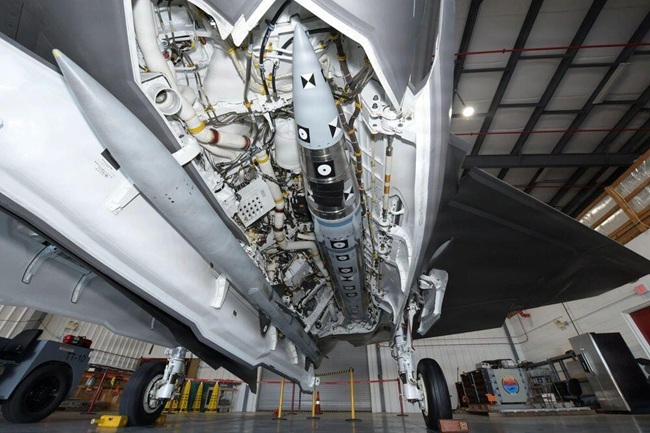
At the recent Tailhook Symposium, held in late August in Reno, Nevada, the US Navy unveiled the development of a new long-range air-to-air missile, the AIM-424 Long Range Air-to-Air Missile (LRAAM) MALICE, built by Raytheon. The missile is intended to provide US Naval Aviation (and the US Marine Corps, USMC) with greater range and lethality in future high-intensity conflicts.
According to the US Navy, the AIM-424 has been designed to preserve a decisive advantage in air combat against increasingly sophisticated threats. With an estimated engagement range in excess of 250 nautical miles (463 km), the weapon is expected to significantly extend the operational reach of carrier-based fighters and strengthen Naval Aviation's ability to achieve air superiority. The development of MALICE reflects a growing focus on countering the advanced capabilities of peer and near-peer adversaries: although official statements have not identified a specific threat, the program is likely linked to concerns over long-range strike platforms such as China's H-6J bomber, designed for anti-ship missions and armed with YJ-12 supersonic anti-ship missiles. Platforms of this kind are intended to engage Carrier Strike Groups from stand-off distances.
Technical information on the AIM-424 remains limited. The missile is reported to measure approximately 4.1 m (13.5 feet) in length, with a diameter of approximately 34 cm (13.5 inches). It is powered by a solid-propellant rocket motor and carries a blast-fragmentation warhead. Specific performance data, guidance systems and expected service-entry timelines have not been disclosed, a level of secrecy consistent with the operational security requirements surrounding the development of advanced weapon systems. Observers nonetheless expect the missile to incorporate significant low-observable and survivability features, improving its effectiveness against modern air defenses and more advanced aerial targets. Images released by the US Navy and Raytheon show that the AIM-424 has already been tested on both the F/A-18E SUPER HORNET and the F-35C LIGHTNING II.
Although the program is currently Navy-led, cooperation between the US Navy and the US Air Force (USAF) in the development of advanced air-to-air weapons is well established: recent joint efforts, such as the AIM-260 program, reflect a shared commitment to maintaining air dominance against emerging threats. As AIM-424 development progresses, broader integration across other US military aviation platforms therefore remains possible.
The introduction of the AIM-424 underlines the US Navy's focus on preparing for future contested operating environments. By extending engagement ranges and increasing tactical flexibility, the missile is intended to support Carrier Air Wings in countering advanced aircraft and long-range strike platforms. As stated by the US Navy, "LRAAM sustains the Department's first look, first shot, first kill advantage by providing our aviators greater reach, greater survivability, and greater tactical flexibility in the air-to-air fight."




Privacy Policy

Powered by © Mobilbyte s.a.s. Information Technology