



A turning point has been reached in the war between the Houthis and the pro-Saudi militias of the Presidential Leadership Council (PLC), weeks after the conflict reignited on a large scale.
Over the past 2 days the Iranian-backed Houthis have advanced along the southwestern coast, first taking the town of Hays and then the port of Al Khawkhah, south of Hodeidah — the port the Houthis have been helding throughout the war, their main outlet on the Red Sea and the logistical hub for supplies arriving from Iran. Houthi formations then pushed farther south toward the port city of Mokha, which several sources report they have already entered, routing the PLC militias.
Should the Houthis take and hold Mokha, the shift would become structural. The city would extend their grip on the jugular of the Bab el Mandeb Strait, with heavy consequences in terms of potential interdiction against commercial traffic transiting the Strait and of coercive leverage for Tehran.
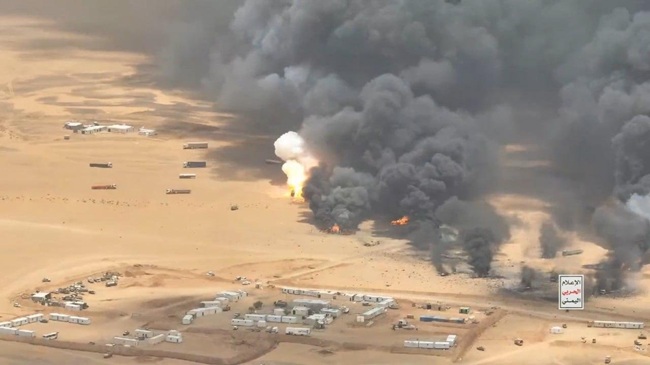
The advance relied largely on fast attack vehicles, backed by heavy use of drones for both reconnaissance and attack and by rockets and tactical missiles. These systematically hit PLC assembly and concentration points and logistical nodes, exploiting effective integration between ISR drones and tactical missile fires.
The Houthis have kept striking targets inside Saudi territory over the same period, with missiles and drones: the air bases of Khamis Mushait and Al Taif, and King Khalid Air Base, hit again last night by a ballistic missile after damage to shelters and base structures in previous days, and Abha international airport. The heaviest strike package came on the night of 7-8 September, the largest attack on Saudi soil in 4 years: an Aramco storage facility was hit at Abha, fires were reported at the Aramco refinery in Jazan, and further targets were struck in Najran.
The PLC militias have again shown poor organization and cohesion against an adversary far superior in both respects, while coordination with the sporadic air strikes of the Royal Saudi Air Force, concentrated mainly around Hodeidah and along the line of contact, has been anything but effective. Elsewhere in the south, the PLC also remains committed against the Emirati-backed Southern Transitional Council (STC), a contest that is far from settled.
The collapse on the coast comes at the end of a 2-month sequence. The formal collapse of the 2022 United Nations ceasefire dates to 13 July, when the Royal Saudi Air Force bombed the runway of Sanaa international airport to prevent the landing of an Iranian aircraft returning from Tehran. Houthi military spokesman Yahya Saree declared the de-escalation phase between the forces on the ground over, and Sanaa responded with a combined ballistic missile and drone attack on Abha international airport.
The real deterioration began on 3 September, when Ansar Allah forces struck government positions in the provinces of Taiz and al-Hudayda with combined short-range ballistic missile and drone attacks, aiming to open advance corridors toward the mountainous area of Maqbanah and to push toward the coast — and therefore toward Bab el Mandeb — with further attacks on positions in al-Jawf and al-Bayda.
In that phase the initiative lay with the PLC. On 4 September government aircraft flew at least 15 sorties against Houthi positions and vehicles around Taiz, while government forces began striking Houthi reinforcements around the port of al-Hudayda with drones and air attacks. Farther north, government forces claimed the capture of the Houthi military camp at al-Libnat, near al-Hazm northeast of Sanaa, and the surrender of dozens of fighters; according to government sources this followed reported Royal Saudi Air Force sorties near the border that opened a gap in the opposing deployment. The Houthis rejected that account and claimed instead to have repelled the advance. Sanaa's forces, again with combined missile and drone attacks, began targeting government logistics, claiming an attack on 7 September against vehicles transiting from Saudi territory at the al-Wadiah crossing.
The government effort in early September spread across divergent axes — Taiz, al-Hudayda, al-Jawf — and the positions taken produced little depth. The Houthis absorbed the pressure, then concentrated on the coast, where the PLC front has given ground steadily over the past 48 hours.




Privacy Policy

Powered by © Mobilbyte s.a.s. Information Technology