



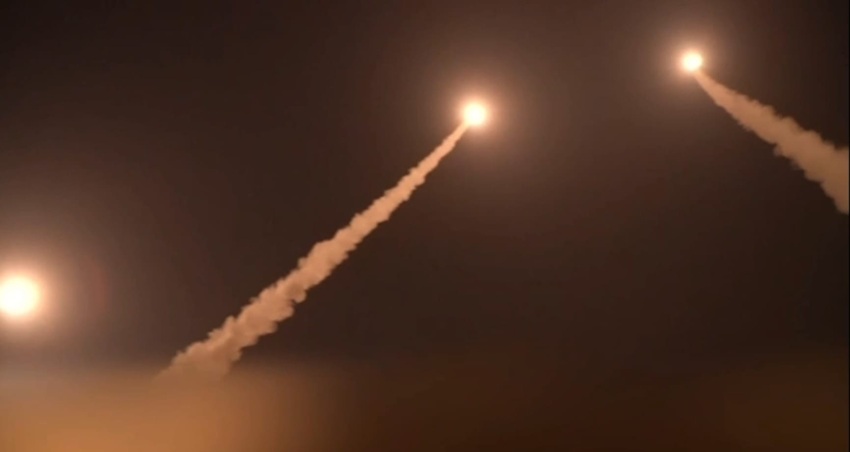
At around 23:30 on September 8, 2026, Iran launched a massive missile attack against U.S. military bases in Jordan.
The raid came in response to American strikes carried out earlier that evening against at least 5 Iranian tankers — 4 off Jask, on the Iranian coast of the Gulf of Oman, and 1 near Kharg Island — strikes that Iranian military authorities had announced in advance. The U.S. attacks were themselves a response to the launch of Iranian anti-ship ballistic missiles against US Navy units in the preceding days.
The main target of the Iranian attack was Muwaffaq Salti Air Base, against which roughly 30 ballistic missiles were launched, some of them fitted with submunition warheads. American air defenses fired more than 70 PATRIOT interceptors, but at least 3 Iranian missiles struck inside or close to the base perimeter. This is what can be confirmed at present from analysis of video and imagery of the attack, pending satellite coverage. A handful of missiles were instead launched toward the Aqaba area, where at least 1 impact was recorded.
After a period of proportionate replies to American strikes — salvos of a few missiles, essentially demonstrative in nature, though still enough to maintain a degree of attrition against the adversary — Tehran has now chosen escalation and a disproportionate response. The speed of the Iranian retaliation is also notable: it came only a few hours after the American attacks.
The most significant point, however, is that the September 8 attack shows that Tehran still retains — or has rebuilt — the capability to launch dozens of missiles from at least 5-6 separate launch sites simultaneously (Isfahan, Yazd, Khorramabad, Tabriz and Arak), with a fully functioning command and control chain. The raid also puts further pressure on American PATRIOT interceptor stocks, already heavily depleted by the February-April war and by the sporadic exchanges of the following months, raising serious questions about the sustainability of the U.S. presence in theater.
This is a hard blow for Washington, which sees Tehran preserving a significant missile capability despite the massive Israeli-American bombing campaign — a campaign that has also dangerously drawn down stocks of high-end stand-off strike weapons (TOMAHAWK, JASSM/JASSM-ER, ATACMS/PrSM).
Anti-ship ballistic missiles have recently entered the equation as well: after the strikes of the past few days against American naval units, on the same night Iran launched 4 anti-ship ballistic missiles in an attempt to hit 2 US Navy destroyers. This is a new development that warrants close attention, and one that could also strain stocks of naval interceptors (the STANDARD MISSILE family, SM), with the added problem that warships need to put into properly equipped ports to reload their launchers.
Finally, on September 8 the Islamic Revolutionary Guard Corps (IRGC) captured an American DIVE-LD Autonomous Underwater Vehicle (AUV), built by Anduril, which may have taken part in the covert mine clearance operations conducted in recent months by small Navy SEAL teams supported by unmanned systems.




Privacy Policy

Powered by © Mobilbyte s.a.s. Information Technology