



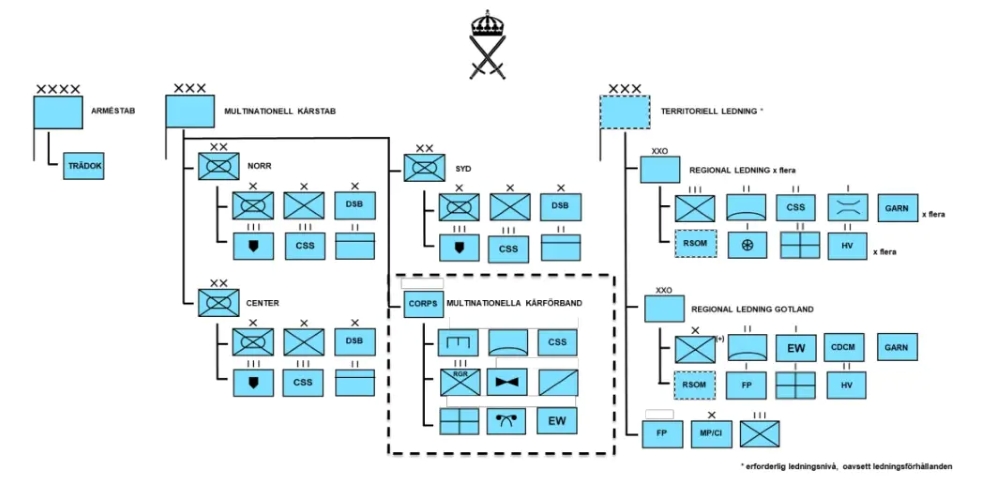
The 1-3-NEXT (Målbild Armén 2040) document has been issued by the Swedish Army staff on 18 June 2026 and is now being circulated in public as well. According to the document itself, “1–3-NEXT describes why, what and how the Army needs to develop towards 2040, and which units and command capabilities are required. The Target Image sets out a structure that is to be progressively filled with personnel, materiel and capability at the pace resources allow”.
The plan has been developed by the Planning Unit of the Army Staff, according to directive from the Chief of Army, Major General Jonny Lindfors. Colonel Rikard Daleke was the project director, with the principal author named as Lieutenant Colonel Mathias Wallin with the support of Brigadier General Michael Carlén, Colonels Lennart Widerström, Magnus Frykvall and Filip Scheynius, with the contribution of Lieutenant Colonels Lars Greko and Niklas Collin.
The work has been circulated for comment within Army leadership and through Sweden’s Military Representation at NATO SHAPE. The document identifies the need for the creation of a Corps headquarters “primarily” able to command land operations in the north-eastern operational area, in a NATO context, so extending into Finland and the Baltics, not limited to Sweden’s borders.
The Corps, “through a common situational picture”, will be tasked with planning and target coordination to integrate effects from assigned units, systems and capabilities in several domains. The attached units will be both Swedish and multinational or assigned from other nations. The Corps shall have to reinforce the Divisions through the provision of “command, intelligence, engagement, air defence, electronic warfare, logistics and reinforcement to support the divisions, enable long-range engagement and shape the fight across the land-operational depth”. It notes the need to be able to operate “dispersed, concealed, mobile and enduringly in depth”, a capability “reinforced inter alia by a dedicate Ranger Regiment.
The Corps will have 3 manoeuvre Divisions: the (North) one oriented towards “the High North and northern Finland”. It shall be able to operate in a “sub-Arctic environment”, over long distances and with limited infrastructure. It constitutes the Army’s primary contribution to land operations in the north-eastern part of the Nordic-Baltic operational area.
Division Centre is oriented towards the central Swedish operational area and is dimensioned primarily to reinforce in the north-eastern operational direction while ensuring protection of central Swedish national functions. The Centre is to ensure operational depth and create endurance in the war effort by reinforcing and relieving the Division in the North.
Division South is oriented towards southern Sweden, the west coast, the Öresund region, Gotland and the Baltic states. Its intended mission is the protection of strategic nodes, the support to Allied force generation, and “endurance” for Swedish contributions to security in the Baltic Sea area.
Each Division has 2 maneuver brigades and one Brigade for the fight in depth and maneuver support (Fires, surveillance and target acquisition). Of the 2 combat brigades, 1 is mechanized and one is an infantry formation: the mechanized brigade provides “weight” in high intensity combat, with the infantry brigade providing “volume and endurance” in the fight as well as the infantry mass to operate in canalizing, urban or difficult terrain. The Deep-Battle brigade is meant to contain sensors and Fires such as to “detect, fix, disrupt and engage the opponent over large areas and in depth”.
Each Division is also to have a Maneuver Support Regiment teaming in itself the capabilities to ensure mobility, protection, medical support and control of the Division’s rear / operational area. The Army’s study reaffirms the key role of heavy armour as the core of maneuver capability, with “better utilization” of the conscription and of masses of infantry, backed by autonomous and unmanned systems, are meant to “increase the army’s volume”.
It is specified that the precise design of the Units will vary and adjust according to “task, operational environment and available resources.” All of this will further be backed by territorial defence units and organizations, split across 2 commands.
The scale of the growth implied by 1-3-NEXT is very noticeable considering that at present Sweden is still working on bringing to maturity a force structure based on 3 mechanized brigades and a “reduced” brigade, with 1 Divisional command and set of supports.
The growth of support and enablers, in particular, is proportionally more relevant and important than that in terms of maneuver brigades.




Privacy Policy

Powered by © Mobilbyte s.a.s. Information Technology