



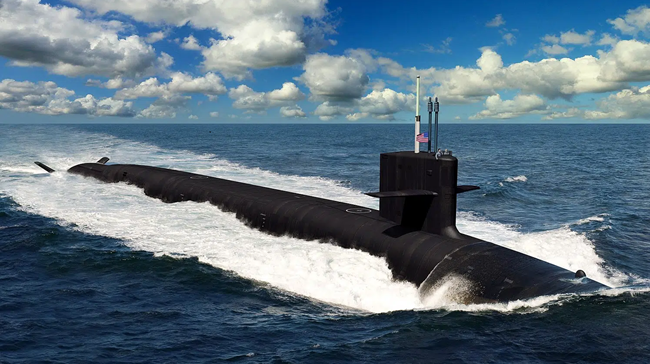
On 29 July 2026, the Pentagon formalized the signing of a historic multiyear contract package with industrial giants General Dynamics Electric Boat (GDEB) and Huntington Ingalls Industries-Newport News Shipbuilding (HII-NNS). The agreement reaches a total value of $76.6 billion, setting an all-time record in the history of US naval procurement for the undersea component.
The largest share of the investment, amounting to $42.1 billion, is earmarked for the construction of 9 nuclear-powered attack submarines (SSN) of the VIRGINIA Block VI class, plus the acquisition of long lead items for a tenth boat. A further tranche of $29.5 billion will fund the construction of 5 nuclear-powered ballistic missile submarines (SSBN) of the COLUMBIA Build II class, while the remaining $5 billion will be used to directly strengthen the infrastructure and production capacity of the shipyards involved.
This massive financial commitment represents a crucial step in the expansion and modernization of the US Navy's submarine forces, as well as in the consolidation of Washington's nuclear deterrence triad. In addition to advancing the COLUMBIA program, the US Navy intends to expand the VIRGINIA fleet both numerically and qualitatively. The class already boasts 26 operational boats and a further 23 under construction, under contract, or planned. With the new acquisitions, the total number of VIRGINIA-class submarines is set to approach 50 units across various Blocks, materializing a long-planned strategic objective. Vice Admiral Robert Gaucher, head of the US Navy's submarine programs, emphasized that the stability of work flows ensures continuity for the national shipbuilding industry, while also sending a strong signal of reassurance to Washington's allies and deterrence toward potential adversaries.
From an industrial organization standpoint, the mega-deal consolidates the longstanding operational synergy between GDEB and HII-NNS. The division of labor sees HII-NNS engaged in the fabrication of bow sections, stern sections, and other modules for both classes of boats, while GDEB builds the central sections, nuclear reactor compartments, and vertical launch silos for the TRIDENT II D5 ballistic missiles aboard the COLUMBIA-class boats.
The VIRGINIA Block VI submarines included in the new contract constitute the second group of boats equipped with the Virginia Payload Module (VPM), a hull section designed to accommodate TOMAHAWK land-attack cruise missiles or the future long-range hypersonic missile systems currently under development for the US Navy.
The signing of the contracts comes at the end of a prolonged negotiating stalemate linked to the sharp rise in production costs that occurred in the wake of the COVID-19 pandemic. Friction between the US Navy and industry dates back to 2022, when negotiations with GDEB over the last 2 VIRGINIA Block V submarines stalled for approximately 18 months due to legal disputes over specific insurance clauses introduced by the Biden Administration. Once the financial guarantee hurdle was overcome, negotiations focused on wage adjustments for the workforce. The inflationary surge and the shortage of skilled labor — exacerbated by a wave of retirements during the health crisis — forced the shipyards to raise wages in order to compete with the civilian manufacturing sector. The breakthrough came in April 2025 with the signing of the $18.5 billion contract for the submarines BALTIMORE and ATLANTA, the last VIRGINIA Block V boats, a deal that paved the way for the $76.6 billion mega-contract, bolstered by Congressional authorization for the construction of POTOMAC, the first VIRGINIA Block VI.
As for the COLUMBIA class, the Build II variant will begin with GROTON, the third boat in a class of 12 units whose estimated total cost approaches $128 billion, while the first deliveries of DISTRICT OF COLUMBIA and WISCONSIN are expected in 2029 and 2030 respectively.
A key corollary of the multibillion-dollar contract is the formal decision, adopted by the US Navy on 3 August 2026, to reclassify as guided missile submarines (SSGN) 19 units of the VIRGINIA class fitted with the VPM module. The first boat to receive this designation is ARIZONA, the second Block V hull, since the preceding OKLAHOMA lacks the VPM. The new SSGN fleet will therefore comprise 10 VIRGINIA Block V boats (from ARIZONA through ATLANTA) and the 9 Block VI boats covered by the latest contract. The discrepancy with the 10 Block VI boats originally planned may point to the development of a special variant reserved for covert seabed operations, a topic RID has previously covered.
It should be noted that each VIRGINIA SSGN will carry a total of 40 TOMAHAWK missiles: 28 in the 4 seven-cell VPM modules and 12 in the 2 six-cell VPT (Virginia Payload Tube) modules. A further 25 weapons could theoretically be added from the torpedo tubes, but it is unlikely that the missile loadout of a single boat would be increased to that extent at the expense of torpedoes, mines, and/or underwater drones.
The decision to reclassify the VIRGINIA boats stems from the need to offset the progressive retirement of the 4 OHIO-class SSGN boats, a process already underway with GEORGIA, which completed its final deployment on 27 July 2026 and whose formal inactivation at Norfolk Naval Shipyard is scheduled for July 2027. This decision, however, highlights a sharp gap in both timing and capacity. Each OHIO-class SSGN can carry up to 154 TOMAHAWK missiles, as well as serve as a mothersub for drones and special operations forces: to match the capacity of a single OHIO SSGN, approximately 4 VIRGINIA SSGNs — totaling 160 TOMAHAWK missiles — will therefore be needed. Since the full delivery of all 19 VIRGINIA SSGNs will not be completed until approximately 2038, the US Navy will also face a capability gap lasting nearly a decade.
Doubts also remain over the shipyards' actual ability to sustain the required production rates, made even tighter by the commitments undertaken under the AUKUS agreement, pushing the US Navy to aim for an increase to 2 boats per year in deliveries, albeit not before 2030.




Privacy Policy

Powered by © Mobilbyte s.a.s. Information Technology