



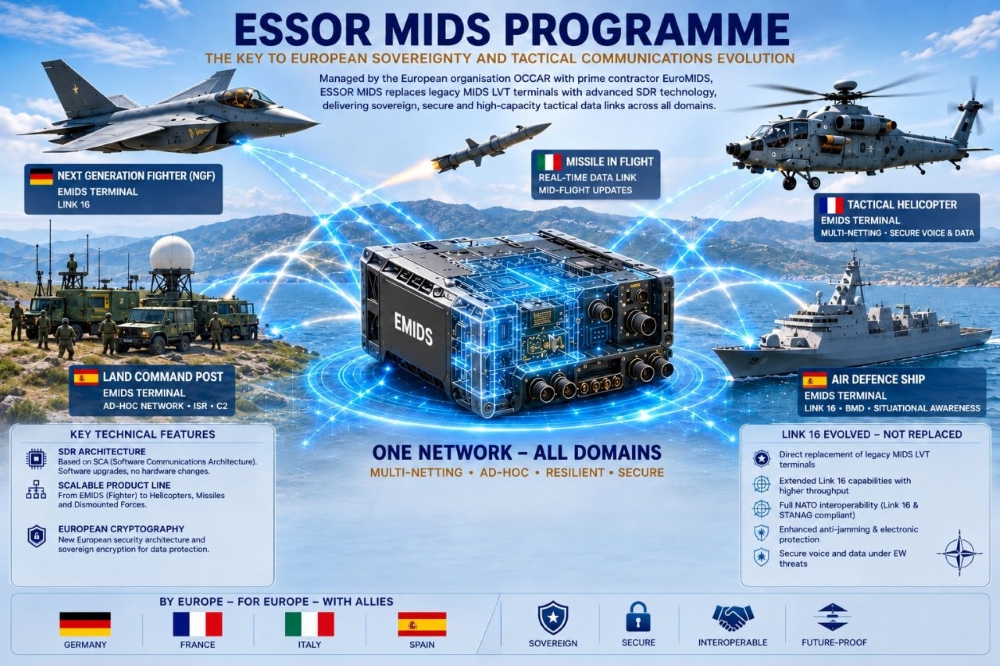
On 28 July in Bonn, OCCAR and the industry partners had a “kick-off meeting” to launch Stage 2 of the EMIDS project, or more precisely ESSOR-MIDS, from European Secure Software Defined Radio and Multifunctional Information Distribution System. The aim of the project is the development of a European capability for secure and interoperable military communications.
Building on the positive results of the ESSOR programme for the common definition of new software-defined radios, new portable waveforms and new interoperable software-defined terminals, EMIDS 2 aims to develop a European MIDS system with Tactical Data Link 16 functionality. ESSOR is a project led by Germany, France, Italy and Spain.
The new European MIDS will be adoptable on existing fighters and will also find application on future European 6th-generation fighters. The current 2-year contract will lead to the first EMIDS demonstrators. A subsequent Phase 3 would then follow to bring the project to production and integration of the terminals on the platforms.
The Stage 2 contract has been awarded to the EuroMIDS SAS consortium, composed of Hensoldt Sensors, Indra Group, Leonardo and THALES SIX GTS France.
According to Indra, the new terminal “will replace” the current Link 16-based MIDS system employed on the TYPHOON, RAFALE and TORNADO IDS/ECR, as well as on support aircraft such as the A400M and the E-3F AWACS (at least conceptually; some of the mentioned platforms will leave service in a few years).
Still according to Indra, the work will focus on the development of an “F-EMIDS A.0 model” to define communication capabilities and the software side, and on the F-EMIDS B.0, that is, the first physical prototype of the actual terminal.
Key features of the EMIDS include a new dual-architecture cryptographic system; the use of 2 waveforms to enable the aircraft to connect simultaneously to different networks (CMN, Concurrent Multi-Netting) and to receive more data in “saturated” environments (CCR, Concurrent Contention Receive); as well as the introduction of the new wideband waveform developed under ESSOR.
The first phase of the programme conceptualised an entire family of terminals, including the F-EMIDS for combat aircraft, H-EMIDS for helicopters, M-EMIDS for naval applications and S-EMIDS for ground use.




Privacy Policy

Powered by © Mobilbyte s.a.s. Information Technology