



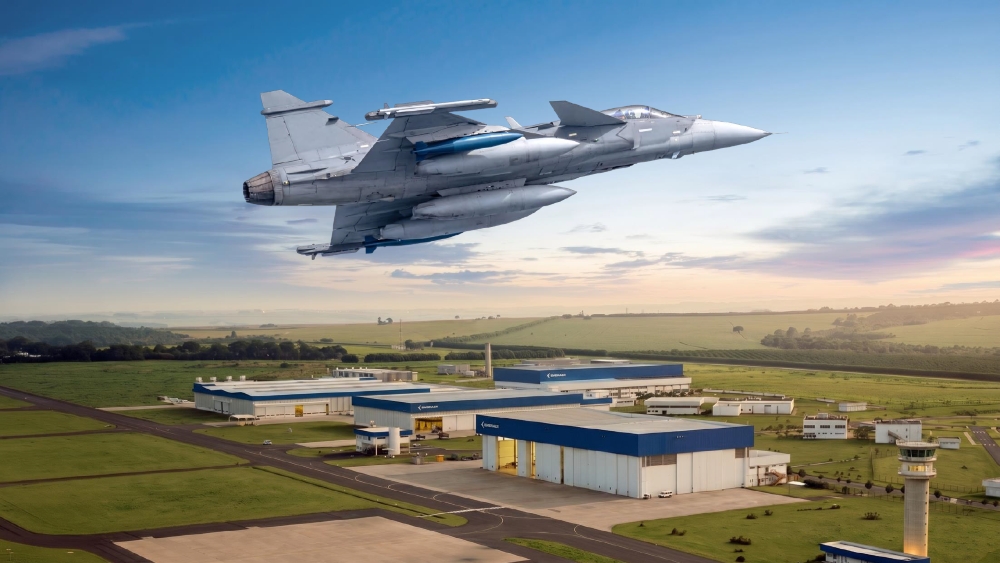
Brazil’s expansion of the GRIPEN final assembly line at Embraer’s Gavião Peixoto site marks a decisive shift from licensed production to genuine co-production of a front line combat aircraft, with strategic implications for Brasília, Embraer and Saab alike.
Under a new Heads of Agreement signed at the Farnborough International Airshow, Embraer and Saab have set the framework for the production of 20 additional GRIPEN fighters at Gavião Peixoto, home to the only GRIPEN final assembly line outside Sweden. Embraer will assume responsibility for assembling these aircraft, operating as a complement to Saab’s line in Linköping in a globally integrated production model designed to meet rising international demand for the Swedish fighter.
The expanded mandate consolidates more than a decade of bilateral cooperation around the Brazilian Air Force (FAB) programme, which has already driven extensive technology transfer, training of engineers, pilots and technicians in Sweden, and the emergence of Gavião Peixoto as a qualified hub for high end combat aircraft production.
For Brazil, the move strengthens national defence autonomy and reinforces the country’s long standing ambition to master the full life cycle of combat aviation. By anchoring GRIPEN assembly on Brazilian soil, Brasília not only secures industrial sovereignty for its own fleet but also positions the country as a net exporter of sophisticated airpower, with the potential to deliver aircraft and support packages into Latin America and beyond.
The decision also deepens the country’s aerospace industrial base. Gavião Peixoto already hosts final assembly lines for the KC 390 tactical transport and the GRIPEN, and a critical mass of test, integration and support activities for both civil and defence programmes, with production capacity scaled for complex, multi station flow lines and a high degree of automation. Adding additional GRIPEN batches reinforces this ecosystem, sustains skilled employment and offers Brazilian suppliers longer term visibility across multiple major platforms.
For Embraer Defence & Security, this follow on GRIPEN order reinforces its status as a systems integrator and partner of choice in high technology programmes, alongside flagship products such as the KC 390 MILLENNIUM and A 29 SUPER TUCANO. While the company’s defence backlog remains smaller than its commercial portfolio, it is anchored in a globalisation strategy that includes new offices, international production partnerships and ambitious campaigns in Europe, Asia and the Middle East. In fact, expanding output on Brazil’s established GRIPEN line fits squarely within this trajectory.
Operationally, ramping up GRIPEN production at Gavião Peixoto enables Embraer to further exploit its digitalised, partially robotic assembly infrastructure to absorb additional complex workshare. The resulting learning effects in advanced manufacturing, supply chain orchestration and quality assurance are likely to cascade across Embraer’s broader product range, from regional jets to special mission platforms.
For Saab, partnering with Embraer to expand output in Brazil offers a cost effective hedge against capacity bottlenecks in Sweden while keeping the GRIPEN offer attractive in price and schedule for export customers. The Brazilian line increases delivery headroom within a “globally integrated manufacturing model” and provides flexibility to surge production if new orders materialise, particularly from markets seeking industrial participation and local content.
Just as importantly, the arrangement strengthens Saab’s political and industrial footprint in South America through a trusted regional champion. The company’s leadership explicitly frames the deal as a long term commitment to the continent, enabling future co development, upgrades and support solutions that can be tailored jointly by Swedish and Brazilian engineers.
Looking ahead, the expanded GRIPEN line at Gavião Peixoto could evolve from a Brazilian offset facility into a global node within Saab’s fighter value chain. If the HoA converts into firm orders - and is followed by additional export contracts - Brazilian assembled GRIPENs may increasingly serve third country customers, in much the same way as the KC 390 line has become a production and support hub for NATO and non NATO operators.
Beyond aircraft numbers, the deeper significance lies in the institutionalised technology transfer and knowledge exchange between Sweden and Brazil, which both companies describe as generating “lasting benefits” and long term growth opportunities. For Brazil’s defence industrial base, Embraer’s portfolio and Saab’s international strategy, the expansion of the Brazilian GRIPEN assembly line thus represents a structural bet on shared industrial sovereignty and a broader role in the future fighter market.



Privacy Policy

Powered by © Mobilbyte s.a.s. Information Technology