



France’s RAFALE fleet is entering the second half of 2026 with a notably dense agenda that combines rapid integration of new weapons, experimentation with collaborative electronic warfare, and preparations for a long-range power projection mission spanning three strategic theatres.
The anti-drone imperative drives rapid armament innovation
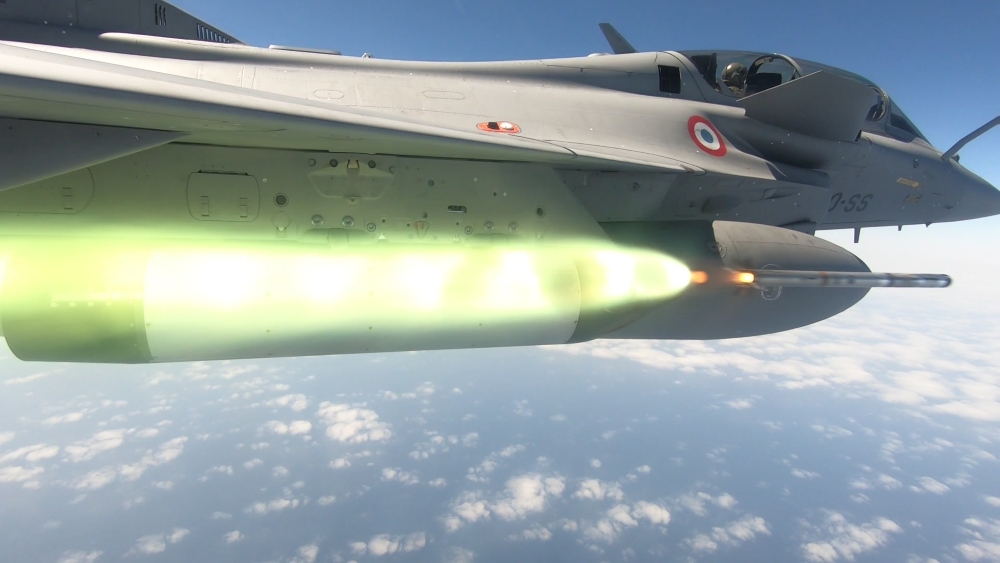
The most immediate development is the fast tracked integration of 68 mm laser guided rockets on RAFALE for counter UAS missions, a capability now validated by the Direction Générale de l’Armement (DGA). On 7 July 2026, DGA completed a test campaign to qualify this armament on RAFALE, just eight months after contract notification under an “Urgence Opération” procedure, illustrating the degree of pressure generated by the drone threat – notably loitering munitions such as Shahed. The chosen effector is a Thales 68 mm induction rocket, already qualified on the TIGER attack helicopter and now repurposed to give the fighter fleet a relatively low cost precision option against small aerial targets.
The LADAC (Lutte anti drone sur avion de combat) configuration combines these rockets with the TALIOS targeting pod, updated with specific air to air tracking and designation modes for drone engagement. From February 2026, a sequence of trials has focused on adapting RAFALE’s sensors and fire control chain: radar detection of drones, TALIOS based tracking and laser designation, carriage and safe release of rocket pods across the flight envelope, and guidance of rockets to aerial targets representative of current threats. This has required coordination across multiple DGA centres, including electromagnetic qualification of launchers at DGA Techniques aérospatiales, separation trials at Istres and Cazaux, and live firing at Biscarrosse followed by operational experimentation by the Centre d’Expertise Aérienne Militaire (CEAM).
From an industrial and capability perspective, the choice of a mature 68 mm guided rocket reflects a pragmatic approach. Indeed, rather than waiting for a bespoke anti drone missile, the French authorities have leveraged an existing air-to-ground effector whose induction based architecture simplifies logistics and allows mixed loads of different rocket types within the same launcher. This aligns with broader European trends in counter UAS, where air forces seek scalable, “good enough” solutions to counter massed drone attacks without expending high end air to air missiles on low cost threats.
Collaborative electronic warfare with NAMIB
Parallel to weapon integration, RAFALE F4 is also serving as a testbed for collaborative combat concepts integrating lightweight autonomous systems. Dassault Aviation and Harmattan AI announced a successful demonstration flight in which a RAFALE F4 executed a simulated strike based on targeting data provided by a drone equipped with the new NAMIB electronic warfare payload. NAMIB is designed to detect, identify and geolocate electromagnetic emissions, especially those from ground based air defence radars, using small tactical drones – either quadcopters or fixed wing platforms with greater endurance.
During the demonstration, NAMIB discreetly located a radar at several tens of kilometres and transmitted precise coordinates to the RAFALE, which then simulated an attack run on the designated objective. This scenario highlights an emerging “high-low mix” philosophy, including a high end combat aircraft coordinated with expendable or low cost autonomous effectors operating closer to threat emitters. The F4 standard’s architecture, emphasising connectivity and multi domain networking, is presented as enabling fluid exchanges not only with unmanned systems but also with land forces and other actors, which is vital for integrating distributed EW and targeting into air operations. Beyond the demonstrator itself, the partnership between Dassault Aviation and Harmattan AI, launched in January 2026, indicates a deliberate move to industrialise autonomy and collaborative combat functions around RAFALE as a core node.
For France, this is strategically relevant, as RAFALE will remain the backbone of combat aviation for the foreseeable future, even as work on next generation air combat systems progresses, and early operationalisation of man machine teaming in EW provides a bridge between current and future architectures.
PEGASE 26: long range projection across three theatres
While these trials unfold, the French Air and Space Force is preparing PEGASE 26, its sixth major air deployment of this kind, scheduled to start in early September 2026. The mission will see four RAFALE in F4 standard deployed alongside three A330 MRTT tankers and two A400M ATLAS transport aircraft, with around 300 air personnel engaged over 38 days. The itinerary traces an extensive strategic arc: from an initial stop in Greenland for high latitude training and validation of an alternative route to North America, through Alaska for Franco US cooperation, then across the Pacific with stops in Japan, South Korea and Indonesia, before splitting between India and French forces in the southern Indian Ocean, and finally transiting through Qatar to participate in the AMUN 26 exercise in Egypt.
PEGASE 26 is structured around three pillars regarded as fundamental to French air power: projection of combat capability, strategic mobility, and logistic support. The deployment’s modular design, enabling assets to split between India and the southern Indian Ocean theatre, underscores the emphasis on agility and the ability to reinforce overseas bases on a temporary basis. Operationally, it serves several purposes, including reaffirming the capacity to deploy RAFALE rapidly across long distances, exercising coalition and partner based cooperation with a wide set of nations, and demonstrating sustained expeditionary reach from the Arctic environment to Indo-Pacific and Middle Eastern airspaces.
For RAFALE operators, such missions are also an opportunity to validate new standards and capabilities – including F4 improvements – under realistic long range conditions, from tanker supported transit to multi stop diplomatic and operational sequences. The Commandement de la Défense Aérienne et des Opérations Aériennes (CDAOA) at Lyon Mont Verdun will plan and control the mission, underlining that this type of deployment is now considered part of France’s routine operational repertoire rather than an exceptional endeavour.
Hence, PEGASE 26 positions RAFALE within a broader narrative of French power projection and alliance management, traversing the Arctic, Indo Pacific and Middle East at a time when all three regions feature prominently in transatlantic security debates. For observers of European air forces, the density of RAFALE related activity over the summer and early autumn of 2026 underscores both the adaptability demands placed on legacy fleets and France’s intention to keep its main combat aircraft at the centre of innovation in air warfare, even as unmanned and autonomous systems gain prominence.




Privacy Policy

Powered by © Mobilbyte s.a.s. Information Technology