



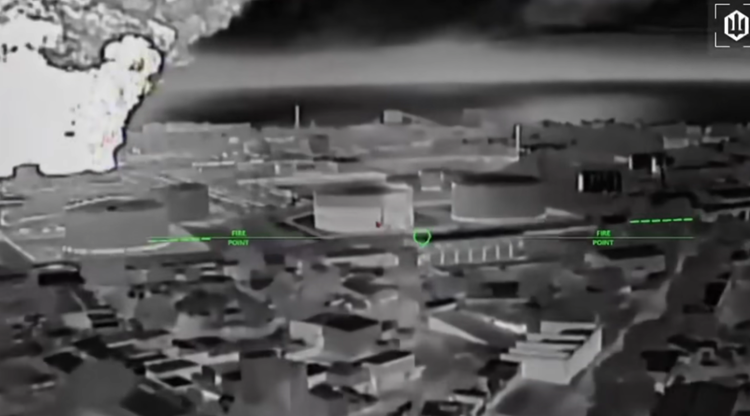
The Ukrainian Unmanned Systems Forces continue their deep-interdiction campaign against Crimea and the Sea of Azov.
Over the past week, Kiev has concentrated its strikes on both the peninsula's energy infrastructure and the maritime traffic Russia relies on to move fuel into Crimea and sustain its operations on the southern front.
On the night of July 5-6, at least 5 Ukrainian FP-2 drones struck the 330 kV Simferopolskaya substation near Simferopol, causing power outages across several locations in Crimea and sparking a large fire. At the same time, 2 tankers of the Project 15781 class belonging to the so-called "shadow fleet" — the KAPITAN BARMIN and the SANAR-4 — were also hit while carrying roughly 7,000 t of fuel along the Taganrog-Crimea route across the Sea of Azov. The following night, between July 6 and 7, Ukrainian FP-2s targeted numerous vessels anchored near the Kerch Strait. Reportedly hit were 8 tankers — the VENERA-3, SANAR-1, SANAR-17, KLIMENA, TETI, ALEKSEY SAVRASOV, PENELOPE, and DRAGA IVAN CHEREMISINOV — along with the ferry SKS ONE and an unidentified cargo vessel.
Between July 7 and 8, the strikes intensified further. Ukrainian drones hit 5 electrical substations in Crimea — one 330 kV, one 220 kV, two 110 kV, and one 35 kV — as well as a gas compressor station near the village of Tasunove. Kiev is thus targeting multiple tiers of the grid hierarchy at once: from the primary transmission backbone (330 kV, which feeds the entire peninsula's ring network), down through sub-transmission (220 kV and 110 kV, serving urban centers and industrial facilities), to medium-voltage distribution (35 kV, reaching smaller towns). The effect is to saturate several grid layers simultaneously, reducing the peninsula's ability to reroute load through its usual backup paths and complicating repairs, since each layer requires different replacement components.
In parallel, a fresh strike hit the same naval units targeted the previous day. Reportedly, 9 vessels were hit, including the tankers EFROSINIA V and MARIA, the cargo ships VLADIMIR YARYGIN and FEOFAN SHOIKHIREV, the EUGENIA Z, and the already-damaged tankers SANAR-17 and KLIMENA.
On the night of July 8-9, Kiev struck the PP-2 "Crimea" electrical node in the Kerch area. The facility is one of the key nodes of the energy bridge linking Krasnodar Krai to the peninsula via undersea cables across the Kerch Strait. Significant damage to it could reduce electricity transmission capacity to Crimea, already under growing strain from previous strikes on the local power grid.
During the same operation, Ukrainian drones again targeted vessels anchored off the Kerch Strait. Available information indicates at least 14 units were hit, including the merchant vessel CHELSEA-6, the tugboat ALFEO, and the tankers AURA, SANAR-1, ILYA REPIN, GALIASAR KAMAL, and VENERA-3. The tanker PENELOPE was reportedly hit again, along with 6 other as-yet unidentified vessels.
Operationally, the Ukrainian strike campaign appears to pursue 2 complementary objectives.
The first is to limit the availability of fuel and ammunition for Russian forces deployed in Crimea and in the occupied south of Ukraine. The second is to raise the economic and logistic cost of holding the peninsula, forcing Moscow to commit further resources to protecting strategic infrastructure and lines of communication. The impact of this campaign in the long run remains uncertain and will require a deeper assessment.
Russia still maintains a broad and relatively resilient logistic network, including the Kerch Bridge, rail and road links through occupied southern Ukraine, and numerous shipping routes across the Black Sea and the Sea of Azov. These, however, are under mounting pressure from Ukrainian forces. On June 15, for instance, Ukrainian drones struck the Henichesk Bridge and the Chonhar Bridge (previously hit with STORM SHADOW missiles), 2 critical links between Crimea and Russian-occupied Kherson Oblast. On June 27, a section of the bridge near the village of Volodymyrivka, in Russian-controlled Zaporizhzhia Oblast, collapsed following a drone strike.
That structure was part of the road network connecting Crimea to Russia's so-called "land bridge" toward the occupied south of Ukraine. Also notable are Ukrainian strikes on the R-280 "Novorossiya" highway, the strategic artery linking Rostov-on-Don to Simferopol.
Since late 2025, first focusing on military targets and later shifting to energy infrastructure, Kiev appears to be pursuing a strategy aimed at turning Crimea from a relatively safe rear area into a territory under constant pressure. If strikes continue at their current intensity, the peninsula could face growing difficulties in energy and fuel supply. While not enough to fully isolate Crimea in the short term, such pressure could complicate life for the local population and logistical support for Russian forces deployed in the southern theater, steadily driving up the costs borne by the Kremlin.




Privacy Policy

Powered by © Mobilbyte s.a.s. Information Technology